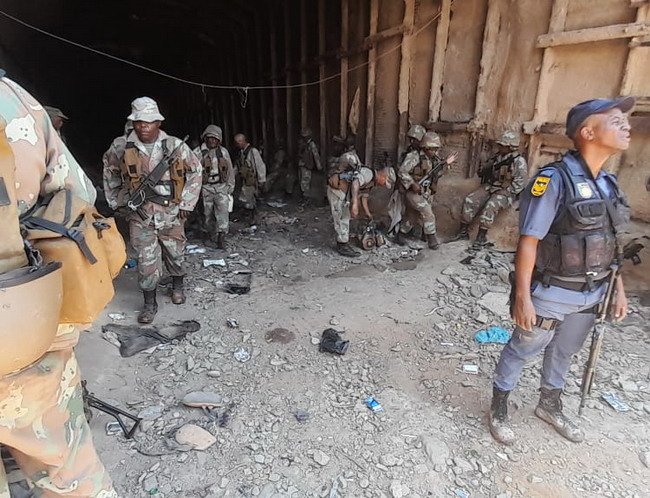

The deployment of the South African National Defence Force (SANDF) to support police attempting to curb specifically gang violence and illegal mining will last for a year, concluding at the end of March 2027.
This is according to a South African Police Service (SAPS) briefing on 4 March to the Portfolio Committee on Police, which revealed the deployment was scheduled to start on 1 March. Soldiers are apparently undergoing pre-deployment training at present.
Objectives of the deployment include reducing crime in designated areas, arresting offenders, recovering illicit firearms, ammunition and explosives, and confiscating criminals’ ‘tools of the trade’ and illicit narcotics.
Priority areas and hotspots where soldiers will be deployed include Cape Town’s Cape Flats (where gangsterism will come in the crosshairs); the Goldfields area of the Free State (targeting illicit mining); the Ekurhuleni, Johannesburg and West Rand districts in Gauteng (also targeting illicit mining); and Nelson Mandela Bay, Humansdorp, and Jeffreys Bay in the Eastern Cape (combating gangsterism). In the North West, soldiers will help police combat illicit mining in the Platinum Belt: the Klerksdorp, Orkney, Stilfontein, Hartebeesfontein and Dr Ruth Mompathi Districts.
The SAPS emphasised that soldiers will respect and protect the rights to dignity, life, and freedom and will not engage in torture or cruel, inhuman, or degrading treatment; arbitrary arrest or detention; or discriminatory conduct. Suspects detained by soldiers will be immediately handed over to the police.
Progress of the deployment will be monitored through the National Joint Operational and Intelligence Structure (NATJOINTS) with regular reports submitted through the chain of command to the national police commissioner and the Chief of the SANDF. Monitoring and evaluation will also be conducted through the broader national organised crime initiative known as Operation Ukubuza.
President Cyril Ramaphosa told South Africa soldiers will – again – be deployed to assist police in fighting crime during his State of the Nation Address on 12 February. With the exception of Gauteng Premier Panyaza Lesufi, who used his State of the Province Address (SOPA) 12 days after the Ramaphosa Operation Prosper announcement, there is no word on how many military personnel will find themselves on active duty. The Gauteng number one is on record as saying “we are pleased these soldiers have already arrived in our province. I want to announce to you, we have allocated over 450 soldiers to come and assist us to stamp out illegal mining and rising gang violence in our province”.
SANDF deployment must be measurable – DA
Lisa Schickerling, Democratic Alliance Spokesperson on Police, said Wednesday’s briefing to the Portfolio Committee on Police does not answer several critical questions about the deployment of the SANDF.
“While the Democratic Alliance supports decisive action against organised criminal networks that threaten community safety and economic stability, military deployment in civilian policing must remain a short-term, clearly defined intervention not a substitute for fixing SAPS,” she said.
“Past experience of SANDF deployments has shown that military support alone does not resolve the underlying drivers of organised crime. The DA’s assessment of today’s briefing suggests that these risks remain unless the deployment is clearly structured around strengthening SAPS operations.”
For this reason, the DA believes the deployment must have measurable operational objectives, including reduction targets in priority crimes; operational integration with SAPS intelligence and detective units to ensure prosecutions; a clearly defined time frame, with an explicit exit strategy linked to operational milestones; and strengthening of SAPS capacity for when the SANDF withdraws.
“More boots on the ground do not automatically translate into dismantling criminal networks. The true measure of success will be whether organised crime syndicates are disrupted, prosecuted and prevented from re-establishing themselves once the military deployment ends,” Schickerling said.
“Most importantly, this deployment must be used as a window to repair structural weaknesses within SAPS, particularly in Crime Intelligence and detective capacity. If those reforms are not implemented during this period, South Africa risks normalising military support for routine policing.”
One Parliamentary oversight committee – Mineral and Petroleum Resources – on 24 February welcomed what it termed was “a comprehensive presentation” by the National Joint Operational and Intelligence Structure on implementing the presidential plan to put a lid on the activities of zama zamas. A Parliamentary Communication Services (PCS) statement has committee chair Mikateko Mahlaule welcoming improved co-ordination and intelligence led operations aimed at dismantling illegal mining syndicates.
“This is organised crime that undermines the economy, threatens community safety and deprives the state of critical revenue,” he said, describing illegal mining as “a nationally co-ordinated organised crime activity requiring a sustained, intelligence-driven and multi-agency response”.
While sceptical about the use of soldiers in policing, Efficient Group Chief Economist Dawie Roodt is reported by Newsday as saying crime is “completely out of control in South Africa” with government control over the SA Police Service “lost”. This, the digital publication reports him being “not sure” about but agreeing with the deployment of soldiers in this instance adding “it’s worth trying, especially in the Cape Flats where police are not capable of maintaining law and order”.
PCME welcomes deployment
Also on the Parliamentary front, the Portfolio Committee on Planning, Monitoring and Evaluation (PCPME) is supportive of soldiers adding their presence to security at plantations, sawmills and other timber processing facilities in the SA Forestry Company Limited (SAFCOL) stable. This came to light during a February oversight visit to, among others, SAFCOL in Sabie where parliamentarians heard the State-owned company (SOC) was losing almost R20 million a year to illegal timber harvesting by organised syndicates.
SAFCOL Acting Chief Executive Sibalo Dlamini told the committee the criminality involved “highly organised and heavily armed syndicates” entering plantations at night to harvest timber.
The vast SAFCOL plantation area stretches from Limpopo and Mpumalanga to KwaZulu-Natal and covers thousands of hectares making securing the area a challenge. Installation of digital security systems for early detection is planned.
While timber growing and processing is SAFCOL’s main business, some of its five thousand employees work in its hospitality and tourism division. This is under threat from illegal mining which has to date seen closure of some hiking trails in SAFCOL nature reserves “due to security risk posed by heavily armed illegal miners”.
Soldiers not a solution to crime crisis
Chairperson of the Standing Committee on Appropriations, Dr Mmusi Maimane, told Parliament’s Finance Cluster Committee on Monday that while calling for the deployment of the SANDF is a popular thing to say, it is not a fundamental solution to the crime crisis in the country.
“But I want to argue strongly. I know it’s a very popular thing to say, ‘send the army, send the army, send the army.’ But what the army doesn’t do is, it doesn’t police murder, and I want that point to sink in.
“Because ultimately, all the army can do is tactically give the police an opportunity to be able to catch up. But it isn’t a fundamental solution to addressing the fact that 74 South Africans are being murdered every day in the last quarter.
“It doesn’t address the fact that conviction rates, as far as murder convictions are concerned, are one in five. We will be looking at Budget allocation, and increasing the number of headcounts and police, making sure that we can employ more detectives, and ultimately make sure South Africa is a safe place to invest in,” Maimane said.
Acting Police Minister Firoz Cachalia, giving an update about the SANDF crime-fighting deployment to a joint meeting of the Parliament’s Police Committee and the Committee of Petroleum and Mineral Resources on Wednesday, said “The deployment of the SANDF is not being presented as a panacea, as a magic bullet. Alongside, as the national commissioner has said, the deployment of the army is a stabilization strategy or to create space for the implementation of an organized crime strategy.”