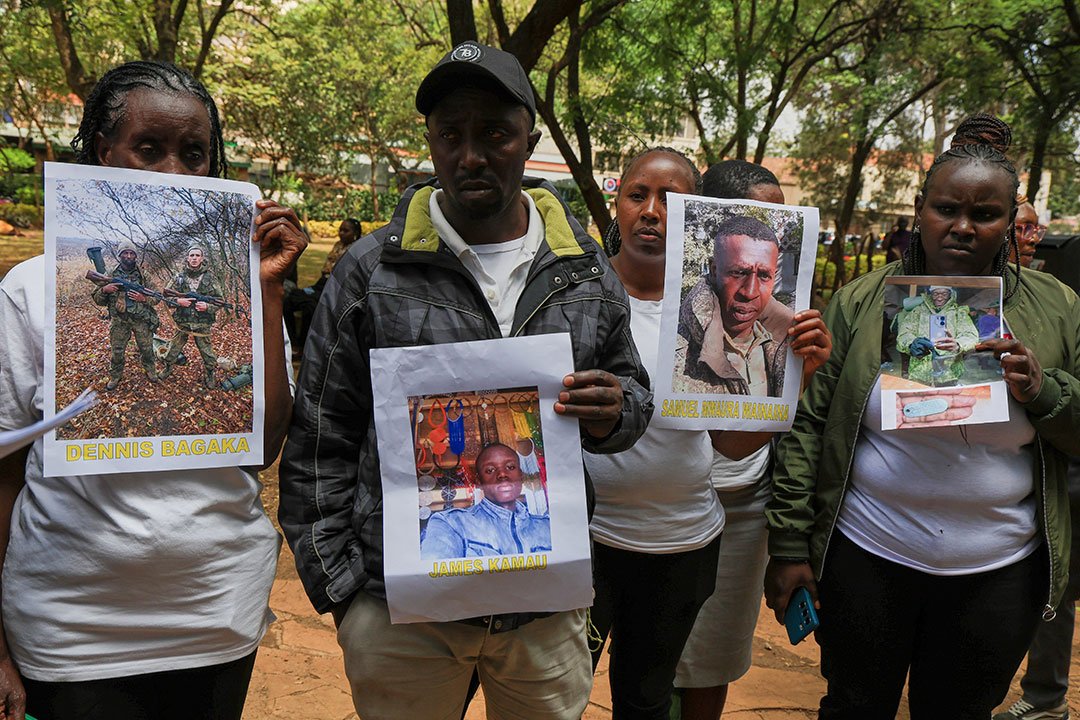
A recent investigation has cast light on the shadowy web of operatives, recruiters, social media influencers and travel agents who have ushered Africans into the ranks of Russia’s front-line fighters in Ukraine.
More than 1,400 Africans from 35 countries signed contracts with the Russian Army from January 2023 to September 2025, including more than 300 who were killed within months of arriving at the front, according to a February 11 report by Swiss-based investigative group INPACT.
“The recruitment of African nationals is not an isolated phenomenon, but rather the core of a deliberate and organized strategy,” the report said. “These recruits have been integrated into assault waves designed to overwhelm Ukrainian defensive lines, contributing to a strategy of attrition.”
INPACT, which produces the Russian mercenary-tracking project All Eyes on Wagner, obtained two files from a Ukrainian government program called Khachu Zhit (“I Want to Live”) that included a list of 1,417 Africans hired by the Russian Army to fight in Ukraine. The data consists of names, home countries and dates of birth. For 316 Africans, the date of their death also appeared.
Russia has averaged more than 26,000 casualties a month — including dead, wounded and missing troops — for a total of 1.2 million since it invaded Ukraine in 2022, according to January 2026 estimates by the Center for Strategic and International Studies. Such staggering numbers are why the Kremlin has systematically recruited in African countries, among many others, to resupply its “meat-grinder” style of warfare that uses human wave attacks against heavily defended Ukrainian positions.
“Russia has a huge need for people to fight in this war,” Danish researcher Karen Philippa Larsen, who is studying Russian recruitment of foreign nationals, told Latvian news website Meduza for a January 22 article. “Most of them don’t have military training.
“Some of them say that their commanders directly told them that they would be killed if they left. They felt like they were prisoners on the front line.”
INPACT’s report showed a steady increase in Russia’s successful recruiting efforts on the continent with 177 Africans in 2023, 592 in 2024 and 647 last year. Of the identified fighters, Egypt had the most (361), followed by Cameroon (335), Ghana (234), The Gambia (56) and Mali (51). In a February 18 report, Kenya’s National Intelligence Service said a network of trafficking syndicates duped more than 1,000 locals into Russian military service.
“The list is not exhaustive,” INPACT investigator Lou Osborne told France 24 TV in a February 16 interview. “We think that it’s actually just the minimum. We believe that there are much more joining. They are very, very aggressively recruiting, and it’s very easy to stumble upon those job offers.”
The report detailed how Russia is using a complex network of social media influencers, travel agents and intermediaries to lure Africans with false promises of high-paying jobs, scholarships, travel, passports and citizenship. Once they arrive, however, many recruits are surprised to end up in the military, where they sign Russian-language contracts. Few know what they are signing up for.
Recruitment networks have thrived by generating “a commercial ecosystem that has created opportunities for individuals and businesses to enrich themselves from human misery,” the report said. Osborne described a multilayered operation that begins in Russia before branching into national and local efforts throughout Africa.
“There is one layer of recruitment which is directly managed from Russia,” she said. “We were even able to speak with a Russian recruiter who told us that actually his travel agency was not real and that it was a front for the Russian security services, the FSB, which was coordinating the main effort.
“Then we have identified travel agencies and recruitment agencies that either just opened and they are only focusing on Russia, or some are well established. From time to time they advertise jobs or sometimes very directly to join the Army. They facilitate all the visa processes.”
Surrounding and supporting the travel agencies, advertisers and intermediaries is another opaque layer of paid social media influencers who tout the benefits of living in Russia. Osborne said Russia’s recruitment operations also are enmeshed with existing human-trafficking networks.
Writing for The Atlantic Council in a February 19 analysis, Katherine Spencer said the Kremlin’s recruiting machine will continue rolling through Africa as Russian battlefield losses persist.
“Russia’s growing reliance on African soldiers is a powerful symbol of an invasion that has gone horribly wrong for Vladimir Putin,” she wrote. “The Kremlin dictator expected to decapitate and subjugate Ukraine in a matter of days. Instead, as the invasion enters a fifth year, Putin finds himself forced to recruit troops from around the world in order to avoid destabilizing Russia and threatening the survival of his own regime.”