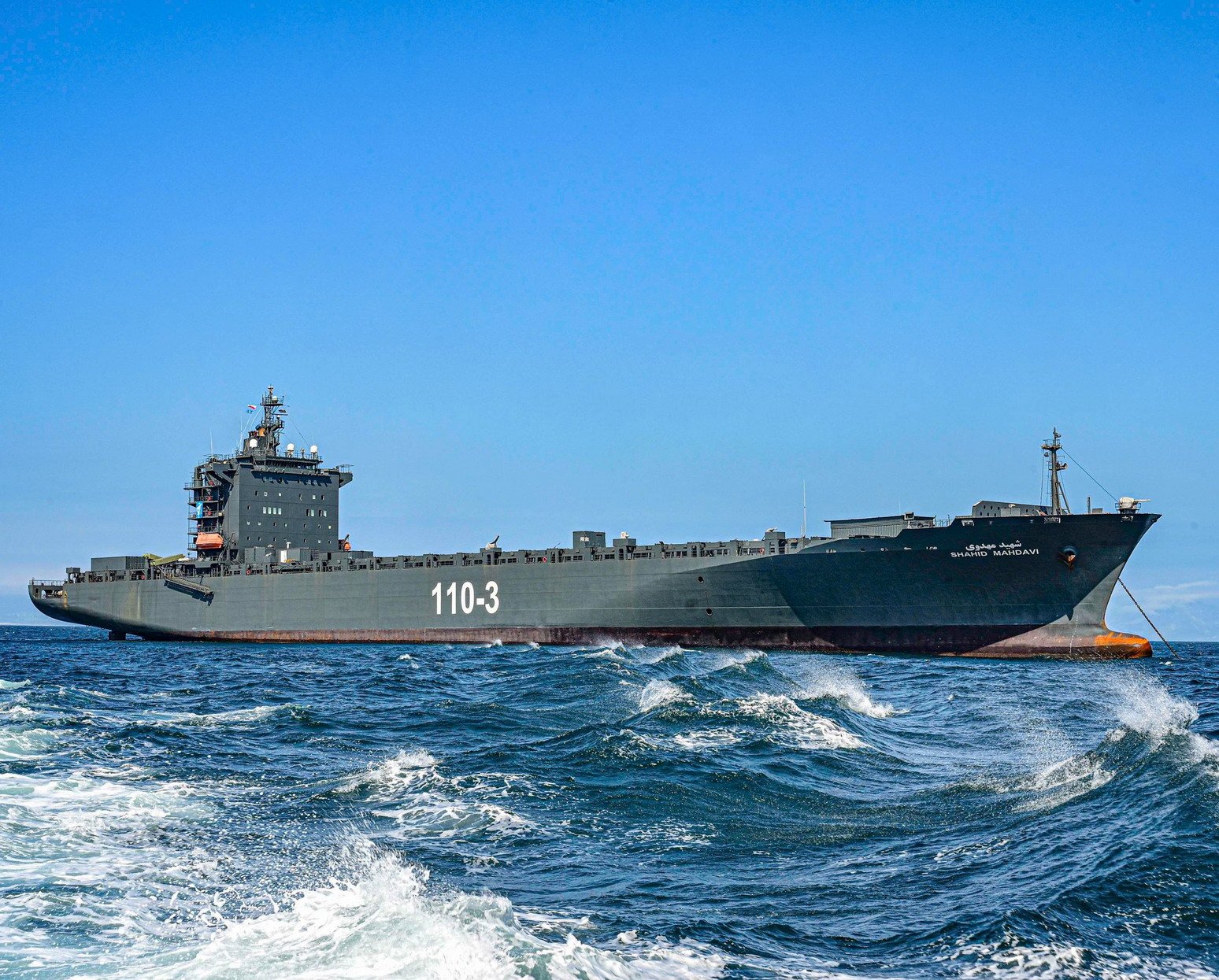

The Iranian navy corvette, Naghdi, which participated in exercises with the SA Navy in January, was sunk in the opening hours of the US aerial attack over the weekend. President Donald Trump said that the US had sunk nine Iranian vessels, and a post of satellite imagery by Intelschizo on X showed what it said were three Iranian corvettes, including the Naghdi, sunk at their moorings.
The Naghdi only returned to Iran, along with two other Iranian navy vessels that participated in the manoeuvres, last Thursday.
Like the Naghdi, SA’s foreign-policy standing is likely to take a hard hit as a result of the war on Iran.
The US and Arab countries that find themselves under missile attack, and Israel — and a future Iranian government — will see SA as having placed itself on the wrong side. If the Mullahs are toppled by a popular uprising, Iran’s new government will harbour similar resentments.
SA’s attempts to present itself as neutral in this conflict have become farcical. Consider for instance the obfuscation and muddle over whether or not the President ordered his minions to exclude Iran from the recent naval exercise. First a military inquiry was appointed to look into this, and last week a judicial inquiry was announced.
Shaken by massive protests, the theocratic regime began killing people on the streets around New Year, giving SA adequate time to inform the Iranians that they were no longer welcome in Simons Town.
The tenor of Pretoria’s statements about the massacre of a reported 30,000 demonstrators would also have been far different if our government were genuinely neutral.
Over the weekend, as US and Israeli bombing on Iran unfolded, there was a statement from President Cyril Ramaphosa calling for talks between Iran and the US, and condemning the attacks as a violation of the UN Charter. According to SA, the Charter only permits one country to attack another for the purpose of self-defence in response to an attack. Since the revolution in 1979, through its support of proxies and its own actions, Iran has fomented countless terror attacks on Israel, the United States, various Jewish communities, and targets in its region.
SA could have redeemed itself by taking a stronger line in the past few weeks, but it failed to do so. In January, SA voted against holding a special session of the United Nations Human Rights Council to address the shooting of protesters in Iran. All the SA Presidency did was call for “restraint and dialogue”.
“Moral hypocrisy”
The DA slammed the South African stance as amounting to “moral hypocrisy”, but is powerless over foreign policy in the Government of National Unity.
What explains the grip of the Mullahs over SA?
We have no significant economic ties that would explain this hold.
Perhaps the ANC favours Iran’s strong anti-Western stance and “Death to America” line. Some believe MTN’s position as the holder of an Iranian mobile-network licence is a factor too.
Then there is the allegation, initially made by The Common Sense editor Frans Cronjé, that the ANC had its payroll met by the Iranians three years ago. That claim came after SA launched its genocide case against Israel at the International Court of Justice.
Whatever the truth, SA is likely to pay a stiff price because of its stance on Iran.
The claimed anchor of SA foreign policy, the Brazil, Russia, India, China and South Africa (BRICS) grouping, has proved to be largely irrelevant. Since Iran is now a BRICS member too, one might have expected a joint statement from the group condemning the killing of the Supreme Leader, Ayatollah Ali Khamenei. Nothing like this was forthcoming.
Russia and China, the linchpins of the BRICS arrangement, condemned the attacks and the killing of Khamenei, but they have signalled that this is not their fight.
Russia expressed “deep concern over the aggression against Iran” and called for an immediate ceasefire. But it is otherwise engaged in Ukraine and probably cannot do much to help Tehran.
China has a growing strategic oil reserve and relies on Iran for only 20 percent of its oil imports, which have declined over the past few years. If the war interrupts this supply, China can fairly easily increase its oil imports from Russia.
As a “middle power,” SA has far fewer options than China and Russia.
Highlighting the divisions within BRICS, Indian Prime Minister Narendra Modi was on a state visit to Israel last week. India wants closer ties with Jerusalem, but SA withdrew its Ambassador to Israel and recently kicked out the Israeli Chargé d’Affaires.
Delusional
If SA has any hopes about the willingness of a highly divided BRICS to provide cover for its tacit support for Iran, they are delusional.
There is gross uncertainty over what government will replace the current regime in Iran.
The Trump administration and Israel are betting that their aerial bombing campaign, even at the risk of bringing about chaos, will result in a better situation. The US, Israel and moderate Arab countries are determined to end Iran’s campaign of terror and destabilisation throughout the region, and this is the chosen moment.
There are multiple scenarios for what comes next for Iran. One possibility is chaos and civil war, similar to what has unfolded in Libya since Gaddafi’s overthrow in 2011. Another scenario, with reasonable probability, is what New York Times columnist Thomas Friedman calls Islamic Republic 2.0.
What gives this scenario some plausibility is that the regime is deeply entrenched and will be hard to displace entirely. Islamic Republic 2.0 is likely to be made up of elements of the old regime, but will be a lot less threatening to Iranians and the country’s neighbours.
Under various “what next” scenarios, the outlook for the Iranian economy, which for some time has been in dire straits, should be far better, even with Islamic Republic 2.0. Sanctions, corruption, central planning, high defence spending, and heavy support for its “ring of fire” proxies around Israel have weighed heavily on the economy. Iran has enormous growth potential due to long unmet needs and a sizeable number of well-educated and skilled people.
Many governments in Arab gulf states were publicly reluctant to endorse the Israel and US air strikes, but that has changed since Iran started lobbing missiles at targets like malls, hotels, apartments, and airports with no US military connections. The United Arab Emirates, Saudi Arabia, Kuwait, Bahrain, Qatar, Jordan, Oman and Iraq have been targeted.
Spectacular surge
Since the Iranian Revolution 47 years ago, many of Iran’s neighbours have lived in fear of Tehran. Removing that fear should result in a spectacular surge in business confidence, growth and investment.
It is unlikely that the Saudis and the Gulf countries will forget who stood with them and who stood against Iran in this conflict. South Africa will not be on the list of supporters, and is unlikely to benefit from a new Middle East.
South Africa seems to have made bad choices all the way down the line.
On this one, SA has made a bad call for reasons of realpolitik and moral credibility.
Written by Jonathan Katzenellenbogen for The Daily Friend and republished with permission. The original article can be found here.