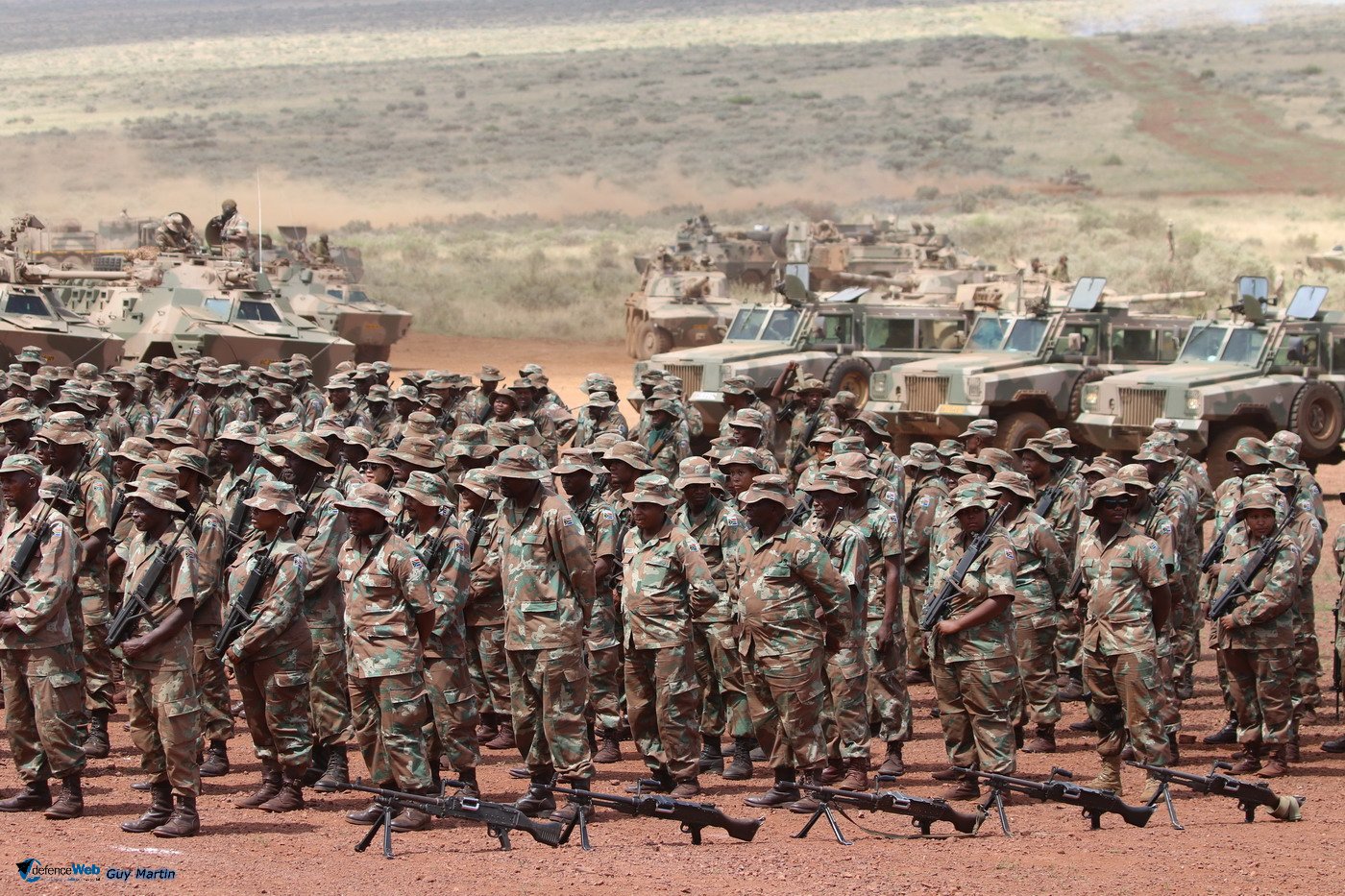

Critics often portray the South African National Defence Force (SANDF) as bloated and inefficient, citing that personnel costs, compensation of employees, consume around 65-70% of the defence budget. This high proportion fuels claims of overstaffing, with calls for drastic headcount reductions to free up funds for equipment and operations. However, this view is a fallacy rooted in a misunderstanding of budget dynamics. The SANDF is not overstaffed; it is chronically underfunded. A modest increase in overall defence spending would dramatically shift personnel costs to a sustainable level without slashing personnel numbers.
South Africa’s defence allocation for 2025/26 stands at approximately R59 billion, equating to roughly 0.8% of GDP. This falls well below international benchmarks of 2% recommended for maintaining credible capabilities, and even short of the presidential target of 1.5%. Deputy Defence Minister Bantu Holomisa has repeatedly highlighted this shortfall, noting that resources fail to meet strategic needs in real or nominal terms. Chronic underfunding has left the SANDF with ageing equipment, non-operational aircraft, and strained deployments, forcing tough trade-offs where salaries crowd out everything else.
Personnel expenditure dominates because the total budget pie is so small. Recent figures show compensation accounting for about 61-65% of the defence vote in 2025/26 projections, often overspending due to fixed salary commitments. With active personnel around 68,000-70,000 (and plans to stabilize near 74,000 through attrition and early retirements), the force has actually shrunk from post-integration peaks. Headcounts have declined steadily, yet the percentage remains high, not due to excess staff, but insufficient non-personnel funding for maintenance, procurement, and training.
The mathematical illusion becomes clear when scaling up the budget. At the current 0.8% of GDP, personnel costs hover near 65%. Raising defence spending to 2% of GDP, a factor of about 2.5 times the current level, would reduce the relative share of salaries to roughly 26%, assuming no change in staffing. This aligns with healthier militaries worldwide, where personnel typically form 25-40% of budgets, leaving ample room for capital investment and operations. Scaling defence spending to 2% of GDP would turning the perceived ‘problem’ into a balanced, sustainable allocation.
This underfunding has real consequences. Equipment decays, readiness erodes, and personnel age without rejuvenation. Blaming overstaffing distracts from the core issue namely misplaced national priorities that relegate defence to an afterthought amid competing demands.
The debate must shift from cutting people to adequately funding the force. Gradual increases toward 1.35% over six years and 2.4% in three decades offer a path forward, but urgency is needed to prevent capability collapse. South Africa’s security requires a capable, modern SANDF, not fewer troops on a shoestring budget. Reframing the narrative from “overstaffed” to “under-resourced” reveals the true path to a stronger defence posture.
Prof Dewald Venter from the Vaal University of Technology is Associate Professor in Tourism Management and Military Heritage Researcher.