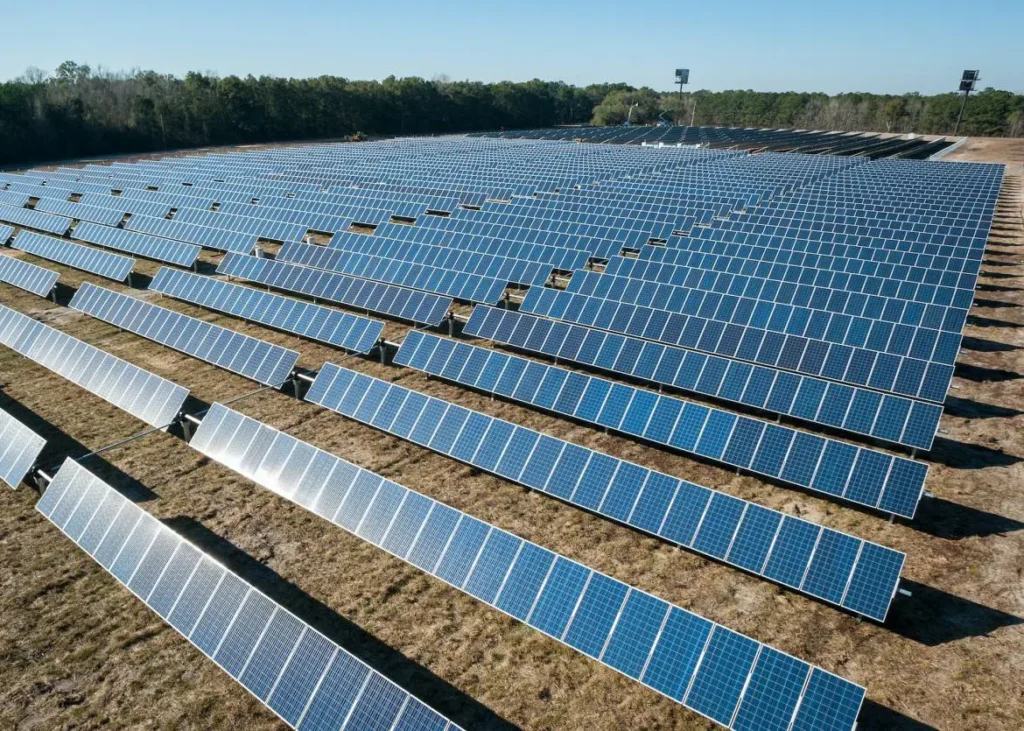
- Kishapu 150 megawatts solar plant, Tanzania’s first major solar farm is now live.
- Energy Minister Dr. Doto Biteko has announced plans to export power.
- Dr. Biteko urges completion of rural electrification in pending villages
Tanzania has commissioned Kishapu 150 megawatts solar plant project, one of the country’s large scale green energy investment. Located in Kishapu District, Shinyanga Region, the 150 megawatts project serves to diversify Tanzania’s energy sources, said Deputy Prime Minister and Minister of Energy, Dr. Doto Biteko.
Speaking at the launch on Sunday, the Deputy Prime Minister said the project serves to reduce reliance on hydropower and natural gas for power generation.
According to Dr. Biteko, the project generated 50 megawatts in its first phase by that was completed in January 2025, and now, the second phase will generate an additional 100 megawatts. “This is in line with President Samia Suluhu Hassan’s directive to increase electricity sources as the existing ones are insufficient,” the Energy Minister detailed.
Completion of the project makes Shinyanga Region a power hub in the Lake Zone complimenting the three existing major power stations Ibadakuli, Bulyanhulu, and Buzwagi.
Seconding the Energy Minister, Lazaro Twange, Managing Director of the Tanzania Electric Supply Company Limited, said the project reflects the government’s commitment to expand access to reliable electricity across all regions of the country. “This project ushers in a new chapter in the country’s history…it is the first solar project of this magnitude,” he commented
On his part, the Kishapu District Commissioner Peter Masindi said the solar farm will serve as a catalyst for the growth of local economic. “We now expect to see a boom in mining and agricultural activities in the region,” he projected.
Summing up, Mariana Mrosso, the Acting Manager at the solar power generation plant, said the facility will be connected to the national grid by March 1st and will serve to improve electricity supply across the Lake Zone regions.
Also Read: Shadows of conflict loom large over EACOP as construction nears end

Tanzania launches Kishapu 150 megawatts solar plant, mulls export plans
Further, Dr. Biteko said Tanzania is also working on other clean energy projects in Songwe and Mbeya where the country has invested in major geothermal projects. “Another project is the 100-megawatt wind power project in Makambako,” he went on to announce.
Dr. Biteko also announced energy export plans pending completion of ongoing works at the Ibadakuli station. “We are working to increase output at this station to distribute electricity outside the country through cooperation agreements in the electricity sector with East African countries,” he announced.
According to the Energy Minister, a large 400 kV transmission line is under construction to run from Ibadakuli to Masaka, Uganda, connecting Tanzania and Uganda through Kagera.
Despite the increased power output in the region, the Energy Minister cum Deputy Prime Minister acknowledged that there are still shortages. He cited the Rural Electrification Authority (REA) works in Shinyanga Region, where he admitted that out of the targeted 509 villages, some 127 still do not have electricity to date.
In light of this reality, Dr. Biteko cautioned contractors working in the REA projects including Suma JKT and Tontan, to speed up completion of their contracts.
Notably, Tanzania’s electricity production is has significantly increased thanks to the 2,115MW generated by the Julius Nyerere Hydropower Plant (JNHPP).
According to the Energy Ministry, Tanzania’s total installed capacity exceeds 4,000 MW as of the 2025/2026 fiscal year. The ministry highlights Tanzania’s power output mix to include by hydro (approx. 67 per cent) and natural gas (approx. 29 per cent), with solar, biomass, and heavy fuel oil contributes the remainder.
At the end of the week, Tanzania’s Parliamentary Standing Committee on Energy and Minerals expressed satisfaction with the country’s electricity generation capacity, reporting total installed production at 4,400 megawatts (MW).
According to the parliamentarians, the achieved output level significantly surpasses current national demand which stands at 2,071 MW. Commissioner for Electricity and Renewable Energy, Eng. Innocent Luoga, reaffirmed commitment to meet the national target of 8,000 MW of electricity generation by 2030 and turn to energy exports.
In his comments, Chairperson of the Committee, Hon. Subira Mgalu, commended the Tanzania Electric Supply Company (TANESCO) for what he described as “effective implementation of strategic energy projects and for steering the utility toward financial sustainability.”
“We commend TANESCO for the successful execution of power projects. Incidents of power outages have significantly declined, and there is currently no load shedding,” he said and urges the power monopoly to “ensure electricity reaches the end consumer, particularly in industrial and mining zones.”
He said TANESCO is currently working to connect the approximately 1.7 million new customers annually. Worth noting, as mainland Tanzania power output is now surplus, the Committee visited the Ras Kilomoni Transmission Station, that transmits 205 MW of electricity to Zanzibar significantly covering the island’s current demand of 140.4 MW.
Tanzania solar generation, off-grid solutions
According to TAMGO Tanzania, an energy and water supply company, Tanzania’s electricity need is rising due to the rapid urbanization, industrial development, and mushrooming population growth.
“However, the national grid still struggles to cover remote and rural areas…Solar installations provide a viable alternative to traditional grid systems,” the company notes in a press statement in the wake of the Kishapu solar power plant launch.
Notably, off-grid and mini-grid solar projects such as the ones offered by TAMGO, help to bridge the energy gap.
“We are aiding communities gain access to electricity where grid expansion has not reached…this decentralized approach allows people in rural areas to power homes, schools, and health centers,” comments Henrik S. Nielsen, TAMGO Operations Manager.
“One of Tanzania’s greatest natural advantages is its abundant sunshine,” he commented citing that the country receives an average of 2800–3500 hours of sunlight annually, making it one of the best regions in Africa for solar energy production.
According to Nielsen; “This consistent solar radiation makes solar systems highly effective and reliable. With the right installations, Tanzanians can generate energy almost year-round, minimizing reliance on costly fossil fuels and reducing the pressure on hydropower, which can fluctuate due to seasonal water availability.”
Another factor why solar adoption is the go to clean energy solution is the significant drop in solar technology costs.
Notably, over the past decade, the cost of solar panels, batteries, and inverters has reduced considerably, making solar energy much more affordable for businesses, households, and institutions alike.
“As costs continue to decline, more Tanzanians are viewing solar as a long-term investment. While the key installation needs capital, the savings on fuel and electricity bills make it economically attractive in the long run,” Nielsen summed up.
Off grid solar solutions continue to offer an alternative to hydropower reliance in Tanzania as the country shifts to clean energy.