



 Download this post…
“Terrana™ fuses nature’s intelligence with machine intelligence to generatively design versatile RNA-based solutions for every aspect of plant health from seed to stem – a revolution for modern agriculture.” Terrana is on the cutting edge ot transhumanism and should stop all experiments. ⁃ Patrick Wood, Editor.
In May 2023, Dr. Tenpenny wrote an article asking this: “what are they doing to our fruits and veggies?” At the time, she wrote about Bill Gates’ Apeel coating that would keep produce fresh for days and days and days.
That was bad, but the situation with our veggies and fruits has gotten worse. A lot worse.
A company called Terrana Biosciences has developed an RNA platform for agriculture. Here are just a few words from their website: “it fuses nature’s intelligence with machine intelligence to design RNA-based solutions for every aspect of plant health from seed to stem.”
Who’s Behind It?
“We can do so many things with this,” the Terrana founder said. Indeed. And that’s what makes us nervous.
Flagship Pioneering put in a $50 million investment into Terrana. By the way, Flagship also helped launch Moderna. That makes us even more nervous. They use words like crop resilience and plant health, but is Terrana a Trojan horse?
Here’s the first thing that popped out at me. The company says its RNA technology helps plants resist disease without altering the plant’s DNA. Why does this sound so familiar? Oh yes, the COVID shot will help you resist disease without altering your DNA. We know now how untrue that statement is.
Keep this in mind: “We can do so many things with this,” the Terrana founder said.
Many think the company is sinister because of its purported connection with Bill Gates, but I could find no evidence of Gates’ involvement in any capacity, nor has the Bill and Melinda Gates Foundation appeared to have given funding. Gates has funded similar agricultural innovation projects like GMO crops, biofortified crops, etc.
Regardless of Gates’ involvement (or not), the concern is over the RNA technology.
What Are They Developing?
And sure enough, the company is exploring 15 different aspects of their RNA platform, and one is plant vaccines and “protective agents.” But not to worry…the company is in the early phases of research and not approved for commercial use, so you’re safe. That’s what they always say.
On the surface, it all sounds great—innovation into crop sustainability and yield without using chemicals. Who wouldn’t want to get rid of glyphosate, after all? But is the new solution more sinister?
Scientists are trying to use RNA in farming to reduce damage from insects, plant diseases and environmental stress. RNA technology is sold as the kindler, gentler methodology, less toxic and more precise.
It uses a process called gene silencing. It happens in nature already, they’re just mimicking nature after all (they say). By the way, this it’s already in nature argument always causes me concern. The plant runs on instructions, but if you block a specific instruction, the plant can’t properly function. And it’s RNA to the rescue. All scientists have to do is design a tiny piece of RNA that matches a specific instruction in a pest or disease. When the pest absorbs the RNA, that instruction is shut off, and the pest weakens or dies. This is the equivalent of using a scalpel instead of a sledgehammer, or disabling one switch instead of blowing up the whole switchboard.
But the problem is the pest. Today, they’re talking about wheat fungus as a pest. What if in the near future, humans are the pest? They can just shut off our instructions. What if the research doesn’t end with plants, and continues on to determine which switches in humans should be disabled?
RNA Use on Crops
If you think RNA is not already used on crops, think again. There are two primary approaches. The first one is the gene silencing genetic approach described above. Basically, the plant is engineered to produce a protective RNA. No matter what they say, the plant’s DNA is absolutely changed in this process. This is a genetic modification (GMO) that is passed on to future generations of that plant to guard against a pest.
The second approach is a non-genetic approach called spray-on RNA. The RNA is similar to a pesticide but without the chemicals. They say the RNA only affects the intended pest. They also say not to worry about ingesting it, since the RNA spray breaks down quickly in rain, sunlight, and soil. It doesn’t change the plant’s DNA, and besides, everything has RNA, so you already eat RNA every day, so stop fretting. (They literally say this). The powers that be assure us that the human body will break down the RNA the same way it does protein or carbohydrates.
And besides, the Environmental Protection Agency (EPA) will do rigorous regulatory testing before anything is approved. But isn’t the EPA the same agency that allowed widespread glyphosate use?
Why Worry?
This is where they basically tell us how dumb we are. It’s the “science can be confusing to dumb people” argument. They tell us we can’t possibly understand RNA and DNA on even the most basic level. Then they blame social media for spreading conspiracy theories.
There’s plenty to worry about. The technology is in its early days, and they’re still working on making sure the spray doesn’t harm bees and other beneficial insects, and making sure the spray lasts long enough but not too long. What happens if it lasts too long? I thought they just said it breaks down naturally? Oh, wait, and here is another challenge—making sure it breaks down naturally instead of lingering in soil and water. I’d say they have some significant hurdles to overcome. Oh, and a hurdle is explaining the science to the public, because, well, we’re dumb.
Products Are Already In Use
The powers that be lead us to believe this technology is in its first stages, but that is not exactly true either. Several uses of RNA in farming are already approved. SmartStax PRO Corn is one of the first commercial crops to use RNA technology. This is a type of corn seed developed to protect against the western corn rootworm, a beetle that burrows into the corn roots and ruins crop yield. The corn has been engineered to produce a tiny piece of RNA that interferes with the key gene in the rootworm and stops the pest from surviving. It’s EPA-approved and planted in the US, Canada and EU.
Calantha is an RNA sprayable insecticide. It’s ready now and it targets the Colorado potato beetle. It is sprayed on the potato plant, and when the beetle eats the plant, it absorbs the RNA, which stops it from feeding and eventually kills it. The EPA approved it in 2024.
Other RNA-enhanced crops include soybeans with altered oil composition to contain healthier fats and non-browning apples. Several sprays are in work to deal with armyworms, leaf-eating caterpillars, mildew, and Fusarium.
The Possible Future?
We are told not to worry about the sprays since they don’t alter DNA. With the gene silencing approach, we are told that it does alter DNA but don’t worry – it is extremely specific and designed only for a specific insect. “They’re incompatible with human genes!” But then comes the disclaimer—there is RNA interference in humans. But it’s normal. And it requires the RNA to be delivered inside cells, so don’t worry about this ag tech. The FDA says it has tested these technologies and the RNA can’t survive digestion, can’t affect mammalian cells, and doesn’t cause allergies or toxicity.
Again, we are reminded of the COVID vaccine narrative, and all the things they said the vaccines wouldn’t do.
We Should Probably Worry
Have you heard of alpha gal syndrome (AGS)? It is a rare tick allergy triggered by a bite from the Lone Star tick. An otherwise healthy 47-year-old New Jersey man died after eating red meat. It is the first known AGS fatality. He ate a beef steak and became violently ill. Two weeks later, he ate a hamburger and was pronounced dead at a hospital after being found unconscious. The cause of death was extreme anaphylaxis and he had all the hallmarks of AGS. The bites on his ankles, thought to be chiggers from their summer vacation, were actually Lone Star tick bites. The allergy is caused by a sugar molecule (alpha gal) being passed into the person’s bloodstream from the tick bite.
So what do Lone Star ticks have to do with RNA sprays? The point here is two-fold. Scientists say that the Lone Star ticks are not bioengineered, and that AGS is naturally occurring, e.g. not from a GMO reaction. But it could be in the future, especially if insects are being modified to keep plants safe? What if a human is bitten by one of those insects? Do we really know the outcome? We don’t, and chances are that the EPA and FDA don’t either.
The other point is that in 2020, GalSafe pigs were engineered through precise genetic modification. What for? To address AGS in humans who can’t eat meat.
The pigs have a genetic makeup that is different from conventional livestock. The modification targets the sugar molecule alpha-gal (galactose-α-1,3-galactose). Humans can’t produce alpha gal, so the human immune system recognizes alpha-gal as a foreign substance, producing antibodies against it. The GalSafe pigs have had the gene responsible for alpha gal eliminated, a process called gene knockout. The alteration has been perfected and is reliably passed down through generations of pigs, making a kindler, gentler pork chop for humans that won’t put anyone in the hospital.
The point here is that while the Lone Star tick is quite common, AGS is quite rare. Yet still, scientists couldn’t resist creating an engineered pig to combat AGS. If we think the RNA technology will stop at plant sprays, there’s a bridge to nowhere that I can sell you.
We should keep an eye on these companies and these technologies, and we should probably worry—just a little bit. The reason we should is seemingly unrelated, but alarming nonetheless.

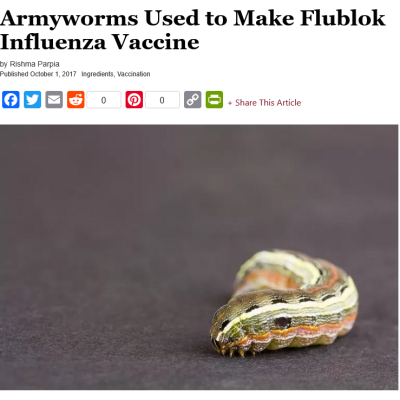
FluBlok flu vaccine contains armyworm fragments, as this article from 2017 states. The FDA approved it in 2013, and FluBlok is indeed still made using armyworms. The vaccine uses insect cells derived from armyworms used to make the recombinant flu vax. It’s made in a lab cell culture system rather than being grown in chicken eggs or being derived from a live flu virus. The cell culture of FluBlok is derived from a cell line called expresSF+ which originated from cells of the armyworm (Spodoptera frugiperda). The FDA assures us that these cells were derived decades ago and that no new armyworms are harvested each year for the vaccine.
But can we really believe the government? Just ask the Henrietta Lacks family–the government lied to them about the HeLa cell line.
If the FDA isn’t being quite so truthful with us, and new armyworms are used, these armyworms are likely exposed to these new RNA sprays that are designed to eradicate, well, armyworms.
It is this vicious cycle that we need to worry about. Or do we? Should we trust Big Pharma and Big Ag when they say these RNA sprays are completely harmless to the human species?
I think you know the answer.
Read full story here…


