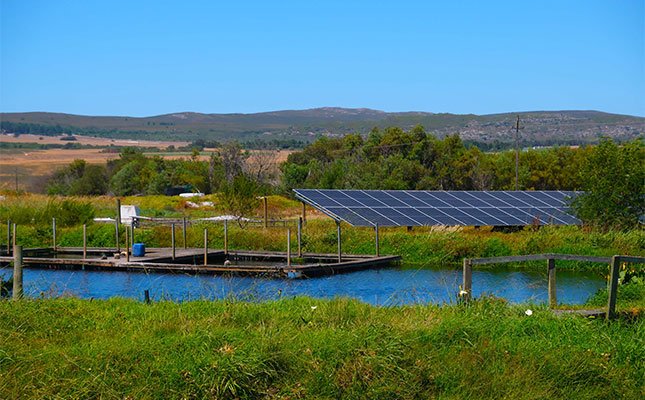
Albert Kemp has turned a childhood fascination with fish into a sophisticated, year-round aquaculture enterprise on a smallholding owned by himself and his wife Alicia in Baardskeerdersbos near Gansbaai.


– ADVERTISEMENT –
His mother knew he was going to be a trout farmer when he caught his first trout in a stream in Du Toitskloof as a four-year-old.
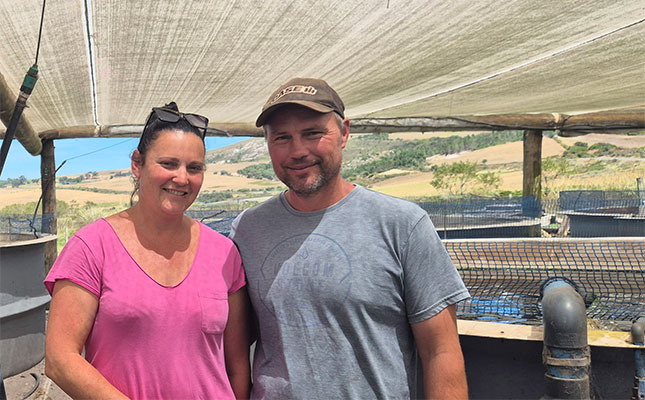
Now, more than three decades later, Albert Kemp and his wife Alicia are running a successful and growing trout business in the Overberg from an unassuming smallholding – with clear plans for expanding.
The Kemps founded B-bos Trout nine years ago on their property in Baardskeerdersbos, about 20km from Gansbaai in the Western Cape. Albert, who grew up on a grain and cattle farm near Swellendam, had dabbled in fish farming as a child and then studied aquaculture at Stellenbosch University.
He has been a fish farmer since 2006. He worked on a fish farm on the Overberg coast, where his current business evolved out of his prior involvement with a commercial Norwegian salmon farm at Gansbaai.
“In the salmon business we were raising the fingerlings in a dam on a nearby farm, from where the salmon would be transferred into cages in the sea to finish growing,” Albert recalls.
When the salmon project proved to be unviable and closed down two years later, the Kemps stayed on at the same farm and started raising rainbow trout fingerlings in the dam and rearing them to adulthood to sell.
After a few years, they relocated the operation to Lomond Wine Estate, where they still run a part of their operation. Nine years ago the couple also established a permanent base for their business on their own smallholding in Baardskeerdersbos.
“We buy the fertilised trout ova from Lunsklip Fisheries in Mpumalanga, hatch them ourselves and grow them in our ponds on the farm, and at Lomond. We source the feed from Specialised Aquatic Feeds, which supplies the aquaculture industry and also manufactures pet food in Hermanus,” says Albert.
Albert and Alicia produce between 40t and 45t of trout annually, of which just under half is sold in bulk to a processor in Cape Town that packages and sells it on to other distributors. The balance they pack themselves throughout the year. Their clients are mostly restaurants and small local retailers, but they also sell direct to the public online.
24/7 operation
The district surrounding Albert and Alicia’s trout farm is dotted with dairy farms, and much like dairy farming, trout farming is a full-time job, of which they do much themselves even though it is a very labour-intensive enterprise.
“Trout farming goes on all day, every day, day and night – the pumps must run constantly, the filters must work properly, the fish must be fed, five or six times a day when they’re little and twice per day when they’re bigger,” says Alicia.
Come harvest time, they are up at 2am to remove fish from the ponds and get them ready for transport, returning home at 7am and getting ready for a normal working day.
A considerable amount of time is also required to move fish between different ponds as they grow, so the Kemps travel between their different trout farming sites and grade the fish into different size classes. This is necessary because the fish compete in the ponds, and faster growers need to be removed in order to benefit the smaller fish.
“The big difference between us and a dairy farm is that if your centre pivot breaks, you have the option of fixing it tomorrow,” says Alicia.
“But if something breaks on your trout farm, you have to fix it immediately, otherwise all your fish die and you have nothing to sell.”
According to Albert, aquaculture can be done with fairly little equipment. At its most basic, it is possible to raise fish in floating cages in any dam.
The most economical way to raise trout is in free-flowing water, or with cage culture. Albert and Alicia use a closed recirculating system because of the limited water supply and high summer temperatures in their area.
“In your typical farm dam there is a high risk of algae growth, which taints the taste of the fish, so it is very important to keep the water as clean as possible, at all times. We believe that water quality is the key to the quality of our product,” says Albert.
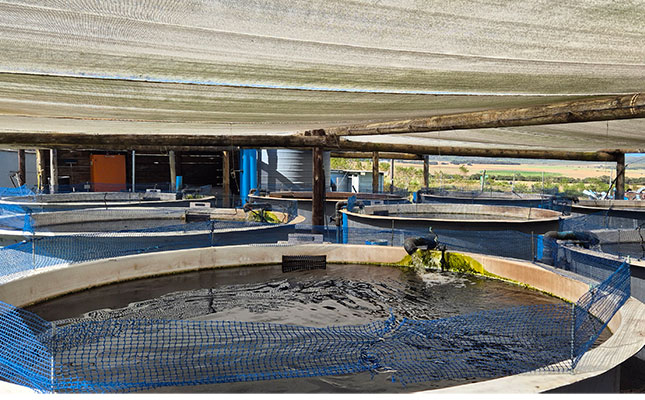
They use a combination of natural and man-made mechanisms to cleanse the water in which they raise their trout, which relies on the constant movement of water through a series of filters.
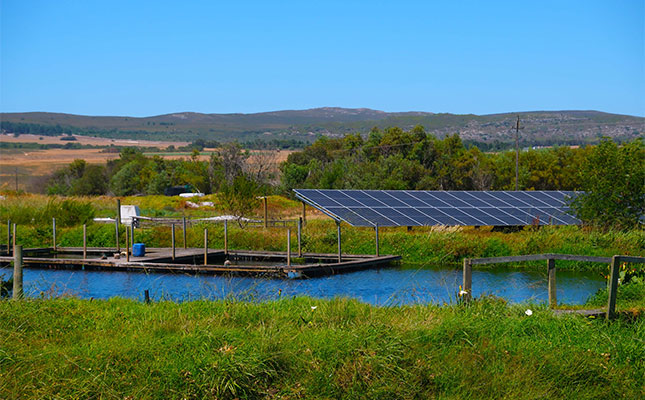
They supplemented a small pre-existing dam on their smallholding with a series of three slightly elevated ponds, and a combination of pumps and gravity move the water from one pond to the next. Through this process, microorganisms and plant roots filter and remove impurities.
For the smaller fish, a series of pools were constructed above ground, which is linked to a multi-stage filtration system to keep the young, vulnerable fingerlings healthy.
The system consists of a drum filter, in which water passes through a rotating drum with a mesh exterior that traps physical impurities, a UV light assembly that kills harmful bacteria, and a biofilter consisting of a large cylinder containing plastic media that is colonised by microorganisms that consume ammonia.
Water is extracted from two levels in the large covered ponds that house younger fish, and pumped through this system to ensure even purification of the ponds.
Backup diesel generators and a solar power system with batteries ensure that the pumps keep the water flowing continuously through these filtration systems, regardless of planned or unplanned power outages.
Water and heat alert
Like most of the Western Cape, the Overberg is gradually becoming hotter and drier – a significant risk when your entire business depends on an organism that becomes stressed when the water temperature rises above 22°C.
“Temperature is not a problem during winter months,” says Albert. “During a very warm, dry year such as 2025, you harvest the fish a little earlier than you would otherwise, and during a cooler, wetter year you wait a little longer before taking them out.”
The Kemps monitor the water temperature closely and adjust how much they feed the fish when it does become hot.
“One hot winter’s day doesn’t make much of a difference to the overall water temperature,” says Albert. “If you do expect longer periods of hot weather while you have fish in your ponds, you keep an eye on the fish and the temperature; you might feed them less on the day before it gets really hot, or you stop feeding them for a day. When you do that, they use much less oxygen than they would if they do get fed.
”The risk associated with higher water temperatures is that warm water does not absorb as much oxygen as colder water, so it is important to manage the trout’s oxygen intake when temperatures do rise.
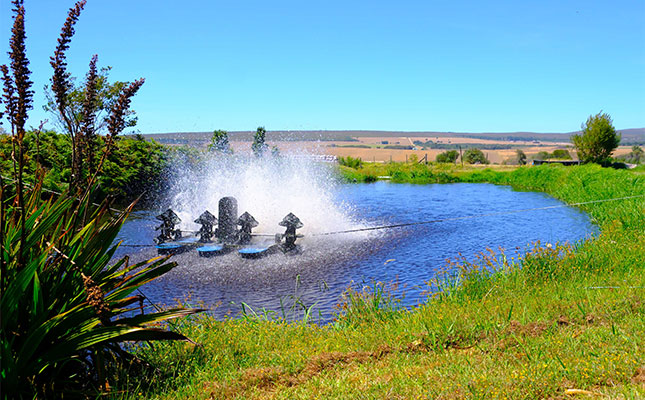
The artificial ponds for smaller fish are shaded to keep them cool, and in the outdoor ponds the Kemps make use of evaporative cooling, which is done by trickle filtration through bioblocks, functioning like a radiator. In the dams, large paddle wheels turn constantly in order to increase the oxygen content of the water.
While fish farming requires large volumes of water, it is not lost during the production process, and all water can be reused.
“We work very carefully with our water,” Alicia points out.
Expansion plans
Albert and Alicia have been steadily growing the proportion of their product that they process, package and sell themselves under their brand B’Bos Trout. They plan to gradually expand this portion of their business until they can pack all of what they produce themselves, and they also look at expanding their farm.
Their production season runs from April, at the end of the long, hot Western Cape summer, to October or November, when the weather starts warming again.
It takes them 16 months to rear a trout to marketable size, with an average weight of 1,5kg. They acquire the fertilised eggs, which are all female, at the end of May and June. The fish remain on the Kemps’ farm from hatching until April the next year, when they are transferred to the cages at Lomond.
Albert says because of the seasonal nature of trout farming, the Overberg with its cool sea air is a good location for such a business.
However, for him the best place to farm rainbow trout would be the cool, elevated valleys of Du Toitskloof, which stay cooler for longer and have a constant flow of clean mountain water, making it possible to harvest fish over six months instead of one. He plans to start a trout farming venture there from 2026, and their long-term plan is to also open a fly fishing venue on their land.
In the meantime, however, they are slowly and steadily expanding B’Bos Trout, targeting chefs and consumers. As more of their produce is sold under their own brand, their margin grows, enabling them to invest more in their own packing capacity.
“Not everyone has the stomach for trout farming,” says Alicia with a laugh. “But the secret is to do as much as possible yourself.”
For more information email Albert Kemp at [email protected].
Get trusted farming news from Farmers Weekly in Google Top Stories.
➕ Add Farmers Weekly to Google
✔ Takes 10 seconds · ✔ Remove anytime