
Since its January launch in Limpopo to coincide with Armed Forces Day commemorations, the South African National Defence Force’s (SANDF’s) Project Owethu has provided healthcare services to more than 50 000 beneficiaries in the province.
This was revealed by Defence and Military Veterans Minister Angie Motshekga, who was speaking at the official launch of Project Owethu at the Collins Chabane Community Hall on 17 February. She said the project has had a “remarkable impact” in the three district municipalities it has been implemented across (Sekhukhune, Waterberg and Vhembe). Villages in these areas were selected due to their limited access to essential services.
South African Military Health Services (SAMHS) personnel reached out to over 5 000 beneficiaries between 26 and 30 January in Mashoanyaneng, Sekhukhune; over 17 000 beneficiaries in Ga-Matlou, Waterberg between 2 and 6 January; and over 29 000 beneficiaries in Basani, Vhembe, between 9 and 13 February.
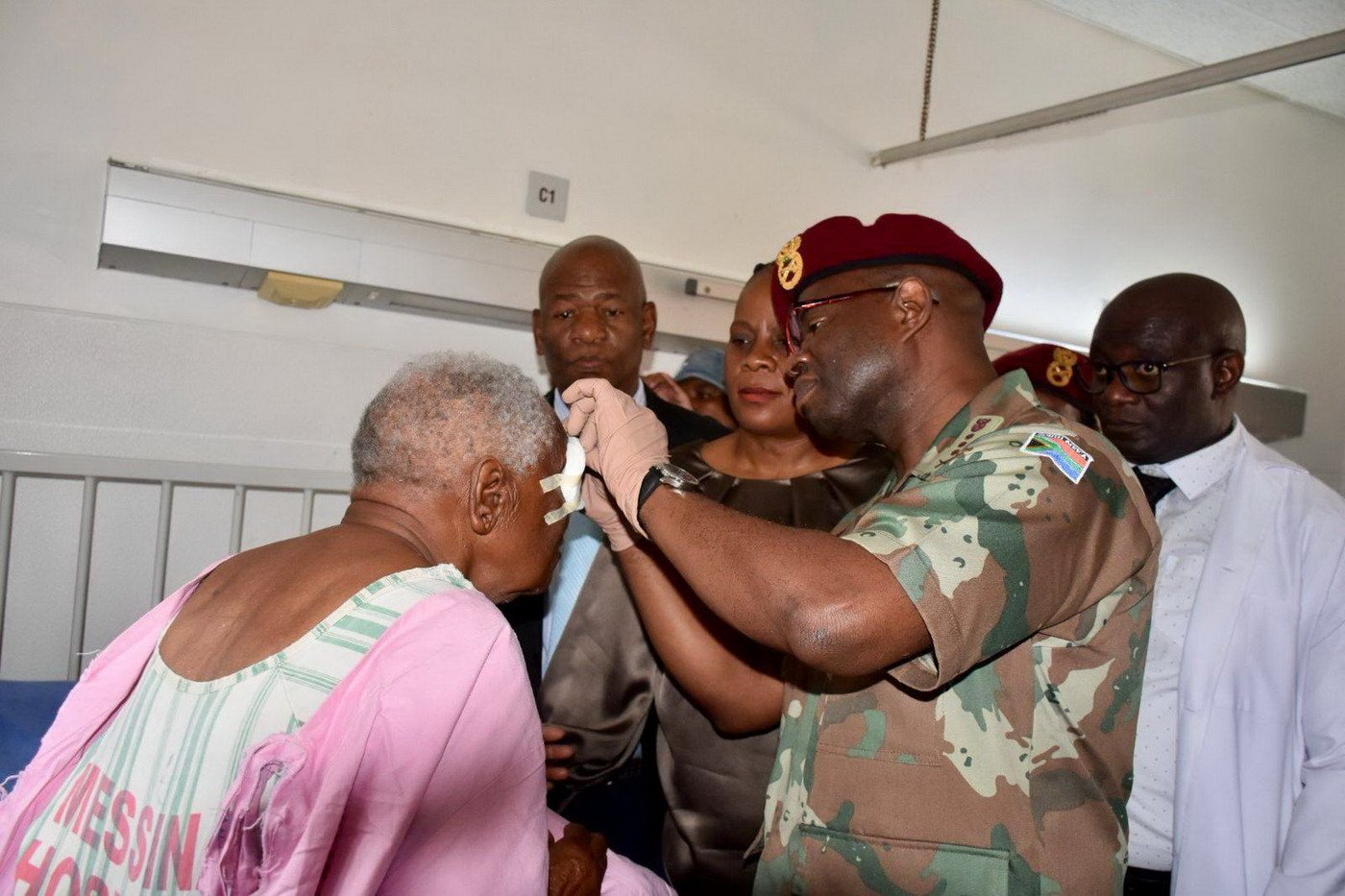
In Vhembe District, at Elim Hospital, 116 community members underwent cataract surgeries between 9 and 16 February. These surgeries will continue until 20 February.
“Amongst the most inspiring cases was a 100-year-old patient who regained sight after five years of blindness, as well as another individual who had lived in darkness for seven years. These are not just statistics; they are restored lives, renewed dignity, and rekindled hope,” Motshekga said.
Project Owethu is designed to deliver integrated healthcare, social support services and youth development initiatives directly to underserved rural communities.
“In alignment with the global ‘One Health’ concept, our multidisciplinary teams integrated human, environmental, and animal health services. Medical practitioners, nurses, oral health professionals, social workers, psychologists, environmental health practitioners, radiographers, physiotherapists, occupational therapists, biokineticists, dietitians, optometrists, ophthalmologists, pharmacists, emergency military medical care providers, and many others collaborated seamlessly,” the Minister said.
Life skills programmes addressed issues such as substance abuse, stress management, HIV and teenage pregnancy, digital violence, suicide prevention, neurodivergence, malaria prevention, body safety, and food safety. Educators received specialised workshops to strengthen early identification and referral systems for learners facing neurodevelopmental challenges.
“Our psycho-social support teams intensified awareness campaigns on gender-based violence in partnership with the Department of Social Development. In addition, these team conducted career guidance workshops to broaden learners’ aspirations and provided psychoeducation on substance-induced psychosis, post-traumatic stress disorder, and other mental health conditions. Mental health screenings and referrals ensured continuity of care within the public health system,” the Minister said.
Environmental health initiatives focused on communicable disease awareness, personal hygiene, pest control, food safety, and malaria prevention — particularly important during the rainy season.
Medicine and Nursing services provided chronic disease screening, treatment re-initiation, adherence counselling, paediatric care, orthopaedic support, and referrals to local hospitals. Radiography support was rendered in theatres and clinics. Nutritional screenings, deworming initiatives, and food handler training strengthened preventative care, Motshekga said.
Oral Health teams delivered education, dental screenings, restorative procedures, scaling and polishing, and extractions in deep rural settings. Pharmacy services dispensed medication wherever consultations occurred.
Beyond healthcare, the Works Regiment undertook infrastructure improvements at a secondary school in Collins Chabane Local Municipality. Artisans skilled in carpentry, bricklaying, welding, and tiling restored critical facilities, including the refurbishment of a laboratory ceiling.
The Department of Home affairs also assisted communities in Limpopo with 209 ID documents and five passports as part of the Project Owethu.
“The SANDF Spouses Forum further demonstrated compassion by sourcing school uniforms for three learners from indigent families, restoring dignity and reinforcing our collective responsibility to uplift those in need,” Motshekga said.
“This initiative reflects our understanding that security is not defined solely by borders and weaponry. True security exists when communities are healthy, empowered, educated and hopeful,” the Minister concluded.