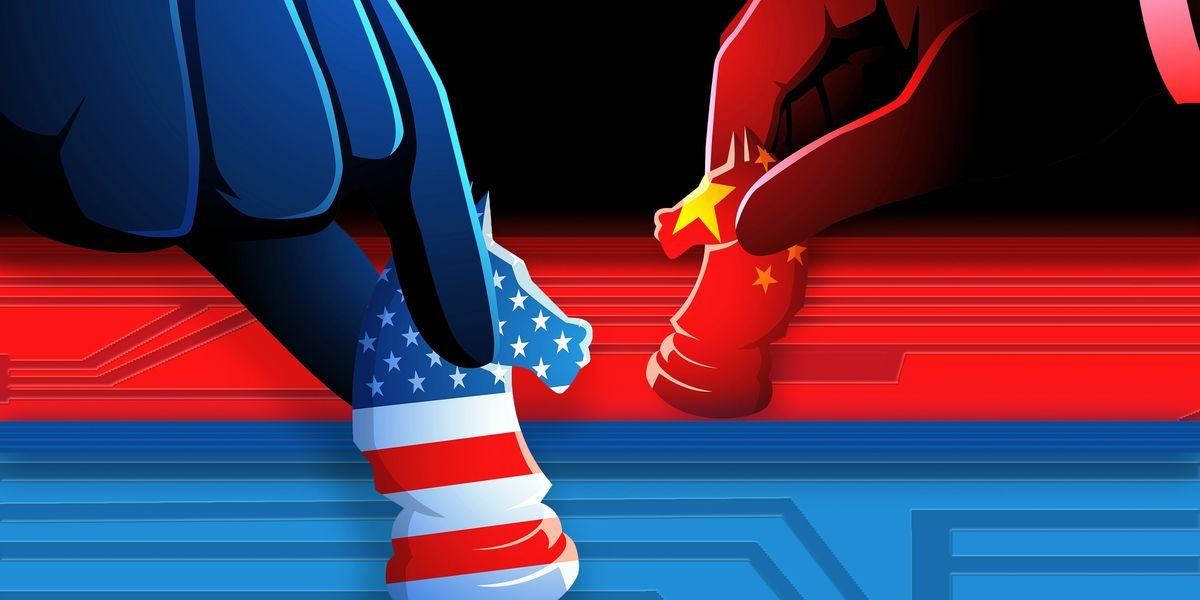

More money has been invested in AI than it took to land on the moon. Spending on the technology this year is projected to reach up to $700 billion, almost double last year’s spending. Part of the impetus for this frantic outlay is a conviction among investors and policymakers in the United States that it needs to “beat China.” Indeed, headlines have long cast AI development as a zero-sum rivalry between the U.S. and China, framing the technology’s advance as an arms race with a defined finish line. The narrative implies speed, symmetry, and a common objective.
But a closer look at AI development in the two countries shows they’re not only not racing toward the same finish line: “The U.S. and China are running in very different lanes,” says Selina Xu, who leads China and AI policy research for Eric Schmidt, the tech investor, philanthropist and former Google chief, in New York City. “The U.S. is doubling down on scaling,” in pursuit of artificial general intelligence (AGI) Xu says, “while for China it’s more about boosting economic productivity and real-world impact.”
Lumping the U.S. and China onto a single AI scoreboard isn’t just inaccurate, it can impact policy and business decisions in a harmful way. “An arms race can become a self-fulfilling prophecy,” Xu says. “If companies and governments all embrace a ‘race to the bottom’ mentality, they will eschew necessary security and safety guardrails for the sake of being ahead. That increases the odds of AI-related crises.”
Where’s the Real Finish Line?
As machine learning advanced in the 2010s, prominent public figures such as Stephen Hawking and Elon Musk warned that it would be impossible to separate AI’s general-purpose potential from its military and economic implications, echoing Cold War–era frameworks for strategic competition. “An arms race is an easy way to think about this situation even if it’s not exactly right,” says Karson Elmgren, a China researcher at the Institute for AI Policy and Strategy, a think tank in San Francisco. Frontier labs, investors, and media benefit from simple, comparable progress metrics, like larger models, better benchmarks, and more computing power, so they favor and compound the arms race framing.
Artificial general intelligence is the implied “finish line” if AI is an arms race. But one of the many problems with an AGI finish line is that by its very nature, a machine superintelligence would be smarter than humans and therefore impossible to control. “If superintelligence were to emerge in a particular country, there’s no guarantee that that country’s interests are going to win,” says Graham Webster, a China researcher at Stanford University, in Palo Alto, California.
An AGI finish line also assumes the U.S. and China are both optimizing for this goal and putting the majority of their resources towards it. This isn’t the case, as the two countries have starkly different economic landscapes.
When Is the Payoff?
After decades of rapid growth, China is now facing a grimmer reality. “China has been suffering through an economic slowdown for a mixture of reasons, from real estate to credit to consumption and youth unemployment,” says Xu, adding that the country’s leaders have been “trying to figure out what is the next economic driver that can get China to sustain its growth.”
Enter AI. Rather than pouring resources into speculative frontier models, Beijing has a pressing incentive to use the technology as a more immediate productivity engine. “In China we define AI as an enabler to improve existing industry, like healthcare, energy, or agriculture,” says AI policy researcher Liang Zheng, of Tsinghua University in Beijing, China. “The first priority is to use it to benefit ordinary people.”
To that end, AI investment in China is focused on embedding the technology into manufacturing, logistics, energy, finance, and public services. “It’s a long-term structural change, and companies must invest more in machines, software, and digitalization,” Liang says. “Even very small and medium enterprises are exploring use of AI to improve their productivity.”
China’s AI Plus initiative encourages using AI to boost efficiency. “Having a frontier technology doesn’t really move China towards an innovation-led developed economy,” says Kristy Loke, a fellow at MATS Research who focuses on China’s AI innovation and governance strategies. Instead, she says, “It’s really important to make sure that [these tools] are able to meet the demands of the Chinese economy, which are to industrialize faster, to do more smart manufacturing, to make sure they’re producing things in competitive processes.”
Automakers have embraced intelligent robots in “dark factories” with minimal human intervention; as of 2024, China had around five times more factory robots in use than the U.S. “We used to use human eyes for quality control and it was very inefficient,” says Liang. Now, computer vision systems detect errors and software predicts equipment failures, pausing production and scheduling just-in-time maintenance. Agricultural models advise farmers on crop selection, planting schedules, and pest control.
In healthcare, AI tools triage patients, interpret medical images, and assist diagnoses; Tsinghua is even piloting an AI “Agent Hospital” where physicians work alongside virtual clinical assistants. “In hospitals you used to have to wait a long time, but now you can use your agent to make a precise appointment,” Liang says. Many such applications use simpler “narrow AI” designed for specific tasks.
AI is also increasingly embedded across industries in the U.S., but the focus tends toward service-oriented and data-driven applications, leveraging large language models (LLMs) to handle unstructured data and automate communication. For example, banks use LLM-based assistants to help users manage accounts, find transactions, and handle routine requests; LLMs help healthcare professionals extract information from medical notes and clinical documentation.
“LLMs as a technology naturally fit the U.S. service-sector-based economy more so than the Chinese manufacturing economy,” Elmgren says.
Competition and cooperation
The U.S. and China do compete more or less head-to-head in some AI-related areas, such as the underlying chips. The two have grappled to gain enough control over their supply chains to ensure national security, as recent tariff and export control fights have shown. “I think the main competitive element from a top level [for China] is to wriggle their way out of U.S. coercion over semiconductors. They want to have an independent capability to design, build, and package advanced semiconductors,” Webster says.
Military applications of AI are also a significant arena of U.S.–China competition, with both governments aiming to speed decision-making, improve intelligence, and increase autonomy in weapons systems. The U.S. Department of Defense launched its AI Acceleration Strategy last month, and China has explicitly integrated AI into its military modernization strategy under its policy of military-civil fusion. “From the perspective of specific military systems, there are incremental advantages that one side or the other can gain,” Webster says.
Despite China’s commitment to military and industrial applications, it has not yet picked an AI national champion. “After Deepseek in early 2025 the government could have easily said, ‘You guys are the winners, I’ll give you all the money, please build AGI,’ but they didn’t. They see being ‘close enough’ to the technological frontier as important, but putting all eggs in the AGI basket as a gamble,” Loke says.
American companies are also still working with Chinese technology and workers, despite a slow uncoupling of the two economies. Though it may seem counterintuitive, more cooperation—and less emphasis on cutthroat competition—could yield better results for all. “For building more secure, trustworthy AI, you need both U.S. and Chinese labs and policymakers to talk to each other, to reach consensus on what’s off limits, then compete within those boundaries,” Xu says. “The arms race narrative also just misses the actual on-the-ground reality of companies co-opting each other’s approaches, the amount of research that gets exchanged in academic communities, the supply chains and talent that permeates across borders, and just how intertwined the two ecosystems are.”
From Your Site Articles
Related Articles Around the Web