

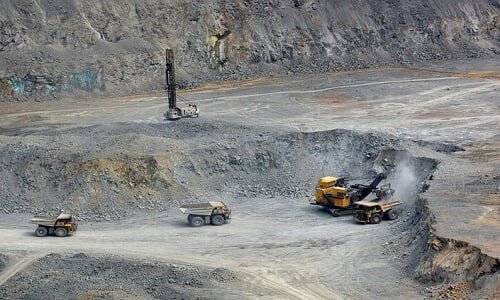
According to sources familiar with the deal, Gecamines will be able to sell nearly half of Kamoto Copper Co.’s (KCC) copper output over the following two years, with the option to market 30% of production in subsequent years.
This new deal is consistent with similar arrangements Gecamines has established with other major Congolese mines, where it retains a minority stake.
As seen on Bloomberg, Gecamines is inclined to manage sales through its cooperation with Mercuria Energy Group Ltd., which offers financial, logistical, and technical assistance to the state miner’s developing trading section, according to individuals who asked to remain anonymous due to the sensitive nature of the discussions.
Although the Congolese government owns 5% of KCC and Gecamines controls 25%, the state miner now has the power to offer up to half of KCC’s copper production in 2026 and 2027, which will assist overcome past shortages in quantities that could not be sold.
KCC produced around 190,000 tons of copper last year, but it aims for 300,000 tons per year, aided by a separate land arrangement signed with Glencore.
Gecamines already markets copper from CMOC Group Ltd.’s Tenke Fungurume mine and the Sicomines project, which is controlled by China Railway Group Ltd. and China Power Construction Corp.
The firm has long-term goals of trading up to 500,000 tons of copper and 40,000 tons of cobalt per year from its joint venture assets.


DRC’s increased copper sales
Very recently, reports showed that the Democratic Republic of Congo (DRC) increased its copper exports by nearly 10% in 2025, reinforcing its position as the world’s second-largest producer of the industrial metal after Chile.
According to preliminary figures published by the DR Congo Ministry of Mines at a mining conference in Cape Town, the DRC exported 3.4 million tons of copper, an increase from 3.1 million tons in 2024.
Congolese copper output is increasing while worldwide supply is disrupted by mining accidents, but demand is predicted to climb due to the renewable energy transition and the emergence of artificial intelligence technology.
Copper prices have mirrored these supply challenges, increasing 40% over the previous year to a high of almost $14,500 per ton in January 2026.
Glencore PLC’s recent deal with the U.S.
Earlier this month, Glencore PLC agreed to sell a 40% share in its Democratic Republic of Congo copper and cobalt assets to the US-backed Orion Critical Mineral Consortium for about $9 billion, including debt.
The transaction includes Glencore’s Mutanda Mining (Mumi) and Kamoto Copper Company (KCC) assets, which are two of the major Western-owned cobalt and copper producers in the DRC.
Furthermore, the group has the option of selling its share of output to specified purchasers, while Glencore will continue to operate the mines daily as part of its company.
The agreement reflects Washington’s growing concern about supply chain risks, namely its reliance on China for crucial minerals used in renewable energy, electric cars, and defense technology.
China already owns or has substantial influence over some of the Democratic Republic of Congo’s top copper and cobalt activities, including the Tenke Fungurume mine, which is majority owned by China Molybdenum, and the Kisanfu and Deziwa mines, which are run by Chinese state-linked enterprises.


