

The Nigeria Labour Congress (NLC) has issued a stern warning, threatening widespread industrial action in response to the ongoing failures of Nigeria’s electricity grid. The NLC asserts that a decade of privatizing the power sector has resulted in a “cycle of darkness, exploitation, and economic hardship” for Nigerian citizens.
The Congress also denounced the categorization of electricity supply into Bands A, B, and C as a formalized system of extortion.
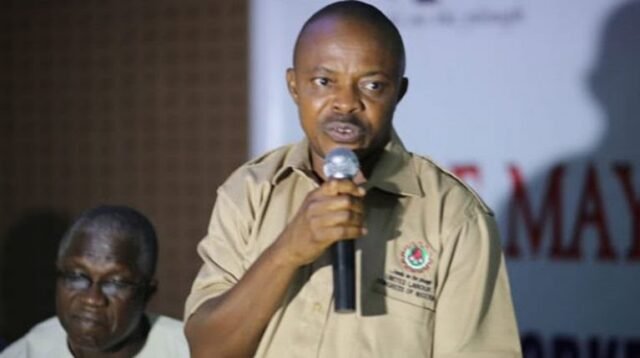
Speaking at the National Union of Electricity Employees’ Annual Conference for Women and Youth in Abuja this past Sunday, NLC President Joe Ajaero delivered what he termed a “final ultimatum” to both government authorities and power sector operators. He insisted that organized labor will actively resist any further increases in tariffs or policies that exacerbate economic hardship without a tangible improvement in electricity supply.
Ajaero lamented that over ten years after the unbundling and subsequent sale of the Power Holding Company of Nigeria (PHCN), electricity generation remains stubbornly stagnant between 4,000 and 5,000 megawatts. This level, he pointed out, is essentially the same as before privatization, despite Nigeria’s substantial population growth and increasing industrial energy demands.
Ajaero described this situation as deeply embarrassing, underscoring Nigeria’s lack of progress. He launched a blistering critique of the current power sector management and demanded an immediate and thorough review of the entire system.
He stated, “We are compelled once again to raise the alarm about the lamentable state of our nation’s electricity sector. We contend that this failed privatization experiment has plunged Nigerian workers, women, youth, and industries further into energy poverty. The national grid continues to collapse while Distribution Companies (DisCos) consistently reject power allocations from the Transmission Company.”
“Instead of advancement, we see regression. Instead of light, we are enveloped in darkness. The national grid malfunctions with the regularity of a faulty generator, often plunging the entire country into a blackout. This is not the ‘transformation’ we were promised; it is a carefully orchestrated scheme to rob the Nigerian people.”
“The NLC reiterates its position that the privatization of the power sector was a monumental deception. The entire exercise was a fraudulent transfer of public assets into the hands of a select few speculators who lack both the necessary technical expertise and the financial strength to properly manage the nation’s electricity infrastructure.”
“These so-called investors did not purchase these companies with their own capital. There was no infusion of foreign exchange, despite claims that these companies originated from outside Nigeria. They relied heavily on loans from Nigerian banks, depleting domestic credit and contributing to the devaluation of our currency. They acquired the DisCos and GenCos at minimal cost and now expect Nigerian workers to repay their debts through exorbitant electricity tariffs.”
Ajaero also condemned the Band classifications (A, B, and C) as a capitalist tool designed to further impoverish ordinary citizens. He characterized the policy as a sneaky tariff hike that imposes cost-reflective billing on consumers without providing service-reflective delivery.
“This banding system remains a systematic form of extortion of Nigerians by the wealthy. Band A consumers are charged exorbitant rates but still experience unreliable power supply. This government is effectively asking Nigerians to pay for darkness. We vehemently reject this segregation. Electricity is a fundamental right, not a commodity to be auctioned off to the highest bidder while leaving the poor in the dark.”
“The claims of electricity subsidies remain illusory, as does the proposal to use three trillion naira to bail out operators. This is yet another deceptive maneuver that will lead nowhere. We question the logic behind the Federal Government’s purported plan to allocate approximately three trillion naira to the GenCos. We believe this is a clandestine attempt to ‘reward cronies’ as the 2027 elections draw closer.”
“We maintain that there is no justification for such a massive bailout to private companies that have demonstrably failed to deliver. If this government is genuinely concerned about the well-being of Nigerians, it must cease using public funds to enrich a cartel of failed investors. Every kobo in the treasury belongs to the workers and the people of Nigeria,” the NLC president declared.
He continued, “The Congress insists that the state must restore the power sector to a social service if we aspire to achieve progress as a nation. Global examples clearly demonstrate that no country has successfully operated its electricity sector purely as a profit-driven enterprise without imposing significant hardship on its citizens. We call for the immediate return of the State as the primary driver of the power sector
The NLC emphasized that electricity is not a luxury reserved for the wealthy, but rather a social service essential for national development. The organization argued that only the state can bear the substantial capital investment required and the extended timeframe for returns on investment. The NLC asserted that the private sector has failed and that it is time to reclaim control of the power sector for the benefit of the people.
“We, therefore, advocate for a People’s Power Roadmap. While acknowledging the new Electricity Act, which delegates power to the states, we caution that decentralization alone is not a panacea. Without a clear, national, and worker-centered strategy, these bottlenecks will persist.”
“Consequently, the NLC demands a National Stakeholders’ Summit; not another unproductive discussion forum, but a genuine convergence of workers, labor unions, manufacturers, and qualified experts to formulate a Power Sector Roadmap that prioritizes affordable and stable electricity for all. This roadmap should include a reversal of the failed privatization model, tariffs that reflect service quality rather than simply costs, and public investment in generation and transmission infrastructure.”
“The Nigerian people cannot continue to pay for darkness. The NLC stands ready to collaborate with the masses and our networks to resist any further exploitation disguised as electricity reform. Power must be accessible before it can be affordable. Power must be returned to the people,” Ajaero asserted.
Nigeria’s electricity crisis remains a persistent problem, with frequent blackouts and inadequate power supply hindering daily life and economic growth. The country’s power generation capacity is struggling to meet demand, with an estimated installed capacity of 12,522MW, but only approximately 4,200MW generated daily.
The government has introduced reforms, including a $2.5 billion plan aimed at addressing the crisis. These reforms focus on settling debts, upgrading infrastructure, and promoting a market-reflective tariff system.
However, the NLC declared on Sunday that it is prepared to mobilize workers and the general public to resist what it perceives as further exploitation disguised as electricity reform in Nigeria.
Meanwhile, power companies have rejected claims of customer exploitation, emphasizing that the sector is facing severe funding shortages, which have negatively impacted business operations.
Recently, power generation companies, under the umbrella of the Association of Power Generation Companies (APGC), urged the Federal Government to extend its proposed N3.6 trillion power subsidy payment plan beyond 2028, warning that the electricity sector’s liquidity crisis cannot be resolved within a mere three years.
Joy Ogaji, the Chief Executive Officer of APGC, made this appeal in response to documents indicating that the Federal Government plans to allocate funds for power subsidy payments between 2026 and 2028, totaling N3.6 trillion.
The PUNCH had previously reported that the Federal Government proposed a N3.6 trillion deduction from the Federation Account to finance electricity subsidies in 2026, 2027, and 2028 – a strategy designed to distribute the financial burden across federal, state, and local governments.
“We commend the Federal Government for initiating this proactive measure. Based on the provided documents, provisions will be made for 2026 to 2028, spanning three years. We are hopeful that it is fully appropriated and that the funds are actually disbursed to the GenCos,” Ogaji stated.
Questioning the long-term viability of the government’s plan, the APGC CEO inquired as to why the subsidy framework should conclude in 2028, cautioning against unrealistic expectations of a sudden turnaround thereafter.
“Is it not feasible to extend the period beyond 2028? Are we anticipating a miracle after 2028? Do we possess a magic wand to resolve the core of the liquidity conundrum?” Ogaji questioned.