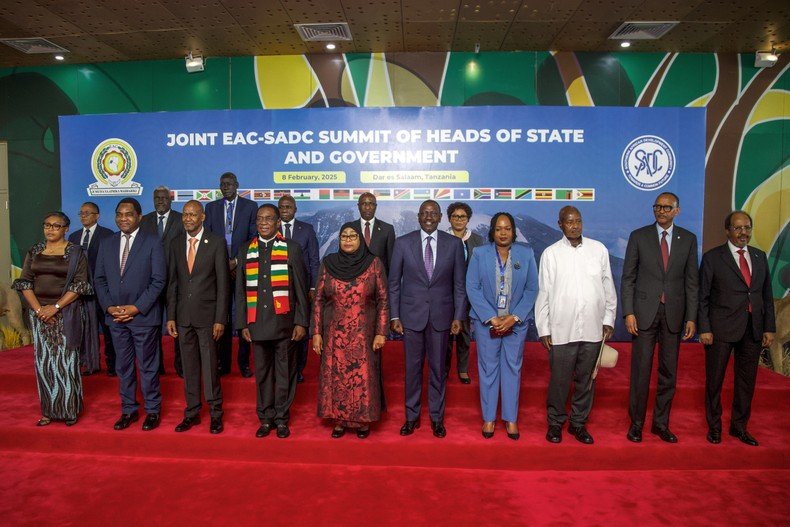
The summit, scheduled for 7 March in Arusha, will mark the first formal meeting of the EAC’s top decision-making organ in over a year. Leaders are expected to debate a new funding formula and agree on measures to rationalise expenditure as mounting arrears from partner states continue to disrupt core operations.
The Democratic Republic of the Congo accounts for $27 million in arrears, followed by Burundi at $22.7 million and South Sudan at $21.8 million. Somalia owes $10.5 million, Rwanda $5.2 million, and Uganda $1.1 million.

EAC institutions face operational paralysis
“That matter is part of the agenda that the Heads of State must deliberate on, because they are the final decision-making organ within the EAC structures,” she said, adding that President Ruto “is keen on this issue” and wants leaders to pronounce themselves in their capacities as heads of state.
The financial squeeze has paralysed several institutions, including the East African Legislative Assembly, the East African Court of Justice, and the Inter-University Council of East Africa, which is owed $18.4 million.
The Lake Victoria Fisheries Organisation is owed $2.1 million, while the Civil Aviation Safety and Security Oversight Agency in Kampala is owed $3.1 million.
At the legislative assembly, members have not been paid since November, undermining oversight functions and prompting concern from lenders such as KCB Bank Tanzania.
In a memo to members and staff, Alex Obatre, Clerk of the Assembly, warned of “major liquidity challenges due to delayed remittances from partner states”, noting that only 38 per cent of the approved budget had been received by early February.
The funding gap has led to salary and gratuity arrears, postponed sessions, and delays in meeting statutory obligations.
Salaries stall as member states debate new funding model
The EAC Secretary General, Veronica Nduva, separately sought clarification on the non-payment of members’ salaries following complaints from KCB Bank Tanzania over unpaid loan instalments.
Kenyan legislator David Sankok confirmed that sittings had stalled. “It has been difficult to receive our salaries regularly. We have now gone some time without pay, so it is a challenge,” he said, blaming member states for failing to honour their commitments.
Sankok singled out the Democratic Republic of Congo and South Sudan for significant arrears and argued that a new financing structure may be needed to prevent recurring crises.
For a bloc that has positioned itself as one of Africa’s most advanced integration projects, spanning a market of more than 300 million people, the cash crunch poses both practical and symbolic risks.
If unresolved, officials warn, the EAC could face operational paralysis and potential litigation, undermining investor confidence at a time when regional trade ambitions are under renewed global scrutiny.
The Arusha summit will now test whether political will can match the bloc’s economic aspirations.