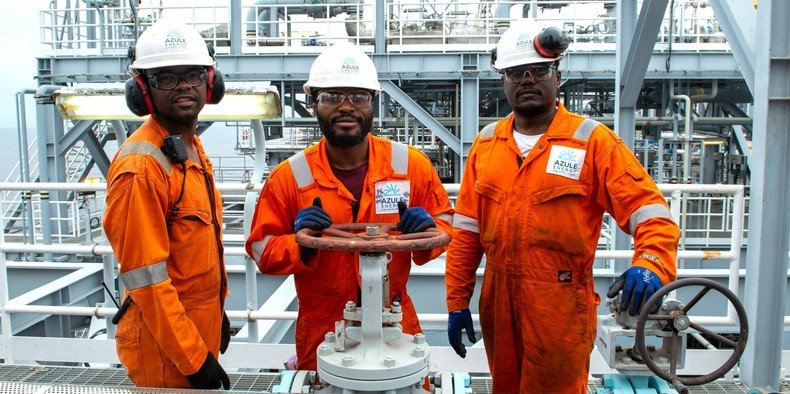
According to the company’s official website, the discovery was made at the Algaita-01 exploration well in Block 15/06, located about 18 kilometres from the Olombendo floating production, storage and offloading (FPSO) vessel in Angola’s Lower Congo Basin.
Preliminary estimates suggest the field contains approximately 500 million barrels of oil in place.
The well, spudded on January 10, 2026, was drilled in water depths of 667 metres by the Saipem 12000 drillship and encountered oil-bearing sandstones across multiple Upper Miocene intervals.
“A comprehensive data acquisition campaign, including fluid sampling, confirmed the quality of the reservoir and the fluid characteristics,” Eni said in a statement.
Azule Energy Chief Executive Officer Joe Murphy said the results confirm “the exceptional effectiveness of the petroleum system in Block 15/06,” adding that the proximity to existing production infrastructure strengthens development potential.
Block 15/06 is operated by Azule Energy, a 50/50 joint venture between Eni and BP, which holds a 36.84% stake alongside Sonangol E&P (36.84%) and SSI Fifteen Limited (26.32%).

Angola’s Production Reality
Angola holds between 7.7 and 7.8 billion barrels of proven crude oil reserves, making it the fourth-largest oil reserve holder in Africa after Libya, Nigeria and Algeria. Globally, the country ranks 18th in proven reserves, according to Vanguard News.
Despite remaining one of Africa’s top oil producers, Angola has experienced a steady decline in output over the past decade as several offshore fields have matured.
Current production averages between 1.0 and 1.1 million barrels per day, a sharp drop from the peak of more than 1.8 million barrels per day recorded in the late 2000s.
However, a recent consultancy outlook projects a modest recovery, with production expected to rise to about 1.14 million barrels per day in 2026.
Oil remains the backbone of Angola’s economy. The sector generates over 90% of export revenues and contributes roughly one-third of the country’s gross domestic product.
This dependence makes new discoveries vital for fiscal stability and long-term economic resilience.
The Algaita-01 discovery therefore comes at a strategic moment, as the government works to counter natural decline rates in ageing offshore fields and stabilise national output.
Key Export Markets: China, India and Europe
China remains Angola’s largest crude customer, typically accounting for 40–50% of total shipments.
Chinese refiners process Angolan grades such as Girassol, Dalia and Cabinda, which are generally medium to heavy blends suited for diesel, gasoline and petrochemical production.
India is another major buyer, with refiners increasing imports of Angolan grades in recent years to diversify supply.
Spain and the Netherlands also feature among European destinations, using Angolan crude to balance refinery slates for transport fuels and jet fuel.
Regional Competitive Implications
The discovery may shift competitive dynamics among Africa’s leading producers.
Nigeria remains Africa’s largest oil producer but continues to face output constraints linked to theft and underinvestment.
Libya’s production remains vulnerable to political instability, while Algeria focuses heavily on gas exports but retains a significant crude presence.
If Angola accelerates development using existing infrastructure near the Olombendo FPSO, it could stabilise its continental ranking and reinforce its relevance in global crude markets.
Paulino Jerónimo, Chairman and Chief Executive Officer of the Angolan National Agency of Petroleum, Gas and Biofuels (ANPG), said in a statement that the discovery “reaffirms the high potential of the Lower Congo Basin and the consistency of the ongoing exploration strategy,” adding that it creates favourable conditions for swift monetisation and positive impacts on national production and state revenues.