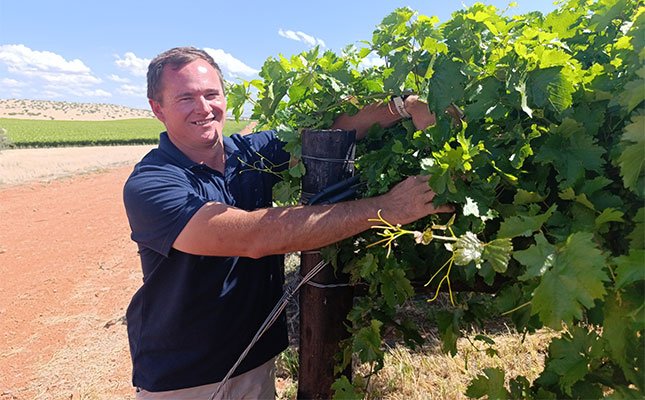
Petri Swart never planned on pursuing a job in agriculture. Yet, his hands-on approach, technical focus, and willingness to challenge conventional raisin production systems has earned him recognition as SA Raisins’ 2025 Young Farmer of the Year.


– ADVERTISEMENT –
Petri Swart grew up on a raisin and lucerne farm near Kakamas in the Northern Cape, but farming was never part of his plans.
“I did not even consider farming as career because dad, Unnis, sold his farm in 2005 for health reasons. So, after matriculating in 2010, I decided to study sports science,” he explains.
But, during his practical year he realised how limited job opportunities were in the sport science field, and struggling to find work, he returned home to Kakamas. After a week of doing nothing, his father told him he could not “just sit around the house all day.”
Venture into agriculture
Unnis arranged a position for him on Gerrit Nel’s farm near Kakamas. Petri initially worked with lucerne, but within a year or two, Nel began training him in raisin and wine grape production. It was here that something shifted, and Petri fell in love with farming.
“I wasn’t motivated at first,” he admits. “But, when I started learning about pests, diseases, and vineyard management, it felt like a whole new world opening up.”
Nel became Petri’s first major mentor, teaching him lessons that would shape his entire approach to farming. “One of the most valuable lessons he taught me was that a farmer’s feet are like fertiliser in the vineyard. I know technology is important, but you cannot rely on it alone. You still need to walk through the vineyards and observe the vines, the leaves, and the soil, to know what is really happening.”
Even today, as a farm manager, he limits his time in the office to just a couple of hours a day. “The real work happens out there in the vineyards. If I’m not seeing it for myself, I can’t make the best decisions,” he says, underscoring the hands-on approach that has shaped his success.
A new season
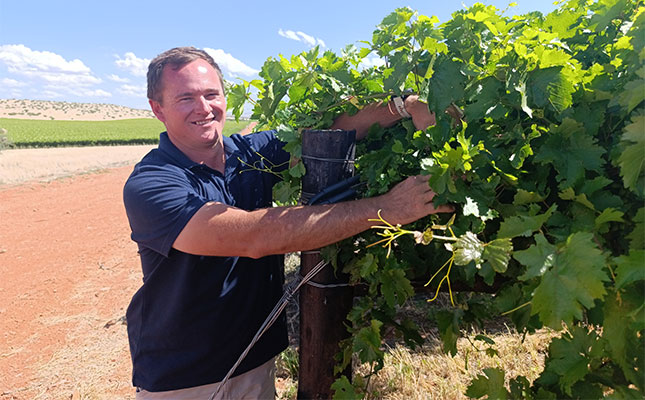
In 2018, Petri moved to Mooiwater in the Orange River Valley, where owner Bertus Killian and the farm’s crop advisor from Nexus, Kobus Burger, helped take his skills and passion to the next level. They deepened his technical knowledge, exposed him to new practices, and entrusted him with greater responsibility.
It was this steady progression – from hands- on learning and close observation to managing increasingly complex production systems – that began to set Petri apart.
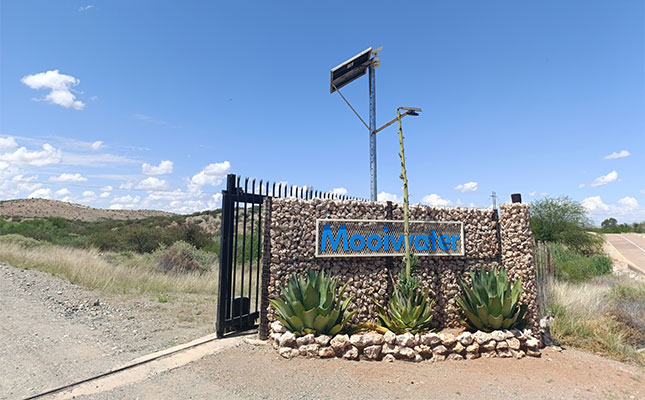
His commitment to understanding the vineyard from the ground up, combined with a willingness to learn and adapt, caught the attention of industry peers, and in 2025 he was named SA Raisins’ Young Farmer of the Year.
Production
One of the main differences between Mooiwater and many other raisin farms in the district is the way in which young vineyards are established and managed. Petri explains that while most vineyards start producing grapes in their third year, the aim at Mooiwater is to have vines bearing fruit from their second year.
In 2025, the farm’s two-year-old Sugra39 vineyards produced 5,3t/ha (dry weight), while Selma Pete achieved 5,5t/ha. Once in full production, Sugra39 should average around 8,5t/ha and Selma Pete about 10t/ha.
Achieving this requires intensive early intervention. According to Petri, it starts with proper soil preparation and infrastructure development. Planting holes, for example, have been enlarged from the standard 300mm x 300mm to 600mm x 600mm. One labourer is allocated per hectare to nurse the young vines for the first two months after planting.
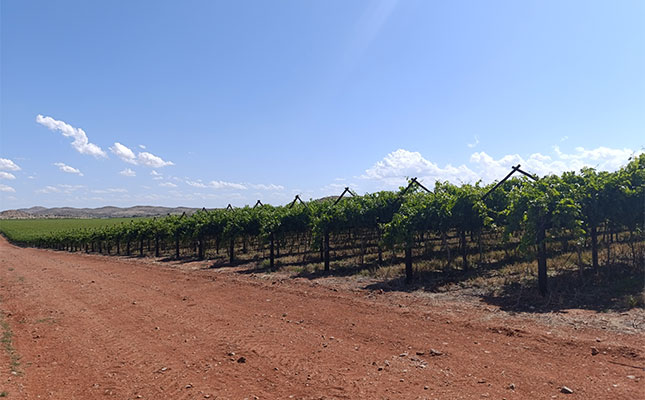
“It is hard, intensive work,” says Petri. “Workers must constantly check that the vines are growing properly, ensure they are not tied too tightly, sucker the vines, and manage weeds by hand. Each vine is trained with two shoots as insurance, primarily against wind damage. We plant up until the end of September, and by the end of January we want the vines on the wire.”
Once the vines are established, labour requirements decline, with one worker able to manage three to four hectares. From this point on, vineyard management follows pre-developed Nexus programmes for fertilisation, foliar sprays and crop protection.
“By front-loading the effort in the early years of production, we can bring vineyards into production sooner without compromising vine health or long-term performance,” adds Petri.
Soil health
While the farm remains cautious about moving into full organic production, soil health and conservation are high priorities.
“We’ve moved away from hard chemicals, many of which are increasingly restricted or banned in the European market, to softer, more environmentally friendly products that help create a favourable habitat for beneficial organisms,” explains Petri. “These organisms can suppress harmful pests and diseases, while also improving soil structure and nutrient availability.”
Rootknot nematodes are a particular challenge in the region’s soils, especially when using Paulsen rootstock. These microscopic pests attack vine roots, forming galls that restrict water and nutrient uptake, weaken vine growth, and reduce yields and vine longevity. While alternative rootstocks could help, Petri says options are limited on their soils to Ramsay, Richter 110, and Paulsen.
Petri notes that they use biological insecticide, such as Bio-insect, which contains spores of naturally occurring fungi (Beauveria bassiana and Metarhizium anisopliae), to help control harmful soil pests, including rootknot nematodes.
Additionally, Eco-T is used to boost soil health, while RootFeed, which supplies essential nutrients for root development, and RhizoVital, which contains the beneficial bacterium Bacillus amyloliquefaciens, are used to encourage stronger root growth and healthier plants.
Cover crops are planted between vineyard rows to keep soils cool, add organic matter, reduce evaporation and break compaction layers. The farm is also experimenting with other cover crop species and mixtures. “The species and mixtures that work best are tested in small plots before being rolled out onto a larger scale,” says Petri.
Harvesting
Selma Pete and Sugra grapes are dried on the vine, a system the farm has used for the past three seasons.
“The first two seasons worked extremely well,” says Petri. “But, 2025 was more challenging. Early-season rain and wind caused some losses and made it difficult to apply crop protection against downy mildew.”
“Despite this, drying on the vine has continued to deliver clear benefits. The grapes achieve good grades, labour requirements are reduced, and overall risk during the drying period is lower than with conventional lane drying.”
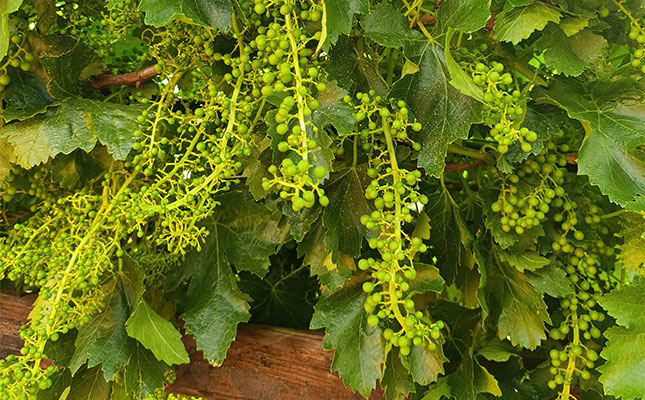
The advantages were particularly evident in 2025, when 275mm of rain fell during the drying period. This severely disrupted harvesting into the drying lanes, because the lanes became congested.
With drying on the vine, grapes are cut just below the wire, a process that takes about half a day for 3ha. Harvesting the dried grapes a few weeks later then takes about a day and a half. By comparison, harvesting the same area before drying would have taken three to four days, highlighting the labour-saving advantage of the system.
Calibre of people
With production systems as intensive as those at Mooiwater, people are central to success. “If you have the wrong people, you know you’re heading for trouble,” warns Petri. “Your team can be your biggest strength or your biggest weakness. That’s why we try to employ the same seasonal workers each year – people who know the job and understand the business.”
The farm has 63,3ha of vineyards under production and employs 21 permanent workers. During the peak harvesting period from January to May, the workforce expands to as many as 90 seasonal workers, mostly from Melkstroom, near Upington in the Northern Cape.
Skills development is focused mainly on three team leaders, who play a critical role in managing workers and transferring skills in the vineyard.
“You cannot manage everything yourself,” Petri says. “You need strong team leaders who understand the work and can guide others.”
Petri describes his management style as strict, but balanced by strong personal relationships. “There is a time for everything. There’s time for chats and laughs, but when we work, we work.”
He also encourages a culture where workers report mistakes early. “If a mistake is picked up immediately, it’s much easier to fix than if it’s only discovered months later, when it has grown into a much bigger problem.”
Positive attitude
Petri relates that his passion for what he does has been a key contributor to his success. “I have grown to love what I am doing, and when you reach that point, your work no longer feels like a job, but a way of life. Of course, there are days that are more challenging than others, but I enjoy the challenge and the excitement that come with it.”
His wife, Anzel, and their children, Ignus (8), Ulrich (5) and Ian (1), inspire him to keep pushing forward and to build a sustainable business for the future.
For more information, email [email protected].
Get trusted farming news from Farmers Weekly in Google Top Stories.
➕ Add Farmers Weekly to Google
✔ Takes 10 seconds · ✔ Remove anytime