At its annual State of the Motor Industry briefing, themed “Driving through disruption”, TSAM president and chief executive Andrew Kirby said South Africa’s market had regained pre-pandemic momentum, but warned that deeper reforms would be required to unlock its full potential.
In 2025, the domestic market recorded 596,818 units, a 15.7 percent increase from the previous year and a return to activity levels last seen before Covid-19. Toyota closed the year with 148,124 units, its strongest performance since 2007, extending its position as market leader for the 46th consecutive year.
“We should be a lot bigger than we currently are, though we are moving in the right direction,” he said, adding that the market could eventually surpass 700,000 units, a level last achieved in 2006.
However, he cautioned that part of the recent expansion was skewed towards lower-priced vehicles. Growth in entry-level passenger car segments, he noted, had “created an artificial growth in volume”, rather than signalling broad-based consumer strength.
“We must adapt and find smarter ways to grow business,” he said.


Export Dependence, Infrastructure Strain, and the EV Policy Gap
A key vulnerability lies beyond South Africa’s borders. In 2025, 81 percent of locally produced vehicles were exported to the United Kingdom and Europe, leaving manufacturers exposed to regulatory changes and shifting demand in those regions.
Exports to Africa have declined from 19 percent to 8 percent, as grey and used imports gain ground across the continent.
Changes to emissions standards in Europe and the UK have introduced additional uncertainty. Without rapid progress on new energy vehicles (NEV) and a policy to support competitive local manufacturing of electric and hybrid models, Kirby warned that export sustainability could be undermined.
“If we say we cannot afford to transition, we are effectively giving up on exports,” he said.
The comments reflect a broader debate about South Africa’s industrial trajectory. Kirby argued that a lack of intentional, forward-looking policy risks premature deindustrialisation, particularly as global production allocations shift towards Asia.
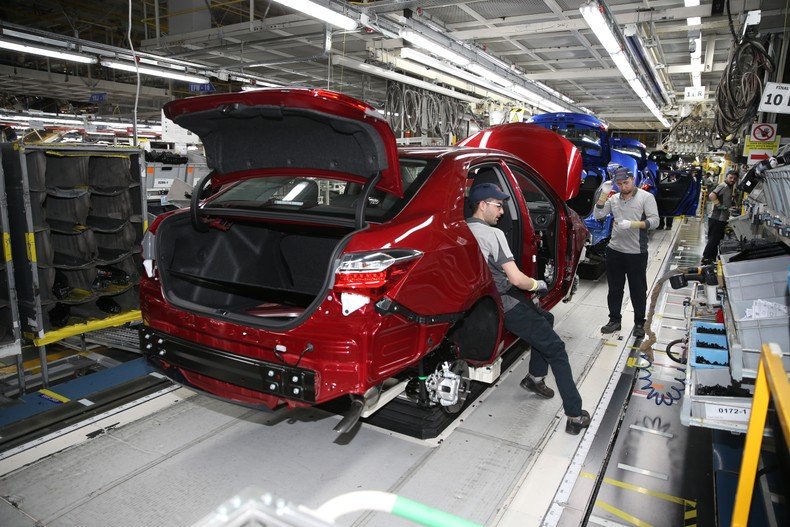
Toyota’s Prospecton plant in KwaZulu-Natal illustrates the strain. High labour costs, steep electricity price increases, logistical bottlenecks, and water security concerns have all added to operating pressures. The company built a dam at the facility to mitigate water shortages, while rail inefficiencies have slowed distribution to major markets.
“We used to transport cars daily from KwaZulu-Natal to Johannesburg. Now we have one train a week, and it takes four days,” Kirby said.
Toyota’s Multi-Pathway Strategy and New Model Offensive
Despite these headwinds, Toyota is doubling down on what it calls a “multi-pathway” strategy, offering a range of powertrains rather than betting exclusively on battery electric vehicles. Globally, more than 40 percent of Toyota’s sales are hybrid models.
Leon Theron, TSAM’s senior vice president of sales and marketing, struck a defiant note on competition.
“We are not scared of our competitors; we welcome them,” he said.
Theron pointed to three pillars supporting Toyota’s position: its alliance with Suzuki, which allows the importation of rebadged models from India to strengthen entry-level offerings; a refusal to engage in price wars; and the continued rollout of diverse powertrain options across segments.
“Toyota is the only manufacturer to compete in every segment,” he said, citing support from Lexus in the luxury category and Hino in the trucking space.
Looking ahead, Toyota unveiled a slate of new models aimed at reinforcing its technological breadth. The company will introduce its first locally produced series-production battery-electric vehicle, the bZ4X, while Lexus launches the RZ electric SUV. Hybrid options will expand across core nameplates, including the RAV4 and the Land Cruiser 300.
The Land Cruiser FJ, a compact ladder-frame model with retro styling, drew particular attention. Positioned as an aspirational entry point into the Land Cruiser family, it is expected to compete in the lifestyle off-road segment.
Kirby hinted that more news would follow in the second half of the year, suggesting that 2026 could prove pivotal not only for Toyota but for the trajectory of South Africa’s automotive industry in a rapidly electrifying and increasingly competitive global market.