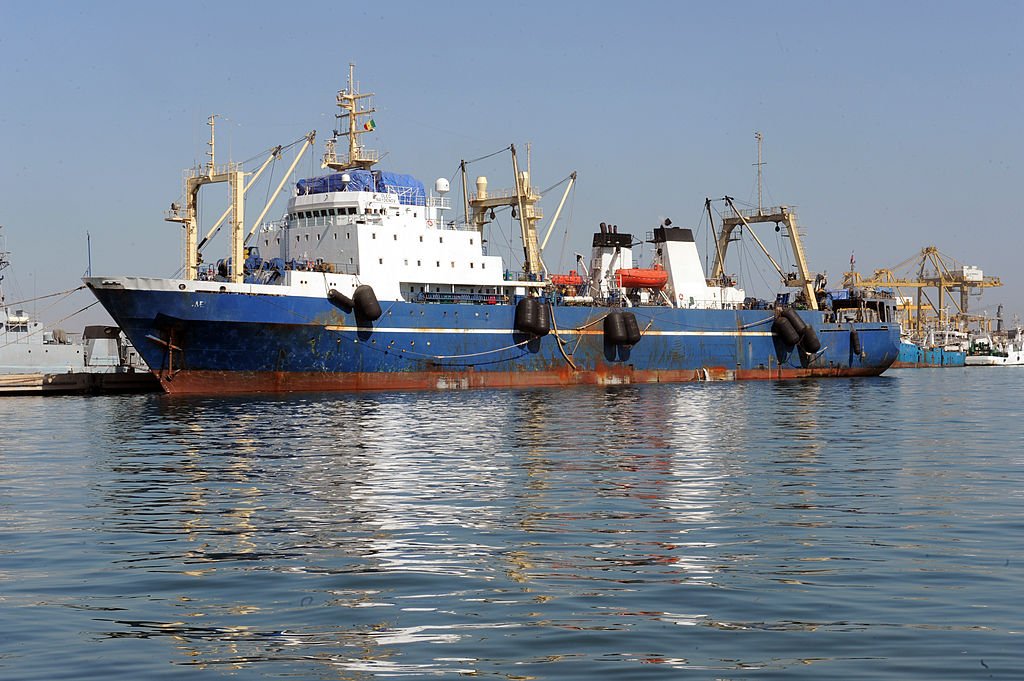
Several ships left a port in Kaliningrad, a Russian enclave between Lithuania and Poland, in August 2024 and sailed off on a mission called “The Great African Expedition.” Launched by Russia’s Federal Agency for Fisheries (Rosrybolovstvo), it was touted as a scientific expedition ordered by Russian President Vladimir Putin to map depleted fish stocks alongside African researchers.
Analysts, however, say the expedition is part of Russia’s broader strategy of influence and resource capture. The Kremlin does not want simply to count fish; it wants to catch them in African exclusive economic zones (EEZs). This is important to Moscow, as it has been heavily sanctioned since it invaded Ukraine in early 2022 and needs money to sustain the war.
According to the IUU Fishing Risk Index, Russia consistently has been ranked one of the world’s worst illegal fishing offenders, typically trailing only China.
“As we’ve seen with gold and other minerals, diamonds, and to some extent oil and gas, Russia sees an opportunity to expand its fishing in African Exclusive Economic Zones,” Joseph Siegle, senior researcher at the University of Maryland at College Park and a specialist on Russian influence in Africa, told Bloomberg magazine. “It is clearly ramping up its interest in Africa.”
Two of the vessels that left Kaliningrad in 2024 sailed to Morocco and Sierra Leone, where officials signed agreements or held discreet negotiations.
In Morocco, Russian scientists observed healthy mackerel and sardine populations, paving the way for exploitation along the entire Atlantic coast, Bloomberg reported. In December 2025, Russia renewed its fishing agreement with Morocco for four years. Morocco loses about $500 million annually to IUU fishing.
Under the previous four-year agreement, Russia was allowed to have 10 of its trawlers access Morocco’s waters to fish 140,000 metric tons of small pelagic species, such as sardines, mackerel and anchovies, Seafood Source magazine reported. In exchange, Russia paid Morocco $7 million annually, and the owners of each trawler paid 17.5% of the total value of their catch to Moroccan authorities. Annual quotas of the new deal have not been publicized.
In Sierra Leone, which loses about $50 million annually to illegal fishing, Russia obtained access to 40,000 metric tons of fish per year and plans to deploy up to 20 vessels, while investing in ports and local infrastructure — a tactic similar to China’s. According to russiaspivottoasia.com, Sierra Leone also is interested in cooperating with Russia to modernize its fishing fleet, attract Russian investments to create onshore refrigeration facilities, produce fishing gear and develop aquaculture activities, among other things.
Analysts say Russia’s interest in African fish likely will further threaten the continent’s marine resources. According to the Food and Agriculture Organization of the United Nations, more than half the stocks from the Strait of Gibraltar to the mouth of the Democratic Republic of the Congo’s Congo River are biologically unsustainable, and Russian trawlers will operate in areas lacking adequate surveillance.
“The Russian fleet has never been particularly disciplined anywhere it operates,” Steve Trent, chief executive officer of the Environmental Justice Foundation, told Bloomberg. “It tends to work in the shadows, with very little reporting on its activities.”
Besides Morocco and Sierra Leone, Russian trawlers operate in Angola, Guinea, Guinea-Bissau, Mauritania, Namibia, Nigeria and Senegal. Beyond Africa, the Kremlin’s fleet is known to operate illegally in Alaska, Antarctica, the Arctic Ocean, Japan and South Korea.
Like Chinese vessels, Russian trawlers are known to launder their illegal catch, commit illegal transshipments of fish at sea, turn off their automated identification systems while fishing, overfish threatened species and fly “flags of convenience,” which places foreign-owned and -operated fishing vessels onto local registries.
The Kremlin’s interest in African fish coincides with the suspension of Russian fishing efforts in the Black Sea and Azov Sea due to restrictions on Moscow’s aging distant-water fishing (DWF) fleet, which it seeks to modernize. According to the Intelligence Service of Ukraine, Russia has 820 to 830 DWF vessels, 65% of which are more than 30 years old and 13% of which are older than 40. By 2030, 533 vessels in the fleet will be more than 40 years old.
“The vast majority of the current fishing fleet, even with major modernization, will not be able to operate fully,” the service said in a September 2025 news release.