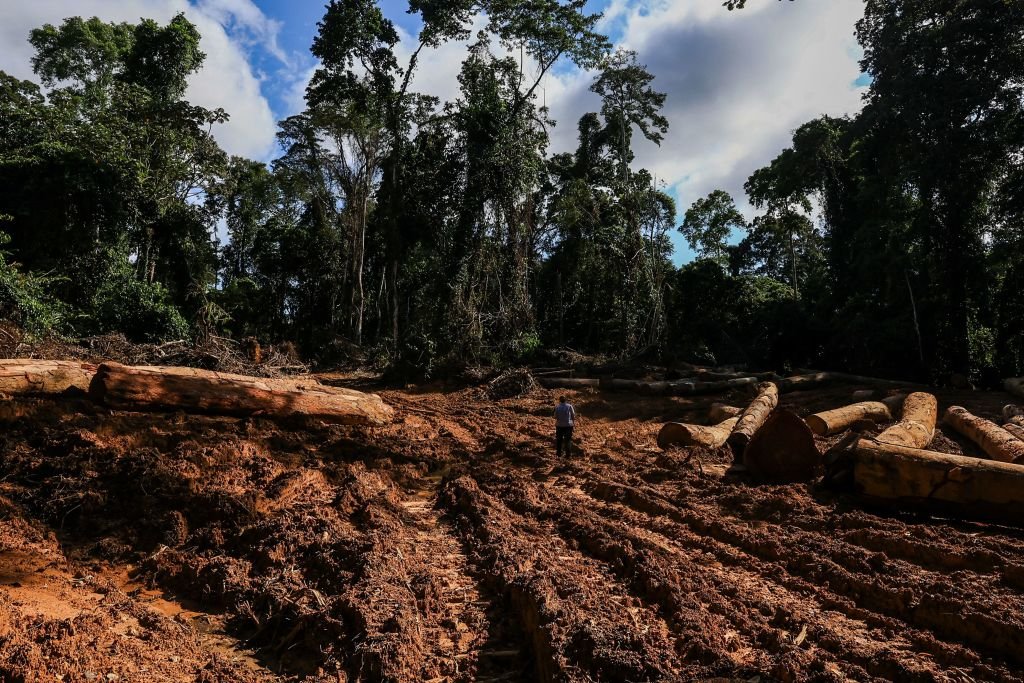
Forests cover nearly half of Cameroon, but they are being rapidly degraded by illegal logging operations that feed China’s appetite for tropical lumber.
Cameroon has granted companies from around the world nearly 100 timber concessions to cut and ship logs legally. However, international observers say that many more logging operations occur unofficially, resulting in a loss of millions of dollars in resources and revenue each year.
Cameroonian legislation adopted in 1994 regulates logging through quotas and requires companies to reforest logged areas. Illegal logging is undercutting all of that, according to analysts.
“While observers focus their attention on legal logging, which is the real driving force behind the forestry industry, illegal logging, which is often better organized, undermines national efforts,” researchers Jean Sovon and Vivian Wu recently wrote for Global Voices
Corruption fuels the harvest and export of illegal logs, known locally as warap. In many cases, the illegal exports are made up of logs cut indiscriminately without concern for their age, size or species. The logs are then shipped to markets in China and Vietnam, which receive 70% of Cameroon’s timber exports, according to the government’s Forest Revenue Securing Program.
“Despite numerous efforts by national authorities to control the flow of timber, strong demand from Asian countries, led by China, has opened the door to unorthodox practices,” Sovon and Wu wrote.
Research by Global Forest Watch shows that deforestation in Cameroon rose sharply between 2013 and 2014 and has remained high ever since, averaging about 171,000 hectares a year compared to an average of 41,000 a year the decade before.
A 2023 investigation by Le Monde newspaper and InfoCongo revealed that illegal logging in Cameroon is accelerating. Officials records from each end of the Cameroon-to-China pipeline tell the story.
According to the United Nations Comtrade database, between 2011 and 2014 Cameroon and China consistently reported about a $100 million difference between the value of wood products exported from Cameroon and imported by China. The gap represents the value of smuggled logs.
That gap grew by 50% in 2015, even as Cameroon’s side of the equation remained fairly steady at about $150 million in exports. By 2018, the most recent year for which data is available, the gap had widened by nearly 75%.
In total, the gap between exports and imports represented nearly $900 million in smuggled timber between Cameroon and China.
Le Monde and InfoCongo interviewed a logging truck driver identified as Derek who has been carrying illegal timber from forests to ports for years. Despite the lack of proper markings, the logs pass easily through government checkpoints, Derek told the researchers.
“Every inspector knows you’re coming,” he said.
In 2022, Cameroon launched the second generation of the Forest Information Management System (SIGIF2) designed to block illegal logging and exports. So far, however, the system has lacked the support from other governments to make it effective.
Further complicating matters, porous borders make it difficult for Cameroon to prevent illegal logging and trafficking by groups outside the country.
Cameroon increased its export tax on logs in recent years in hopes of processing logs into lumber and other items for export. Along with its neighbors in the Economic and Monetary Community of Central Africa (CEMAC), Cameroon plans to suspend overseas timber exports starting in 2028.
Loopholes in the planned ban still could allow logging companies to export by modifying their logs slightly — shaving them from round into square profiles, for example, according to the Center for Action for Development (CAD). Others could get special permits to export, undermining the ban.
In the meantime, logging trucks continue to carry Cameroon’s forests piece by piece to the coast for export to China.
“Logging is like drugs,” Guillaume, a long-time illegal logger, told Le Monde and InfoCongo. “At all times you want to keep consuming.”