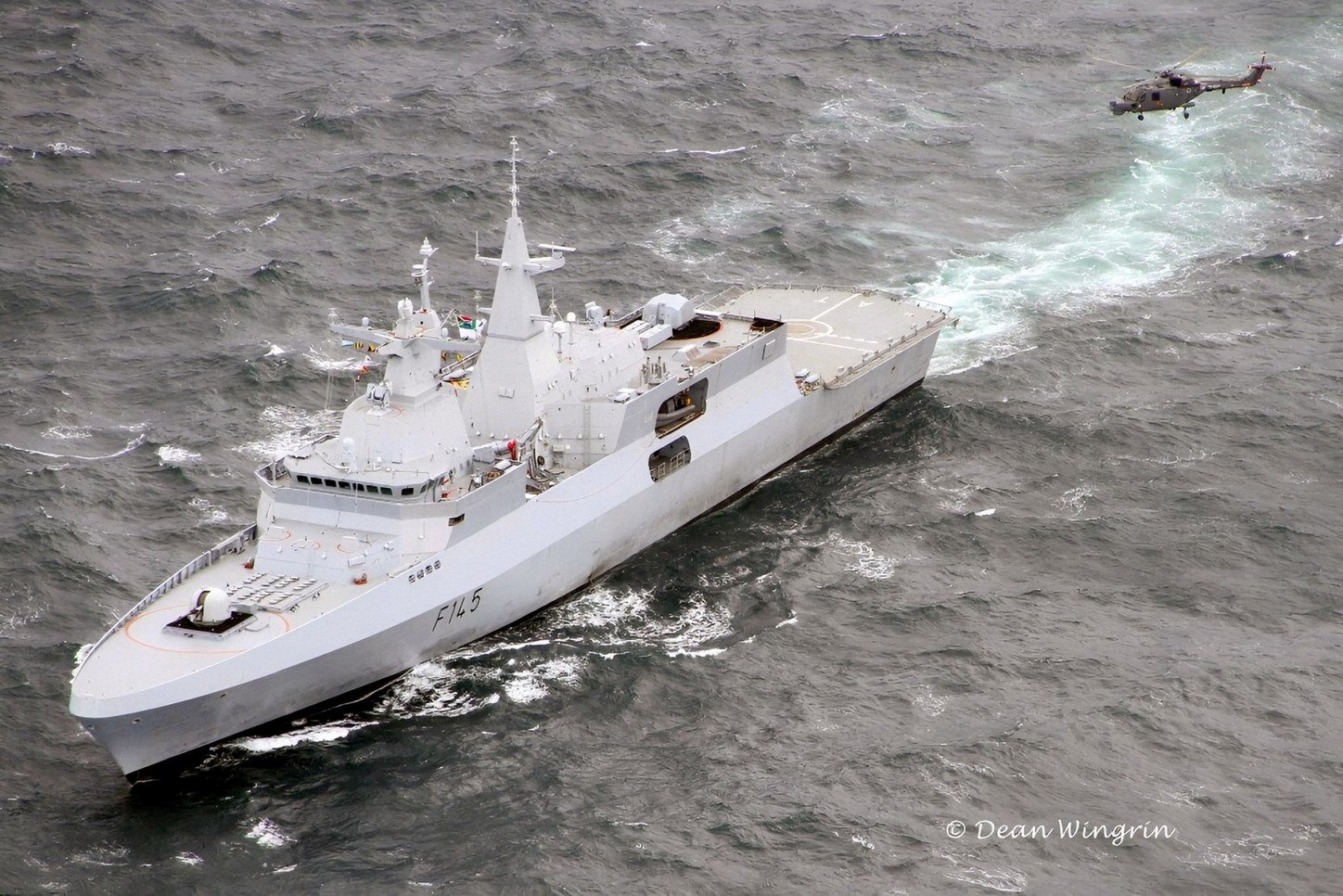
The South African Navy classifies SAS Amatola as an FSG: Frigate, Small, Guided. In practical naval terms, this places her firmly in the light frigate category: larger than a corvette but smaller than medium or heavy frigates.
She was designed as a blue-water, multi-role warship, capable of operating far from home, handling rough seas, and conducting anti-surface, limited anti-air, and anti-submarine operations as part of a task group.
Amatola entered service in 2006. She has not yet received a mid-life upgrade, meaning her sensors, combat management system, and weapons largely reflect their mid-2000s configuration. This context matters when comparing her to more modern ships. Typical naval mid-life upgrades are expected approximately 12–15 years after commissioning, as sensors, combat management systems, and electronic warfare suites age far more rapidly than hulls and propulsion systems, making the absence of such an upgrade technically significant rather than cosmetic.
As a MEKO A-200 design, Amatola was constructed with reserved electrical power generation, cooling capacity, and internal volume to accommodate future combat system, radar, and missile upgrades without structural modification, reinforcing the ship’s inherent growth margins and supporting the argument that she is under-realised rather than obsolete.
Refits, Maintenance History, and Budget Reality
Understanding SAS Amatola’s maintenance history is essential to understanding her current configuration, operational tempo, and the challenges she has faced over time.
2011 – Major Engine Repair
One of Amatola’s main diesel engines suffered severe damage due to water ingress through a faulty exhaust valve. The engine required replacement at a cost of roughly R16 million. While this was not a full refit, it was a significant propulsion repair that affected availability and required careful prioritisation within an already constrained maintenance budget.
2014–2015 – Primary Major Refit
This remains the only full major refit in Amatola’s operational history to date. The work, carried out by Southern African Shipyards (now Sandock Austral Shipyards) included dry-docking, propulsion and engine systems, hull and machinery maintenance, and restoration of onboard technical systems. The contract value was approximately R335 million, with propulsion work forming a substantial portion of the cost. The ship returned to operational service in mid-2015.
2018–2022 – Planned Follow-up Work Delayed
A subsequent refit cycle, normally expected 12–15 years after commissioning, did not occur as planned due to severe budget constraints within the South African Navy. Scheduled maintenance, upgrades, and system work were repeatedly postponed as funding was diverted to higher-priority or safety-critical needs across the fleet. These delays contributed directly to reduced availability and a growing maintenance backlog.
2023 – Docking and Essential Repairs
Amatola entered docking for essential inspections and repairs once critical spare parts became available. This period focused on restoring baseline functionality and safety rather than delivering a full capability upgrade. It was a necessary intervention to stabilise the ship after extended delays in scheduled maintenance.

2024 – Crew-led Restoration
After prolonged periods of inactivity driven by maintenance constraints, extensive onboard work carried out largely by Amatola’s own crew restored operational readiness. This effort enabled the ship to return to patrols and participate in multinational exercises, demonstrating both technical resilience and professional skill under difficult conditions.
2025 – Assisted Maintenance Period
Following extended deployments, additional focused maintenance was conducted on machinery and selected systems to sustain operational capability and prevent further degradation while longer-term refit planning remains constrained by funding realities.
Budget Constraints Affecting the Valour-class
The challenges faced by Amatola are not unique. They reflect a broader, long-term funding reality affecting the entire Valour-class and the South African Navy as a whole.
* In some recent financial years, only around half of the required naval maintenance funding has been available.
* A full frigate refit is estimated at approximately R650–700 million, depending on scope and year.
* Combined frigate and submarine refit backlogs are estimated in the multi-billion-rand range.
* Limited funding means that only one major vessel can realistically undergo significant maintenance or refit work at any given time.
* Without a substantial increase in defence funding, comprehensive mid-life upgrades for the Valour-class are unlikely before the early to mid-2030s.
The Budget Reality Behind the Maintenance Challenges
Between 2006 and 2026, the South African Navy’s total annual budget has generally ranged between R2.5 billion and R5 billion in nominal terms, with the current allocation sitting just under R5 billion per year. In real (inflation-adjusted) terms, this represents a significant decline in purchasing power since the late 2000s.
This level of funding is sufficient to keep the Navy functioning at a basic level, but not enough to sustain regular refits, a high operational tempo, and timely upgrades across the fleet.
Defence planners and naval analysts have consistently indicated that a budget of approximately R8–10 billion per year would be required to keep the Navy operating at a satisfactory and sustainable level. The gap between this requirement and actual funding has had predictable consequences:
* Refits delayed beyond optimal maintenance windows
* Maintenance prioritised on a crisis-driven, rotational basis
* Ships spending extended periods alongside awaiting funds or spares
* Crews increasingly relied upon to recover and sustain capability internally
* Fluctuating operational availability despite the fleet’s underlying technical potential
In this context, Amatola’s long intervals between major refits, reliance on essential-only dockings, and periods of reduced availability are systemic outcomes of constrained funding rather than indicators of poor design, neglect, or platform obsolescence.
Operational Context and Realism
While Amatola’s design includes substantial capability, operational reality is more constrained. The South African Navy conducts relatively few large, high-intensity multi-ship exercises, meaning the full integration of sensors, weapons, and aviation assets is not routinely tested under demanding combat conditions. South African naval doctrine prioritises maritime presence, constabulary enforcement, and regional security missions, which directly shapes how capability is trained for, employed, and perceived.

Photo: US Navy
Some systems, particularly electronic warfare and sonar, reflect their original mid-2000s configuration when compared with newer light frigates. This highlights how rapidly naval technology evolves.
An important point is often overlooked. The Valour-class frigates were designed with advanced signature management across infrared, radar, and acoustic domains, including exhaust cooling and waterline exhaust discharge, mast and superstructure shaping to reduce radar cross-section, and extensive machinery raft mounting for acoustic isolation. At the time of their design, this level of signature control exceeded that of most other light frigates and significantly enhanced survivability despite ageing subsystems.
This does not make Amatola ineffective. Rather, her day-to-day performance reflects limitations in sea time, personnel, and exercise complexity. Structurally and mechanically, she retains latent capability, and all systems remain fully integrated. With sufficient training, funding, and support, she can employ her full combat suite as intended.
Where Amatola Fits Globally
Amatola aligns naturally with light frigates such as the French La Fayette class, SIGMA designs, Brazil’s Barroso, Israel’s Sa’ar 5, Turkey’s Ada class, and earlier-generation ANZAC-class frigates.
Newer or modernised designs, including upgraded ANZACs, Gowind 3100, Istanbul class, MEKO A-200EN, Type 23 frigates, and Sa’ar 6, derive their advantages primarily from modern sensors, combat systems, and missiles rather than fundamentally different hulls or operating concepts.

Photo: Ricardo Teixeira
Despite her age and modest operational tempo, Amatola offers long range, endurance, excellent seakeeping, strong aviation facilities, credible anti-ship firepower, and built-in growth margins. Judged on structural design, inherent capability, and blue-water utility rather than current upgrade state or headline missile counts, she sits comfortably in the upper tier of light frigates worldwide.
Operational Deployment
Since entering service in 2006 and 2007, the Valour-class frigates have represented the South African Navy’s most capable and strategically significant surface combatants. While a naval conflict with another state actor in the region is considered highly unlikely, the frigate fleet continues to provide a credible deterrent and safeguard national interests.
Operationally, the Valour-class frigates have been tasked primarily with maritime security roles, including anti-smuggling patrols, participation in African Union peace support operations, and counter-piracy missions conducted alongside international partners. The frigates have also been extensively employed in multinational naval exercises and diplomatic port visits with the United States Navy, German Navy, French Navy, and Royal Navy. In addition to these core tasks, the class has a secondary role in fisheries protection when providing support to the Department of Forestry, Fisheries and the Environment (DFFE).
In 2007, SAS Amatola became the first South African frigate in decades to undergo the Royal Navy’s Basic Operational Sea Training programme, conducted without embarked helicopters due to delivery delays.
During the 2010 FIFA World Cup, all four frigates were deployed in support of maritime and air defence security, with guardships stationed off Cape Town, Port Elizabeth, and Durban.

Photo: SANDF
From 2011 onward, sustained deployment to the Mozambique Channel under Operation Copper became a central commitment. Rotational frigate deployments with embarked marines contributed to a marked reduction in piracy incidents.
In early 2017, Amatola deployed to the United Kingdom for training and commemorative events, including participation in the SS Mendi centenary.
In the 2024/25 financial year, SAS Amatola was awarded the title of Best Sailing Ship by the Chief of the Navy after deploying for 134 days and sailing nearly 40,000 km in South African territorial waters, underscoring sustained operational output despite prolonged resource constraints.

Photo: SANDF
In late January 2026, SAS Amatola departed on South Africa’s first foreign naval deployment since 2017, en route to India to take part in the International Fleet Review and the multinational MILAN naval exercise.
Even in her current configuration, she remains a credible, balanced blue-water light frigate. With a mid-life upgrade and fuller utilisation of her inherent capabilities, she would stand confidently among the most capable ships of her generation.
Main Characteristics
Displacement: 3,700 tons
Length: 107.3 m at waterline, 121 m overall
Beam: 16.34 m
Draught: 5.95 m
Propulsion (CODAG WARP): • 2 × MTU 16V 1163 TB93 diesel engines, 5,920 kW each, driving two shafts for cruising • 1 × General Electric LM2500 gas turbine, 20,000 kW • 1 × waterjet
Speed: 28 knots
Range: 8,000 nmi at 16 knots
Endurance: 28 days
Complement: Core crew of approximately 120, rising to around 150 when aircrew, marines, and mission personnel are embarked
Sensors and Processing Systems
* Thales MRR-3D NG G-band multi-role surveillance radar
- 2 × Reutech RTS 6400 monopulse X-band combined radar and optronics trackers
- Reutech electro-optical tracker
- Tellumat Integrated Naval Identification Friend or Foe system
- M-Tek target designation sights
- Thales UMS4132 Kingklip hull-mounted sonar
- MDS 3060 obstacle-avoidance sonar
Electronic Warfare and Decoys
* Saab Grintek Avitronics SME-100/200 ESM and ECM suite, including intercept, jammer, and ELINT
* 2 × Saab Grintek Avitronics MRL Super Barricade chaff launchers, carrying 96 decoys
Armament:
Anti-ship
* 8 × MBDA MM40 Exocet Block 2 surface-to-surface missiles, mounted in two four-cell launchers, with a maximum range of 72 km, a maximum speed of Mach 0.93, sea-skimming capability, pre-programmed manoeuvres, an active radar seeker, and a high-explosive fragmentation warhead.
Air defence
* The ship is equipped to carry 16 × Denel Dynamics Umkhonto-IR Block II surface-to-air missiles installed within a 32-cell vertical launching system, of which only 16 cells are currently fitted with the required launch and control equipment. During peacetime, fewer than 16 cells are typically armed. Each missile has an effective range of approximately 15 km, a ceiling of around 8 km, and a maximum speed in excess of Mach 2. The remaining 16 cells are structurally available and reserved for future expansion; with the installation of the necessary equipment, the ship’s missile capacity can be increased to a full 32-missile loadout. The Umkhonto system can engage multiple targets simultaneously and is designed for all-weather operation with resistance to countermeasures.
Guns
* 1 × OTO-Melara 76 mm naval gun, with an effective surface engagement range of approximately 8 km using standard HE ammunition, a maximum ballistic range of about 18.4 km, and a rate of fire of up to 120 rounds per minute. Against air targets, the effective engagement range is approximately 4 km

* 1 × Denel 35 mm Dual Purpose Gun (DPG), a twin-barrel, automatic close-in weapon system (CIWS) designed primarily for point defence against aircraft and incoming missiles, with a secondary role against surface and shore targets. It has an effective range of approximately 4 km against air targets and a maximum surface engagement range of around 6 km. High-speed missiles can be intercepted at close range, making it an effective last-line defence system. The system carries 500 ready rounds, allowing for over 12 short defensive engagements, and can be reloaded by two personnel in about 10 minutes using onboard ammunition lockers. The combined rate of fire is approximately 1,100 rounds per minute
* 2 × Oerlikon Mk1 20 mm cannons, with a maximum engagement range of approximately 6 km, an effective range of around 2 km, and a sustained rate of fire of 1,000 rounds per minute
* 2 × 12.7 mm Reutech Sea Rogue remotely operated machine guns, with a rate of fire exceeding 1,000 rounds per minute, an effective range of approximately 1.8 km, and a maximum firing distance of about 7.4 km
ASW
* 4 × 324 mm torpedo tubes, fitted for but not with torpedoes This limitation reflects procurement and stockpile constraints rather than a design shortcoming, as the ship’s anti-submarine warfare concept relies primarily on the embarked Super Lynx helicopter equipped with dipping sonar and lightweight torpedoes.
Armour
* Welded GL-D36 steel hull
Aviation:
Aircraft capable of operating: • 2 × Super Lynx 300 • 1 × Atlas/Denel Oryx • Provision for future UAV operations

Photo: Ricardo Teixeira
Facilities: • Flight deck • Enclosed hangar
In practice, Amatola currently operates with one Super Lynx, but her design capacity is significantly greater than that of many ships in her class. The generous aviation facilities provide strong latent capability for anti-submarine warfare, surface surveillance, maritime security, and search-and-rescue operations.
Ryno Joubert is a South African writer, historian, and full-time primary school teacher with a strong interest in South Africa’s military heritage, natural heritage and the South African National Defence Force. He conducts in-depth historical research and is currently assisting with research for a comprehensive book on South African Air Force C-47 Dakota aircraft. Ryno is also writing a comprehensive book on the Knysna elephants.