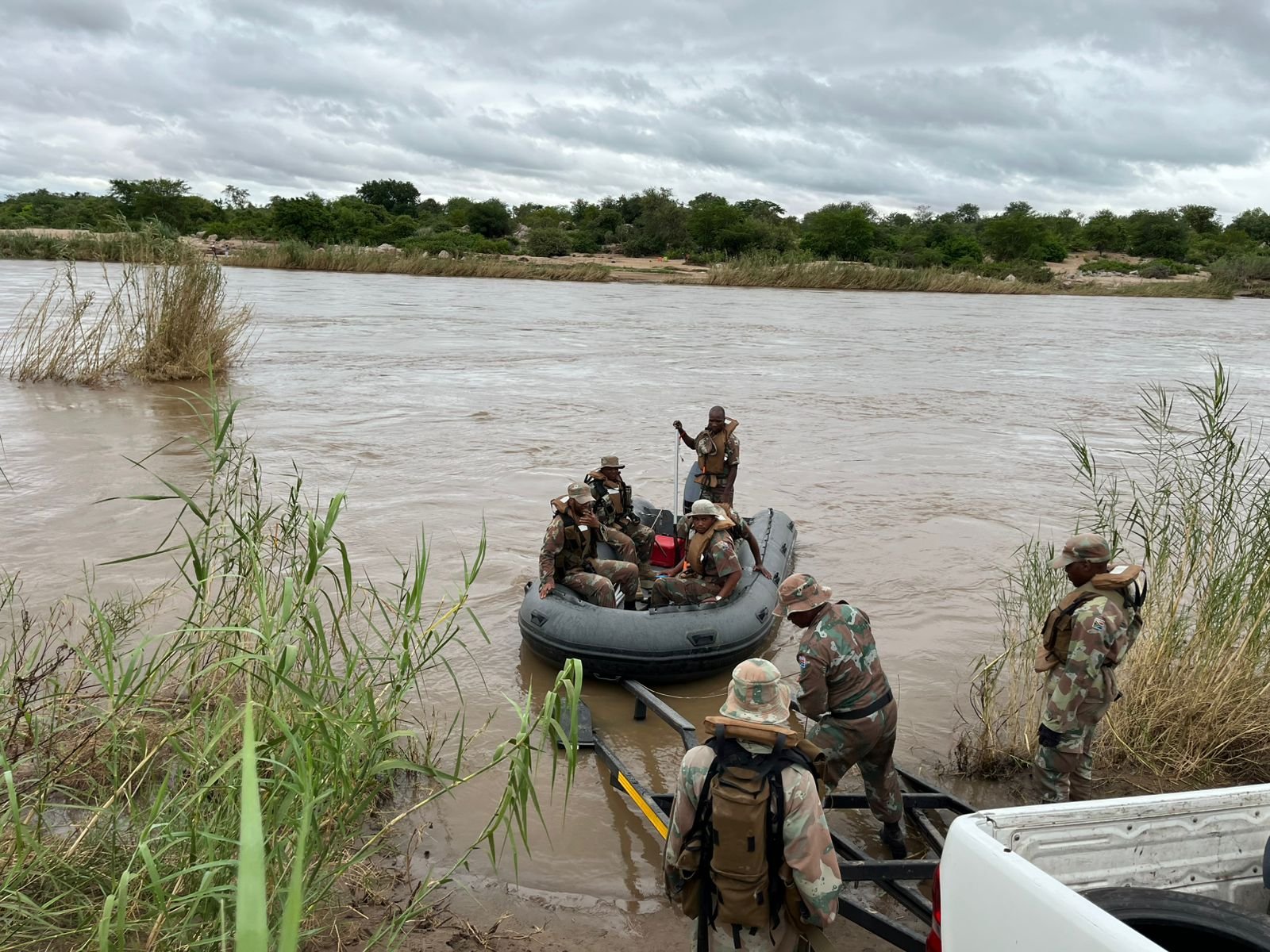

The South African National Defence Force’s (SANDF’s) national border protection tasking can now put an aquatic resource into play when confronting illegal immigrants and contraband smugglers using the Limpopo River as a point of entry to South Africa from Zimbabwe.
Additionally the specialised infantry capability of the SA Army, in the form of its equine soldiers, is patrolling sections of the mountainous Free State/Lesotho border, further boosting Operation Corona effectiveness.
The employment of rigid inflatable boats (RIBs), better known as “rubber ducks”, was brought to this publication’s attention by the SA National Defence Force (SANDF) Directorate Corporate Communication (DCC), responding to an inquiry from another media outlet.
DefenceWeb is happy to share what DCC has as “riverine patrols” with readers and the most likely Zimbabwean media outlet.
“The deployment of rubber boats along the Limpopo River,” the DCC response reads, “is informed by an operational assessment conducted under Op Corona, the SANDF border safeguarding operation mandated in terms of Chapter 3 of the Defence Act, Act 42 of 2002”.
It continues, noting: “The Limpopo River constitutes a high risk, porous border environment, characterised by difficult terrain, limited fixed infrastructure and seasonal fluctuations in water levels that are routinely exploited by cross-border criminal networks”.
“Intelligence assessments consistently indicate that the riverine environment is used for illegal cross-border movement of persons, smuggling of goods, stolen vehicles and contraband, particularly during peak periods such as the festive season.
“To address this a combat engineer capability, specialising in riverine operations, was deployed to reinforce existing land-based patrols. This introduction intends to enhance mobility, visibility and deterrence in areas that are inaccessible to conventional patrol vehicles and foot patrols.
“This deployment ensures a layered border security posture, integrating land, riverine and intelligence-driven operations to deny criminal elements freedom of movement across the riverine border. The effectiveness of the rubber boat deployment is measured through quantifiable operational outputs, which includes reduced activity in identified hotspots.”
Meanwhile, the mounted soldiers of the Potchefstroom-based SA Army Specialised Infantry Capability (SAASIC) are, according to Free State Provincial Joint Operations Tactical Headquarters corporate communicator staffer Private N Julindlombe, keeping their area of responsibility safe and supporting national security.
This is executed on horseback in terrain where steep hills, rivers, thick vegetation dominate. “Our horses make a difference allowing us to patrol longer distances quietly, reach areas that are hard to get to on foot and move smoothly through difficult terrain. Being on horseback also gives us a higher vantage point so we can see further, detect anything unusual early and stay aware of what’s happening around us.”
Horseback patrol is not just about moving through the mountains – it’s about teamwork, focus and learning every day, Julindlombe writes. “We work closely with foot patrols, vehicle patrols and other law enforcement agencies, making sure that all parts of the border are covered and that communities feel safe.”
Soldiers continue to have a busy time on border patrol duties. For example, Joint Operations reported that soldiers in Limpopo recovered more than R1 million worth of illicit goods and livestock in two separate incidents. Members of 1 South African Tank Regiment stopped a truck loaded with livestock (goats and sheep) valued at R103 200, which did not have the necessary documents for proof of ownership. The Director of Animal Health from Pontdrift Point of Entry was called in and he authorised the detention of both animals, trailer (valued at R50 000) and vehicle (valued at R450 000) for contravention of the Animal Disease Act.
On 30 January, whilst busy with foot patrols around Beitbridge Point of Entry, soldiers stopped a Mahindra valued at around R200 000, after which the driver and passenger fled on foot. It was found to be ferrying cannabis valued at R249 342 and alcohol valued at R44 580. The South African Police Service was called in and the Mahindra was forfeited to the State, Captain Moses Semono reported.