

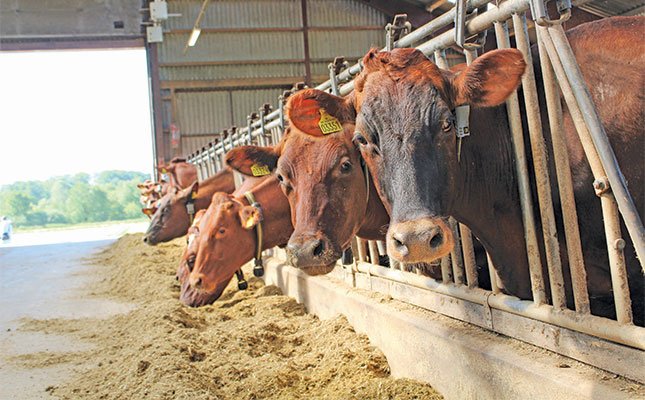
Data from the Animal Feed Manufacturers Association (AFMA), the recognised representative body of South Africa’s formal animal feed industry, show that the industry entered a clear recovery phase in 2025 after contracting in 2024.


– ADVERTISEMENT –
AFMA’s recently published Animal Feed Report October 2025 details month-on-month (October versus September 2025) and year-on-year (October 2025 versus October 2024) feed product performance. (Note: the publication of AFMA’s feed production data is subject to a three-month delay in compliance with Competition Commission requirements.)
According to the report, total feed production showed steady month-on-month (m/m) and year-on-year (y/y) growth. Output rose from 617 493t in October 2024 to 632 068t in October 2025, a y/y increase of 2,7%. Month-on-month, production grew from 626 471t in September 2025 to 632 068t in October 2025, a 0,9% rise.
Dr Lucius Phaleng, trade adviser at AFMA, said the m/m and y/y growth in feed production highlights the industry’s recovery.
“The total feed production from January to October over the past three years indicates modest fluctuations in the industry, reflecting market demand and production capacity. In 2023, the cumulative production reached 5,88 million tons, while in 2024 it decreased slightly to 5,72 million tons, representing a decline of approximately 2,7% compared with the previous year.
“However, production rebounded in 2025, reaching 5,95 million tons, which corresponds to a 4,1% increase from the 2024 production levels, and a 1,8% increase compared with 2023,” he told Farmer’s Weekly.
The report shows that cumulative beef and sheep feed production fell from 712 423t in 2023 to 703 248t in 2024, before dropping further to 631 289t in 2025.
“The decreasing trend is also evident in recent monthly data. Year-on-year production declined in October 2025, from 80 142t to 67 010t, and was also lower than in September 2025,” Phaleng added.
He said these declines are not isolated and instead reflect a broader pattern linked to foot-and-mouth disease (FMD) disruptions.
“Between 2020 and 2025, beef and sheep feed production generally followed normal seasonal trends, except during FMD outbreaks. Declines observed in 2022, 2023, and particularly 2025 align with FMD-related restrictions, which disrupted cattle movement, feedlot placements, and auction activity.”
Phaleng emphasised that FMD is not only an animal health issue but a material economic shock to the feed industry and broader livestock value chain, resulting in underutilised manufacturing capacity, reduced raw material offtake, and increased demand volatility.
Get trusted farming news from Farmers Weekly in Google Top Stories.
➕ Add Farmers Weekly to Google
✔ Takes 10 seconds · ✔ Remove anytime


