

If it feels these days as if everything in technology is about AI, that’s because it is. And nowhere is that more true than in the market for computer memory. Demand, and profitability, for the type of DRAM used to feed GPUs and other accelerators in AI data centers is so huge that it’s diverting away supply of memory for other uses and causing prices to skyrocket. According to Counterpoint Research, DRAM prices have risen 80-90 precent so far this quarter.
The largest AI hardware companies say they have secured their chips out as far as 2028, but that leaves everybody else—makers of PCs, consumer gizmos, and everything else that needs to temporarily store a billion bits—scrambling to deal with scarce supply and inflated prices.


How did the electronics industry get into this mess, and more importantly, how will it get out? IEEE Spectrum asked economists and memory experts to explain. They say today’s situation is the result of a collision between the DRAM industry’s historic boom and bust cycle and an AI hardware infrastructure build-out that’s without precedent in its scale. And, barring some major collapse in the AI sector, it will take years for new capacity and new technology to bring supply in line with demand. Prices might stay high even then.
To understand both ends of the tale, you need to know the main culprit in the supply and demand swing, high-bandwidth memory, or HBM.
What is HBM?
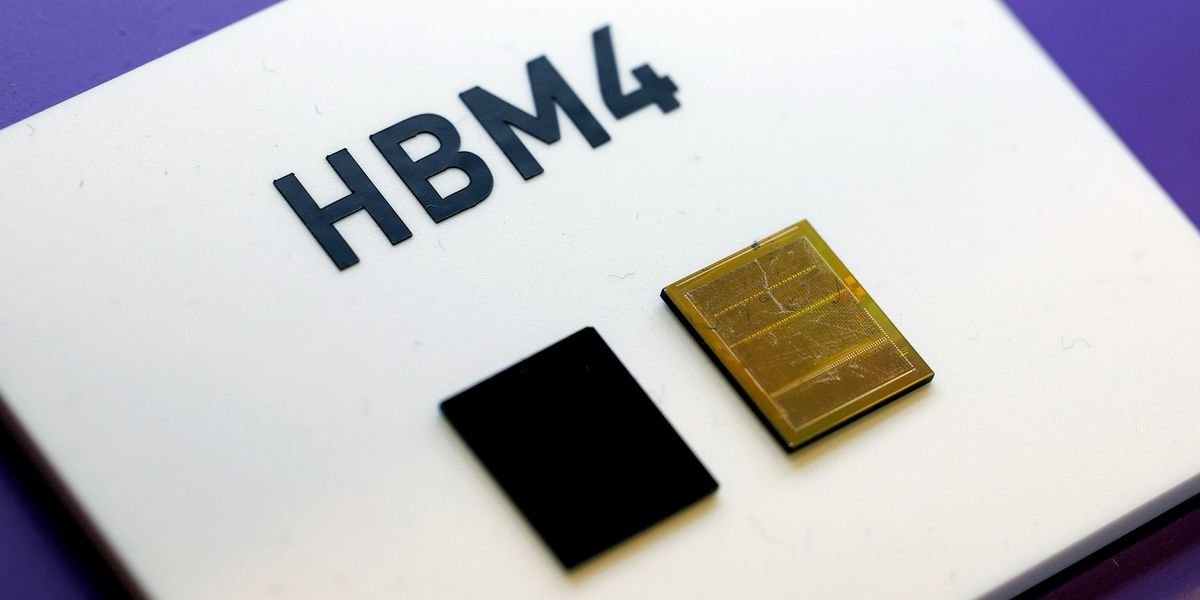
HBM is the DRAM industry’s attempt to short-circuit the slowing pace of Moore’s Law by using 3D chip packaging technology. Each HBM chip is made up of as many as 12 thinned-down DRAM chips called dies. Each die contains a number of vertical connections called through silicon vias (TSVs). The dies are piled atop each other and connected by arrays of microscopic solder balls aligned to the TSVs. This DRAM tower—well, at about 750 micrometers thick, it’s more of a brutalist office-block than a tower—is then stacked atop what’s called the base die, which shuttles bits between the memory dies and the processor.
This complex piece of technology is then set within a millimeter of a GPU or other AI accelerator, to which it is linked by as many as 2,048 micrometer-scale connections. HBMs are attached on two sides of the processor, and the GPU and memory are packaged together as a single unit.
The idea behind such a tight, highly-connected squeeze with the GPU is to knock down what’s called the memory wall. That’s the barrier in energy and time of bringing the terabytes per second of data needed to run large language models into the GPU. Memory bandwidth is a key limiter to how fast LLMs can run.
As a technology, HBM has been around for more than 10 years, and DRAM makers have been busy boosting its capability.
As the size of AI models has grown, so has HBM’s importance to the GPU. But that’s come at a cost. SemiAnalysis estimates that HBM generally costs three times as much as other types of memory and constitutes 50 percent or more of the cost of the packaged GPU.
Origins of the memory chip shortage
Memory and storage industry watchers agree that DRAM is a highly cyclical industry with huge booms and devastating busts. With new fabs costing US $15 billion or more, firms are extremely reluctant to expand and may only have the cash to do so during boom times, explains Thomas Coughlin, a storage and memory expert and president of Coughlin Associates. But building such a fab and getting it up and running can take 18 months or more, practically ensuring that new capacity arrives well past the initial surge in demand, flooding the market and depressing prices.
The origins of today’s cycle, says Coughlin, go all the way back to the chip supply panic surrounding the COVID-19 pandemic . To avoid supply-chain stumbles and support the rapid shift to remote work, hyperscalers—data center giants like Amazon, Google, and Microsoft—bought up huge inventories of memory and storage, boosting prices, he notes.
But then supply became more regular and data center expansion fell off in 2022, causing memory and storage prices to plummet. This recession continued into 2023, and even resulted in big memory and storage companies such as Samsung cutting production by 50 percent to try and keep prices from going below the costs of manufacturing, says Coughlin. It was a rare and fairly desperate move, because companies typically have to run plants at full capacity just to earn back their value.
After a recovery began in late 2023, “all the memory and storage companies were very wary of increasing their production capacity again,” says Coughlin. “Thus there was little or no investment in new production capacity in 2024 and through most of 2025.”
The AI data center boom
That lack of new investment is colliding headlong with a huge boost in demand from new data centers. Globally, there are nearly 2,000 new data centers either planned or under construction right now, according to Data Center Map. If they’re all built, it would represent a 20 percent jump in the global supply, which stands at around 9,000 facilities now.
If the current build-out continues at pace, McKinsey predicts companies will spend $7 trillion by 2030, with the bulk of that—$5.2 trillion—going to AI-focused data centers. Of that chunk, $3.3 billion will go toward servers, data storage, and network equipment, the firm predicts.
The biggest beneficiary so far of the AI data center boom is unquestionably GPU-maker Nvidia. Revenue for its data center business went from barely a billion in the final quarter of 2019 to $51 billion in the quarter that ended in October 2025. Over this period, its server GPUs have demanded not just more and more gigabytes of DRAM but an increasing number of DRAM chips. The recently released B300 uses eight HBM chips, each of which is a stack of 12 DRAM dies. Competitors’ use of HBM has largely mirrored Nvidia’s. AMD’s MI350 GPU, for example, also uses eight, 12-die chips.
With so much demand, an increasing fraction of the revenue for DRAM makers comes from HBM. Micron—the number three producer behind SK Hynix and Samsung—reported that HBM and other cloud-related memory went from being 17 percent of its DRAM revenue in 2023 to nearly 50 percent in 2025.
Micron predicts the total market for HBM will grow from $35 billion in 2025 to $100 billion by 2028—a figure larger than the entire DRAM market in 2024, CEO Sanjay Mehrotra told analysts in December. It’s reaching that figure two years earlier than Micron had previously expected. Across the industry, demand will outstrip supply “substantially… for the foreseeable future,” he said.
Future DRAM supply and technology
“There are two ways to address supply issues with DRAM: with innovation or with building more fabs,” explains Mina Kim, an economist with the Mkecon Insights. “As DRAM scaling has become more difficult, the industry has turned to advanced packaging… which is just using more DRAM.”
Micron, Samsung, and SK Hynix combined make up the vast majority of the memory and storage markets, and all three have new fabs and facilities in the works. However, these are unlikely to contribute meaningfully to bringing down prices.
Micron is in the process of building an HBM fab in Singapore that should be in production in 2027. And it is retooling a fab it purchased from PSMC in Taiwan that will begin production in the second half of 2027. Last month, Micron broke ground on what will be a DRAM fab complex in Onondaga County, N.Y. It will not be in full production until 2030.
Samsung plans to start producing at a new plant in Pyeongtaek, South Korea in 2028.
SK Hynix is building HBM and packaging facilities in West Lafayette, Indiana set to begin production by the end of 2028, and an HBM fab it’s building in Cheongju should be complete in 2027.
Speaking of his sense of the DRAM market, Intel CEO Lip-Bu Tan told attendees at the Cisco AI Summit last week: “There’s no relief until 2028.”
With these expansions unable to contribute for several years, other factors will be needed to increase supply. “Relief will come from a combination of incremental capacity expansions by existing DRAM leaders, yield improvements in advanced packaging, and a broader diversification of supply chains,” says Shawn DuBravac , chief economist for the Global Electronics Association (formerly the IPC). “New fabs will help at the margin, but the faster gains will come from process learning, better [DRAM] stacking efficiency, and tighter coordination between memory suppliers and AI chip designers.”
So, will prices come down once some of these new plants come on line? Don’t bet on it. “In general, economists find that prices come down much more slowly and reluctantly than they go up. DRAM today is unlikely to be an exception to this general observation, especially given the insatiable demand for compute,” says Kim.
In the meantime, technologies are in the works that could make HBM an even bigger consumer of silicon. The standard for HBM4 can accommodate 16 stacked DRAM dies, even though today’s chips only use 12 dies. Getting to 16 has a lot to do with the chip stacking technology. Conducting heat through the HBM “layer cake” of silicon, solder, and support material is a key limiter to going higher and in repositioning HBM inside the package to get even more bandwidth.
SK Hynix claims a heat conduction advantage through a manufacturing process called advanced MR-MUF (mass reflow molded underfill). Further out, an alternative chip stacking technology called hybrid bonding could help heat conduction by reducing the die-to-die vertical distance essentially to zero. In 2024, researchers at Samsung proved they could produce a 16-high stack with hybrid bonding, and they suggested that 20 dies was not out of reach.
From Your Site Articles
Related Articles Around the Web


