With the recent announcement of Nissan ending manufacturing locally and selling its factory to Chery, all eyes are on Volkswagen and its legacy of operating in South Africa.


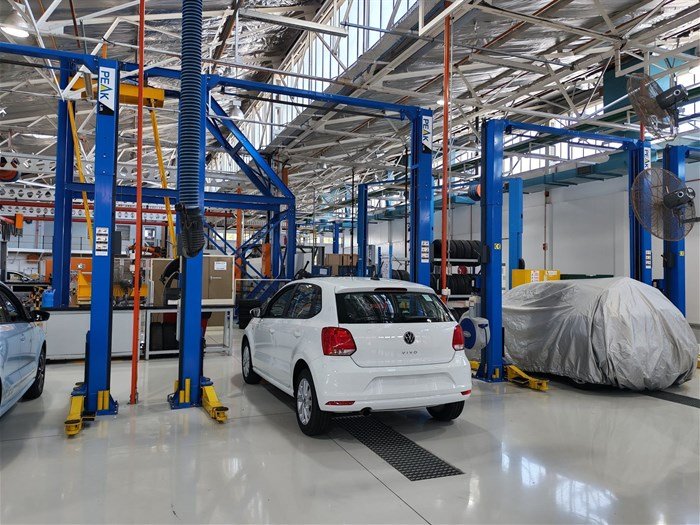
A new Polo Vivo at Volkswagen Group Africa’s product development facility in Kariega | Image credit: Imran Salie
By now, most are aware of what ails the local automotive sector. There is a surface-level understanding of the pressures facing the industry, including the rapid influx of Chinese brands and the rising price of new vehicles. But the reality is more complex, particularly for OEMs that have operated successfully in South Africa for decades. For them, shifting global trade dynamics and slow-moving local policy reform add another layer of risk.
In Volkswagen Group Africa’s case, where questions about long-term manufacturing sustainability inevitably arise in light of Nissan’s departure, almost all of these pressures apply, bar exposure to US tariffs. Instead, Volkswagen’s concerns are rooted closer to home: a shrinking domestic market, growing reliance on exports, and uncertainty around South Africa’s readiness for the transition to new energy vehicles.

End of an era: Nissan to cease manufacturing in SA, selling factory to Chery
Those concerns were laid out in detail by Volkswagen Group Africa managing director and chairperson Martina Biene during the company’s third annual Volkswagen Indaba, held on 4 February, where the group provided a business update against a fast-changing local and global automotive backdrop.

Volkswagen Group Africa’s Martina Biene addressing media at the third annual Volkswagen Indaba | Image credit: Imran Salie
Addressing media, Biene warned that South Africa’s automotive manufacturing sector had reached a crossroads, with Volkswagen facing what she described as a “make-or-break” period as investment decisions for the next decade come into focus.
An industry at a crossroads
Biene said the South African automotive industry was being shaped by four converging pressures, all of which threaten the long-term sustainability of local manufacturing if left unaddressed.
“The assessment of our industry is that South Africa’s automotive manufacturing sector is at a crossroads,” she said. “There are four forces defining this moment, and we are all aligned across the industry on what needs to be done.”

The four pressures on SA’s auto industry | Image credit: Imran Salie
The first, she said, was a stagnant domestic market that is failing to grow at the scale required to support sustainable production. South Africa produced just over 610,000 vehicles last year, well short of the one million unit target set under the South African Automotive Masterplan.
“With this production volume, South Africa ranks 23rd globally,” Biene said. “Only one manufacturer in India produces more vehicles than the entire South African industry combined. That lack of scale impacts procurement, supplier investment and overall competitiveness.”
Fewer locally built cars sold at home
Compounding the problem, Biene noted that fewer locally manufactured vehicles are being sold into the domestic market, with imports now accounting for around two-thirds of all new vehicle sales.
“In 2006, about 56% of vehicles sold in South Africa were locally manufactured,” she said. “Today, that figure has dropped to around 33%, with 67% being fully built imports.”
While importing vehicles is not inherently a problem, she said the shift had reduced the effectiveness of production-linked incentives, which were originally designed to support local manufacturing through export-led growth.
“We are producing vehicles for export, generating incentives, but the domestic market is not growing,” Biene said. “That leaves manufacturers sitting with incentives that have limited practical use.”
Heavy reliance on Europe under threat
The third major concern for Volkswagen is its reliance on Europe as an export destination, at a time when the region is rapidly transitioning to electric vehicles.
South Africa has historically benefited from strong access to European markets, but Biene warned that this advantage is becoming increasingly fragile.
“Europe is moving to battery electric vehicles, and South Africa has not catered for that transition,” she said. “If nothing changes, exports to Europe will become more difficult over time.”
Volkswagen currently exports around 76% of its locally produced vehicles, with Europe accounting for the majority of that volume. However, rising carbon dioxide penalties in the EU are already beginning to impact production planning.
“We are already seeing around 20,000 fewer vehicles in our European order book this year due to CO2 taxation,” Biene said. “If this trend continues, it has real consequences for production volumes and employment.”
Policy lag on new energy vehicles
Biene’s fourth concern was what she described as slow and insufficient policy development around new energy vehicles in South Africa.
“It is not about policy uncertainty anymore,” she said. “It is about the fact that the current automotive policy no longer works.”
She argued that South Africa’s policy framework remains too narrowly focused on battery electric vehicles, which are currently unaffordable for most local consumers and unsuitable for many African markets.
“We need a broader definition of new energy vehicles,” she said. “That includes hybrids and other transition technologies. Without consumer incentives and a realistic production framework, the domestic market will not absorb these vehicles.”
A narrowing investment window
Against this backdrop, Biene said 2026 would be a decisive year for Volkswagen Group Africa, as global investment decisions are made for the period beyond 2030.
“This year is make or break for us,” she said. “We need to see movement on policy, otherwise there are better business cases elsewhere.”
She added that while infrastructure improvements such as more stable electricity supply and better port performance were welcome, they were no longer enough to secure investment on their own.
“Headquarters are not comparing whether South Africa is slightly better than last year,” she said. “They are comparing South Africa to Morocco, to India, to other markets competing for the same capital.”
Holding the line while planning ahead
Despite the challenges, Biene said Volkswagen remained committed to South Africa and was actively working to maintain export volumes while exploring new opportunities.
The company plans to introduce mild hybrid technology into locally produced models such as the Polo to meet European emissions requirements, while also expanding its focus on African export markets over the longer term.

A plug-in hybrid Caravelle unveiled at the VW Indaba, set for mid 2026 in SA | Image credit: Imran Salie
“At the same time, we need a strong domestic market,” she said. “Volume manufacturers cannot survive on exports alone.”
Biene concluded by stressing that the industry, labour and government stakeholders were largely aligned on the problems and the required solutions, but warned that time was running out.
“We do not have the luxury of debating for another two or three years,” she said. “We know what needs to be done. The urgency now is to act.”