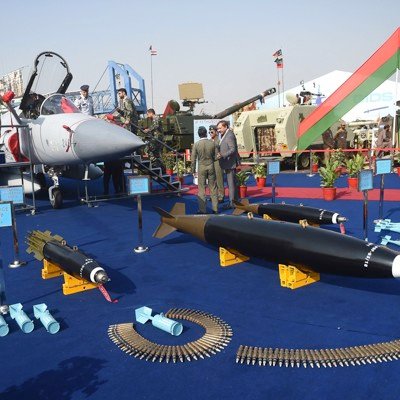
U.S. policymakers need to energize their engagement with the midtier arms producers fighting for a larger slice of the global arms market. They should look most urgently at Pakistan, whose cost-effective weapons and growing ties to China make it a country of increasing geopolitical importance.
Islamabad’s expanding defense industry, exemplified by its JF-17 fighter jet, has drawn interest from buyers across Africa, the Middle East, and Asia. Pakistan has demonstrated an ability—uncommon among emerging suppliers—to bundle production with training, maintenance, and operational support. Under Field Marshal Asim Munir, Pakistan’s armed forces have grown more capable and outward-looking , positioning Islamabad as an emerging force in the international arms market.


Yet while Pakistan expands its defense partnerships across South Asia and beyond, the United States remains largely absent. This is a strategic mistake. The Pentagon should establish a robust defense industrial partnership with Pakistan that uses Islamabad’s manufacturing capacity while advancing American interests.
The strategic rationale is clear. Pakistan sits at the crossroads of South and Central Asia, with deep military relationships across Muslim-majority nations and growing influence in Africa. Its defense sector offers cost-effective platforms that emerging partners can afford, regional production capabilities that reduce supply-chain vulnerabilities, and proven military professionalism. Most importantly, the China factor: Pakistan has long been a bridge between the U.S. and China, since the days of Richard Nixon. China already plays a significant role in Pakistan’s defense sector. The question is not whether Beijing will be present—but whether Washington will have any influence over how Pakistan’s defense industry evolves, exports, and integrates with regional partners. America’s competitive partnership with Pakistan’s growing defense industry should be seen in this light.
Recent developments underscore the urgency. Pakistan’s growing ties with Bangladesh—including discussions about potential JF-17 sales—have alarmed New Delhi. While Indian media outlets criticize these developments, the Pentagon should view them as an opportunity to shape defense relationships in a region where U.S. influence has waned since the Afghanistan withdrawal. Rather than ceding this space to China or allowing India-Pakistan tensions to dictate U.S. regional strategy, Washington should engage with both South Asian nations.
What should this partnership look like? First, the Defense Department should establish joint production agreements for specific platforms where Pakistan has proven capabilities—potentially including trainer aircraft, light attack helicopters, or armored vehicles. These agreements would allow U.S. forces to reduce costs while ensuring interoperability with partner nations that operate Pakistani equipment.
Second, U.S. defense firms should work with Pakistani manufacturers to co-produce components and subsystems. This would give American companies access to lower-cost production while maintaining quality control and creating dependencies that strengthen the bilateral relationship. It would also position the United States as Pakistan’s partner of choice for technology transfer and industrial modernization.
Third, the Pentagon should expand military-to-military cooperation beyond traditional training exchanges. This should include joint exercises focused on defense industrial cooperation, shared maintenance facilities for regional partners, and coordinated defense export strategies that align with U.S. objectives. Defense ministries often exert influence comparable to or greater than foreign ministries, and the United States must use these channels.
Critics will cite Pakistan’s nuclear program and rivalry with India. These are legitimate concerns, but they should not paralyze American strategy. The United States has successfully compartmentalized cooperation with far more problematic partners when strategic interests demanded it. Moreover, deeper defense industrial ties would give Washington greater leverage to address these very concerns.
It is true that India would naturally object. New Delhi has long viewed Pakistan’s defense relationships through a zero-sum lens, and any expansion of U.S.–Pakistan defense industrial cooperation would generate friction at a moment when Washington is investing heavily in its partnership with India. But U.S. strategy in South Asia cannot be held hostage to bilateral rivalries alone. The United States already manages defense relationships with adversarial partners elsewhere—from Greece and Turkey to Japan and South Korea—by separating regional deterrence from industrial cooperation. India itself has diversified its defense procurement across Russian, French, Israeli, and American suppliers. Washington should expect the same strategic flexibility in return, while remaining transparent with New Delhi about the scope and limits of any cooperation with Islamabad.
The broader lesson extends beyond Pakistan. As middle-tier defense manufacturers emerge globally, the Pentagon must develop a strategy to engage rather than ignore them. These countries will produce and export weapons regardless of American preferences. The question is whether the United States will shape these developments to advance American interests or stand aside while China builds the defense industrial partnerships that will define the next generation of global security relationships.
Pakistan’s emergence as a defense supplier presents a strategic opportunity the United States cannot afford to miss. By establishing meaningful defense industrial cooperation with Islamabad, the Pentagon can strengthen American influence in South Asia and provide cost-effective options for partner nations, all the while providing a counterweight to China that keeps the region in balance.
Joe Buccino is a retired U.S. Army colonel who last served as Communications Director for U.S. Central Command.