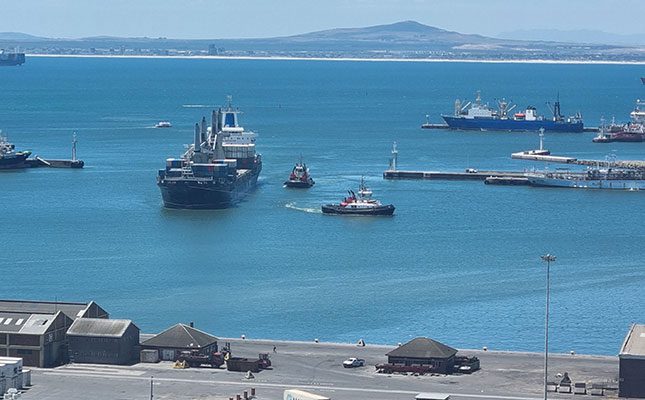
Hortgro, the deciduous fruit industry, is considering taking legal action over port failures that have led to direct losses of hundreds of millions of rands since the start of the 2025/26 season.


– ADVERTISEMENT –
Hortgro said in a strongly-worded statement issued on 30 January that losses to the deciduous fruit export value chain in the 2025/26 season have already exceeded R350 million due to problems at the Port of Cape Town, “with further exposure continuing to accumulate daily as delayed vessels arrive at destination ports”.
Over the past few years, agricultural export industries have refrained from criticising Transnet in public, choosing instead to work collaboratively to find solutions to costly shipping delays brought on by machinery breakdowns, ageing infrastructure, and labour issues.
However, in a striking departure from this conciliatory tone, Hortgro Executive Director Anton Rabe laid bare Transnet and the Perishable Products Export Control Board’s (PPECB) egregious failures in a newsletter to industry and other stakeholders.
“[During] the latest crisis at the Cape Town harbour, new equipment, operational plans, and undertakings given by Transnet were simply not complied with or implemented. On top of that, key personnel were absent during this critical time, mostly without leave, thus AWOL [absent without leave].
“Yes, the wind blew, but this has been the case since before the time of Jan van Riebeeck, and actions to overcome wind-related delays were not implemented with urgency. The consequences of this on fruit quality and the accompanying claims, as well as additional costs to rotate containers to other harbours and even to bring in conventional ships at higher cost, are simply outrageous and can no longer be absorbed by the producer,” Rabe wrote.
He added that complaints had been raised about PPECB inspectors being unavailable over the Christmas–New Year period, causing disruptions during peak harvest and packing.
“Deficient management and oversight landed us in a mess, but there are no consequences for poor service delivery and/or the absence of workers. This fails the export industries big time and has to be addressed,” Rabe said, appealing to Transnet and the PPECB to discipline the guilty parties.
Persistent subpar performance
“While the industry recognises the commitment and effort of operational teams working under extremely difficult circumstances, the persistence and scale of performance failures at the CTCT [Cape Town Container Terminal] point to deep-seated structural weaknesses that extend beyond isolated incidents or external disruptions, such as adverse weather,” Hortgro said in its statement.
“Over many years, the fruit industry has engaged constructively and in good faith with Transnet and port management, including a deliberate and disciplined commitment not to pursue media engagement while solutions were addressed internally.
“Despite these efforts, productivity has not recovered to globally competitive or operationally reliable levels, despite substantial new equipment investment following more than a decade of capital underspend and readiness assurances provided ahead of the season.
“Global productivity standards range from 25 to 30 GCH [gross crane movements per hour], while the CTCT remains below 20.
“The commercial consequences of this sustained underperformance are now severe, and options to recoup lost income and cover additional costs are being explored.”
Disastrous bottlenecks
Hortgro explained that, by the second week of the 2025/26 export season, exports were down by 9% compared with last year, while inspection volumes increased by 37%. This resulted in “an abnormal build-up of approximately 1 688 containers in cold storage”, which “equates to an estimated R1 billion in fruit inventory currently at risk, excluding additional volumes already plugged in at back-of-port facilities”.
It added that shipments via Port Elizabeth have increased by 140% thus far this season, “with additional transport costs exceeding R133 million”. Exporters have even had to route about 900 reefer containers through Durban and around 1 200 through Walvis Bay, Namibia.
Additional costs from truck standing time penalties, cold storage, agent fees, and rising quality claims have not yet been calculated.
“These compounding losses are eroding exporters’ margins, destabilising rural economies, and placing South Africa’s hard-won reputation as a reliable supplier of high-quality fruit under increasing strain,” Hortgro said.
Failures abound
Hortgro said the South African deciduous fruit industry has “escalated its operational engagement with Transnet and is considering formal legal remedies due to ongoing operational failures at the Port of Cape Town”.
It ascribed the problems at the CTCT to five interconnected structural failures, rather than temporary operational shocks:
- Shortcomings in human resources and labour management
- Gaps in health and safety governance
- Equipment and systemic infrastructure issues
- Weaknesses in operational processes, execution, and control
- Failures in communication and accountability
It added that it had documented and shared these failures with Transnet as part of efforts to push for a solution, noting that there had been some positive outcomes. However, the improvements were too late to be of use to stone fruit exporters.
“Hortgro is firmly of the view that the challenges at the CTCT can no longer be addressed by incremental fixes or reactive crisis management. What is required is a coordinated, transparent, and expert-led transformation programme, supported by measurable commitments, strong executive ownership, strict accountability, and private-sector operational involvement,” it said.
No transparency
In his newsletter, Rabe said egregious neglect must be called out and addressed.
“Private-sector participation in our harbours is really not negotiable any more. Transparency also has to be implemented. It seems as if key data and information is purposefully withheld from the industry. This creates mistrust and definitely does not help in the search for collective solutions.
“Our neighbouring countries run circles around us with harbours such as Walvis Bay and Maputo, which offer private-sector participation and advantages, in the best interests of those countries as a whole. As landlord, the state’s income [from these ports] is much higher than before, and the entire country benefits from cost-effective service provision.
“[It’s] a no-brainer, but unfortunately [in South Africa], it is blocked by political rhetoric and obsolete policy. This has to change,” he wrote.
Get trusted farming news from Farmers Weekly in Google Top Stories.
➕ Add Farmers Weekly to Google
✔ Takes 10 seconds · ✔ Remove anytime