


Warning: Apocryphal Spoilers Ahead!
When The Carpenter’s Son was released in 2025, it was described as “Bible horror” involving teenage Jesus. This fact alone was already a strong indicator that something would be terribly wrong with that movie.
Then, it was announced that the Virgin Mary would be played by … FKA Twigs?

A viral tweet indicated that FKA Twigs as the Virgin Mary wouldn’t work because the singer/actress has an “iPhone face.” While I’m not sure what’s that supposed to mean, I also understand exactly what’s its supposed to mean. Also, Mary was not half-Jamaican. Just saying.
The blaring miscasting continued with Joseph being played by Nicolas Cage. It is seriously ridiculous. This means that throughout the movie, we’re watching FKA Twigs (and her iPhone face) speak with a British accent while Nicolas Cage (who is constantly freaking out) yells in an American accent. None of it is remotely believable, and this might very well be by design.


Indeed, The Carpenter’s Son is not about being believable or even entertaining; it is about desecrating the Holy Family and Christianity as a whole in a succession of highly symbolic scenes.
The symbolic clues that pop up before the movie even begins.

The movie was produced by Nicolas Cage’s company Saturn films.
As explained in previous articles, Saturn is esoterically associated with Satan. Saturn (Cronus) represents the limitations of the material world, as opposed to the divine light of the sun. In various mythologies, Saturn was associated with ancient deities such as Moloch and Baal, and then merged with Pan (the horned goat) to influence the modern image of the Devil.
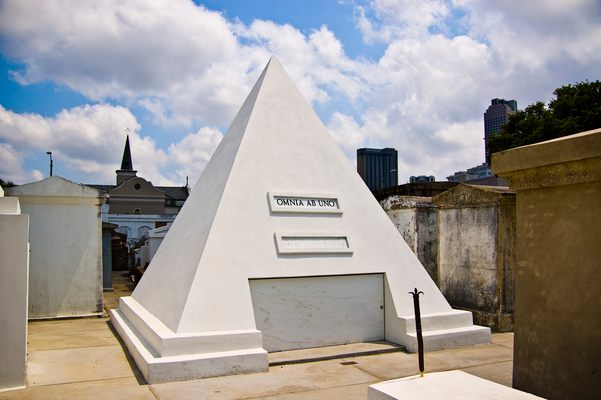
Nicolas Cage’s highly occult pyramid tombstone, featuring the hermetic phrase “Omina Ab Uno” (Everything From One), indicates that the actor is well-versed in occult symbolism. Relevant fact: Cage was attacked by a swarm of bees in one of the caves intended to be a filming location.
In short, the movie’s motivations were not very Christian. Although the movie is described as a “biblical thriller,” none of its story appears in the Bible. Instead, it was loosely inspired by the Infancy Gospel of Thomas, an apocryphal text from the 2nd century which was described as “inauthentic and heretical” by early Christian writers.
Written by an unknown author, The Infancy Gospel of Thomas describes the life of the child Jesus from the ages of five to twelve, as he experiences bizarre, supernatural, and even malevolent events. For instance, the text contains a few stories where Jesus uses a curse to kill children who transgress him. He also blinds his neighbours blind as retaliation for complaining about his family.
The movie’s writer and director, Lotfy Nathan, was clearly inspired by this “evil Jesus” narrative. However, he took some great liberties with the story, adding Satan as a main character, even though the text makes no mention of him. Furthermore, the Infancy Gospel ends with Jesus at age 12, who is fully aware of his divine mission. However, in The Carpenter’s Son, Jesus is 15, and he’s very angry and confused.
The rest of the movie is pretty much the director doing whatever he wanted with the Holy Family as characters in a horror movie. The result is … horrific.
The Carpenter’s Son begins with FKA Twigs giving birth, squatting. While this position was the norm at the time, the scene immediately accomplishes a goal of the movie: To make the Holy family more human than divine.
After Jesus’ birth, the family flees to Egypt because King Herod ordered the execution of all male children under the age of two.

The movie’s makers decided to depict this event with a prolonged scene of babies being thrown in a fire (including close-ups), turning it into something resembling ritualistic offerings to Satan.
After this horrific scene, the movie fast-forwards 15 years.

FKA Twigs stands next to an angry teenager, rocking a broccoli-head haircut and hoodie. We then realize that’s supposed to be Jesus.
As Jesus looks suspiciously at everyone in the village, we hear demonic whispers, hinting at the fact that Satan is in control of this land. This will occur throughout the movie.

Scenes at the movie’s beginning are occasionally intercut with random shots of goats, foreshadowing its unmistakably satanic atmosphere.
Most of the movie’s scenes take place in desolate settings where pain, suffering, sickness, and death are prevalent. In this godless context, Joseph has to betray his beliefs and has to carve wooden idols to make a living.

On a few occasions, we see Joseph working on these demonic-looking things.
Once again, the movie’s makers fabricated this part of the story, as there are no mentions of Joseph ever making idols. As a Jewish man living under the Law of Moses, creating idols would have been a direct violation of the Ten Commandments, which strictly prohibit making, bowing down to, or serving idols. However, scenes such as this one serve the movie’s true purpose: To turn the Holy family into an Unholy family.
The desecration also applies to Jesus. Throughout the movie, he is yelled at, called a liar, slapped behind the head, and spat at. When he becomes aware of his powers, Jesus is less a miracle worker and more a sorcerer who uses his “magic powers” to attack or even kill those who get in his way. This leads the townspeople to accuse him of being Belial – a biblical word describing the Devil.
Of course, this angers Joseph, who constantly berates Jesus.

Joseph punishes Jesus by forcing him to pray, an activity that is less about connecting with God and more about mindlessly reciting a bunch of words. Of course, Jesus hates it.
Notice Joseph’s hands in the screenshot above. It is seen throughout the movie. Praying with one’s palms up (called Oran’s posture) is a sign of adoration and submission. Joseph has a bizarre version of it, with his hands clenched in anger towards God.
Joseph also has profound anger against Jesus. In the scene above, Joseph asks God:
“Is he from your angels? Is he from demons? Is he your son?”
Indeed, Joseph constantly complains about Jesus and heavily doubts his heavenly status. After accusing Mary of copulating with a Roman soldier (what?), he believes that Jesus he practices black magic, adding:
“He who is near him is near the fire!”
At one point, he tells Mary:
“He’s unclean. He defiles himself, always covered in filth.”
What does Joseph mean by “he defiles himself”? The movie implies some rather weird things about teenage Jesus.
In Christian theology, Jesus is considered both the Son of God and God in human flesh. However, he’s definitely not godly in The Carpenter’s Son.

Jesus meets a mute girl named Lilith and her mother. He immediately becomes obsessed with her.

While Lilth is washing up naked outside her house, Jesus spies on her like a creep. This scene has no reason to exist except for turning Jesus into a horny teenager.
There is no religious text, biblical or otherwise, that documents a relationship between Jesus and a girl named Lilith. It is one of the many fabrications in the movie. However, it has a symbolic meaning.
The girl’s name is not random: Lilith is the primordial “she-demon” cited in the mythology of multiple civilizations.
Lilith, female demonic figure of Jewish folklore. Her name and personality are thought to be derived from the class of Mesopotamian demons called lilû (feminine: lilītu), and the name is usually translated as “night monster.”
– Encyclopædia Britannica
Appropriately enough, Lilith gets possessed by a demon later in the movie. And Jesus is accused of violating her.
As if that wasn’t enough, Jesus befriends another demonic figure in the movie: Satan himself.

While Jesus has tense relations with nearly everyone, he has a sweet spot for a girl who turns out to be Satan.
Not only do Satan and Jesus become friends, but she also becomes something of a mentor to him. She makes him aware of his powers and informs him that Joseph is not his true father but “his oppressor”.

Satan offers Jesus a wooden snake. He accepts it (and even cherishes it), although Joseph forbids “games of the gentile.”
As they spend time together, Satan tells her “origin story” where she’s sympathetic, and God is jealous and insecure.
“I was a very beautiful thing. Such a thing I cannot describe in words. He shunned me. He would let no one be his equal.”
In the Bible, Jesus dominates Satan and various demons. In The Carpenter’s Son, it’s the other way around.

Satan grabs Jesus’ face and forces him to stare into the depths of hell.

She yells the words “Sitra achra” – a Kabbalistic expression meaning “the realm of evil.”

Jesus symbolically falls to his knees next to Satan, completely in awe and mesmerized by her words.
After this display of power, Satan forces Jesus to say her name. This is less a movie and more a Satanic ritual at this point.
When Joseph finds the two friends bonding together, he sees a very different Satan.

While Jesus sees Satan as a girl, Joseph sees a demonic figure that makes Baphomet’s “As Above, So Below” handsign. Why is there a difference in perception between the two?
Then, Satan violently attacks Joseph while bragging to Jesus:
“He reveres me for my cruelty. Because he fears me!”
Yup, in The Carpenter’s Son, Satan violently murders Joseph (while stating that he “reveres” her) as Jesus stands by powerless.
When Jesus tries to use his powers to heal him, Joseph stops him, because, apparently, he wants to cowardly die and abandon his family. Furthermore, he is denying God’s help while allowing Satan to win over him.
As Joseph dies, he asks Jesus:
– What awaits us when we turn to death?
– Dust.
I’m not a theologian, but doesn’t this contradict Jesus’ entire teaching that his followers receive eternal life? Is he implying that Joseph is not one of his followers?
After this baffling interaction, Jesus goes back to Satan … and hugs her.

The last words said in the movie come from Satan, who tells Jesus, “We are the same.”
Jesus doesn’t contradict Satan on this. He just remains silent, implying agreement to this Satanic statement.

The movie ends with Jesus not saying a word and walking in a random direction… followed by FKA Twigs.
The Carpenter’s Son is one of those movies where you can immediately feel that something terribly wrong is happening. It is not just about the bad acting, the pointless narrative, or the glaring biblical inaccuracies; it is about the mean-spirited energy that permeates it.
Either we are hearing demonic voices in the background, various characters (including Joseph and Satan) cursing out God, or Jesus being dominated by Satan. We are not watching a movie; we are watching Hollywood weirdos partaking in an organized desecration of Christianity.
In short, The Carpenter’s Son is a perfect representation of the entertainment industry’s moral corruption: It promotes a movie under the “biblical” pretenses while it is nothing less than a Satanic manifesto.
With that said, does this movie have any redeeming qualities? Yes, it is relatively short. Thank God.

Latest discussions at the VC Forums


