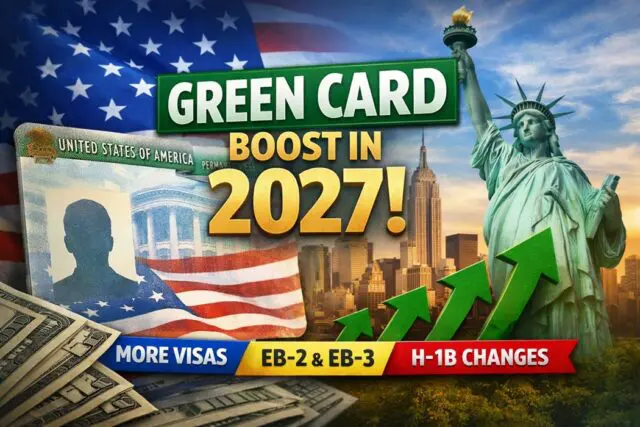
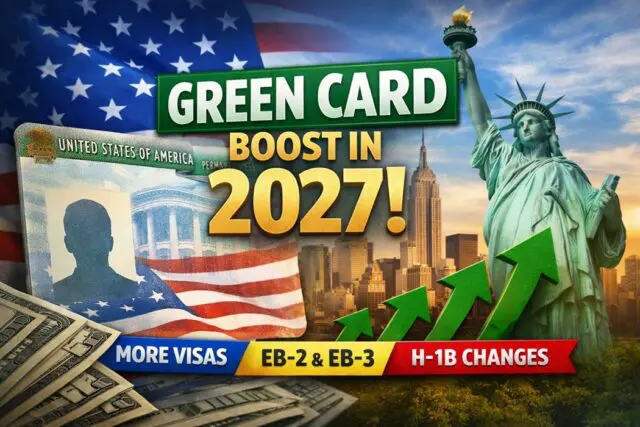
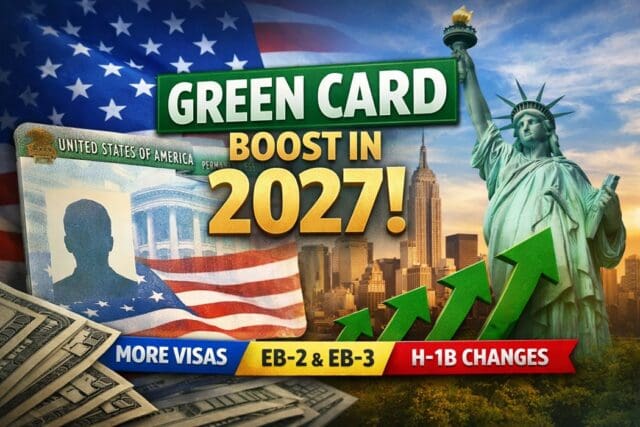
Green card applicants targeting Fiscal Year (FY) 2027 may be in for a major advantage, as recent U.S. immigration policy changes are expected to significantly expand the number of available employment-based permanent residence visas.
Immigration analysts say a rare convergence of policy decisions—ranging from visa bans to lottery reforms—could dramatically reshape the green card landscape, especially for high-skilled professionals who have faced long backlogs for years.
50,000 Unused Family Visas Likely to Spill Over
A key factor behind the projected boost is a ban on immigrant visas for citizens of 75 countries, which took effect on January 21, 2026. Due to this restriction, officials expect that up to 50,000 family-based green cards allocated for FY 2026 may go unused.
Under U.S. immigration law, unused family-based immigrant visas automatically roll over—or “spill over”—into the employment-based green card quota in the following fiscal year.
As a result, the FY 2027 employment-based cap, which is normally set at 140,000, could rise to approximately 190,000 green cards.
“This kind of spillover is rare but extremely impactful,” immigration experts say. “It can move priority dates forward by months—or even years—for some applicants.”
EB-2 and EB-3 Applicants Stand to Benefit Most
The expanded quota is expected to significantly advance priority dates, particularly in high-demand categories such as:
- EB-2 (Advanced Degree Professionals)
- EB-3 (Skilled Workers and Professionals)
Applicants from India, who currently face the longest employment-based backlogs, are projected to see the most meaningful relief, though benefits may extend to other oversubscribed countries as well.
For many professionals already in the U.S. on temporary work visas, this could mean earlier eligibility for adjustment of status, faster access to work authorization flexibility, and improved family stability.
DV-2027 Diversity Visa Lottery Delayed Indefinitely
In a separate but related development, the U.S. State Department has indefinitely delayed the launch of the DV-2027 Diversity Visa Lottery.
Officials say the pause is necessary to implement new security and integrity measures, including:
- A redesigned online entry system
- Mandatory passport scans at the time of application
- Introduction of a new registration fee
While the delay has created uncertainty for Diversity Visa hopefuls, it does not directly reduce the overall green card cap. However, it adds to broader changes reshaping the immigration system ahead of FY 2027.
H-1B Lottery Replaced with Wage-Based Selection
Another major policy shift affecting future green card pathways involves the H-1B program. The Department of Homeland Security has finalized a wage-based selection system for H-1B visas beginning in the FY 2027 season.
This new model replaces the traditional random lottery and instead prioritizes:
- Higher-paid positions
- Senior and specialized professionals
- Roles aligned with prevailing wage levels
While this change may disadvantage entry-level applicants, it is expected to favor experienced professionals—many of whom are also prime candidates for employment-based green cards.
What This Means for Green Card Hopefuls
Taken together, these developments signal a potentially more favorable environment for employment-based green card applicants in 2027, especially those who are already in the system and waiting for priority dates to become current.
Key takeaways:
- Employment-based green card numbers may rise by up to 35%
- EB-2 and EB-3 backlogs could ease substantially
- Indian nationals may see the largest gains
- High-wage professionals gain an edge under new H-1B rules
Immigration experts advise applicants to closely monitor Visa Bulletins, maintain lawful status, and consult qualified immigration attorneys to prepare for rapid changes once FY 2027 allocations are confirmed.