
US Africa Command (Africom) Commander General Dagvin Anderson has moved in his first five months to implement military collaboration and capacity-building partnerships with security implications. This would mean acting on African leaders’ direct requests for American investments alongside strengthened defence capabilities. All this is aligned with the Trump administration’s trade-focused Africa policy.
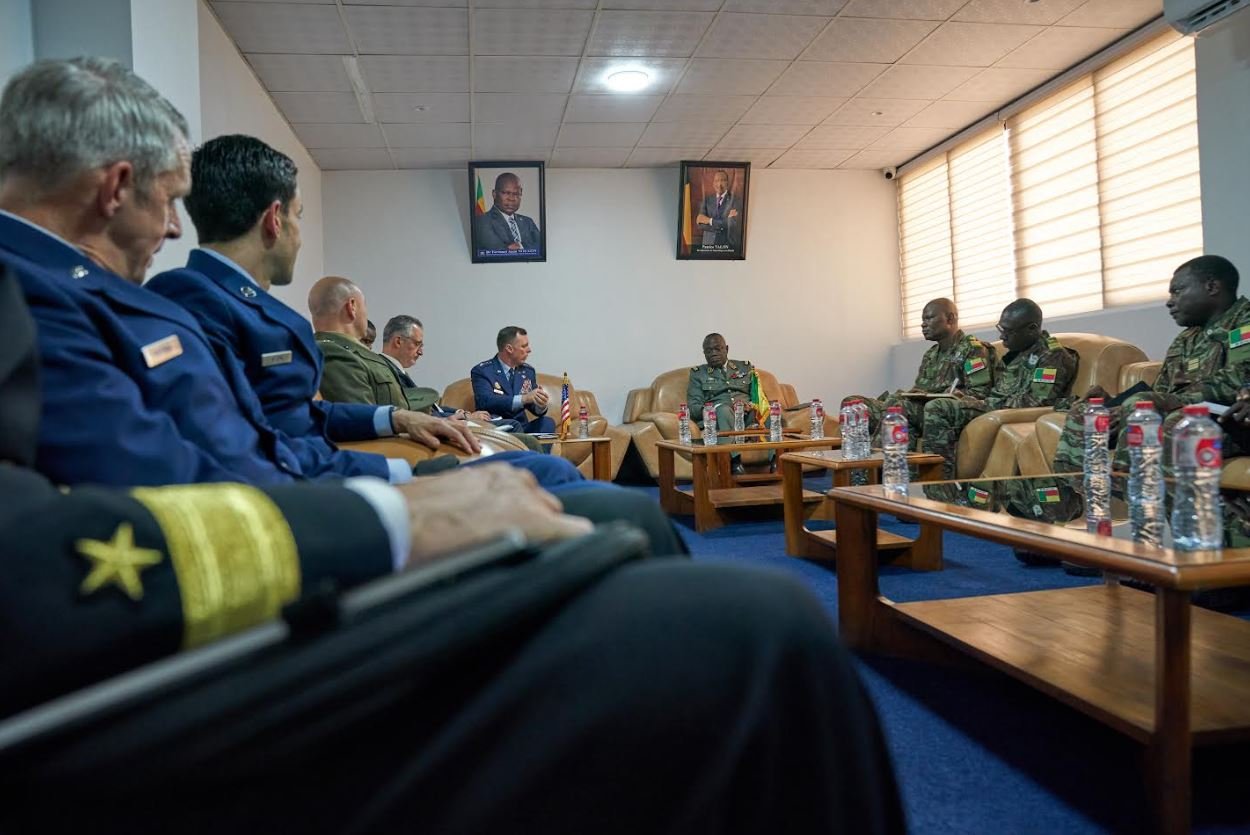
Since assuming command, Anderson has travelled to 11 African countries. Among them are Tunisia, Ethiopia, Somalia, Libya, Benin, Cameroon, Morocco, and Kenya. These listening tours revealed consistent high interest from African countries looking for US business investment over traditional aid, paired with military professionalization to counter expanding terrorist threats. On 22 January 2026, Anderson operationalized this mandate through a landmark inter-agency conference at the National Defense University, Fort McNair – an annual event for the first time including US Department of Commerce representatives.
“We had this dialogue set up. There was an opportunity to talk about how we’re looking at engaging slightly differently, especially on the continent. How do we look, from a combatant command perspective, and engage with the State Department and the Department of Commerce, in ways we haven’t necessarily done in the past,” Anderson told Pearl Matibe, for DefenceWeb, who had private audience with him at the inter-agency forum on the day of the forum.
The all-day Fort McNair forum united DoW (US Department of War), State Department, Commerce, and industry leaders to align military partnership with economic opportunity. Anderson committed to organizational transformation within Africom headquarters itself, establishing approximate timelines for execution.
“It has to have commander interest and commander emphasis. I will stay engaged on this [inter-agency security-commerce nexus]. I think we need to look at what the structure is within the headquarters to make this most effective,” he stated, adding, “I’m very interested in this, and I think this is in all our interests.”
These timelines operationalize President Trump’s deal-making directive. The security-commerce nexus addresses dual imperatives, for example, commerce generates youth employment to deny ISIS and Al Qaeda recruitment pools, while simultaneously professionalizing African militaries through tailored capacity building.
He talked about NCO development creating systems sustainment. A cornerstone of Anderson’s approach targets non-commissioned officer (NCO) corps development, led by Sergeant Major Banfield. “[Banfield]… is focused on how we better develop the NCO core across Africa. Each country is unique, because each country has different needs, and so how can we best partner to meet those needs, to help develop and professionalize their military?”
For South African defence industry executives, this creates direct pathways. Professional NCOs represent reliable end-users and maintainers for complex systems. Enhancing International Military Education and Training (IMET) content has the potential of driving demand for simulation and training technologies.
Anderson’s Air Force background and eighth joint assignment equip him to address Africa’s unique operational challenges. “Air power is critical to the continent. Understanding how air can be utilized to enable partners to be more effective […] and how you integrate multiple domains,” he explained.
What might defense planners recognize as immediate applications? C-130BZ fleet replacement or upgrade pathways through C-130J platforms; maritime patrol gaps addressable via MQ-9 derivatives; SOF interoperability leveraging Anderson’s Special Operations Command Africa experience.
Six months into command, Anderson identifies terrorism’s continental expansion as his greatest concern. “How do we contain that? How do we work together with partners to contain that? That, to me, is the biggest concern that I see that is moving across the continent,” Anderson said.
He elaborated saying, “It’s not just isolated to one region, but many regions. And even regions that aren’t directly impacted by terrorism, have indirect impacts, and so whether it’s through migration or illicit trade or other things that the terrorist activity brings. That’s my biggest concern.”
The solution lies at the security-commerce intersection. Legitimate private sector investment stabilizes local economies, crowds out extremist financing, and creates skilled defence workforces capable of sustaining advanced systems.
On the 2026 roadmap for defence industries’ procurement officers and executives, African commerce and trade, and military education planners, could potentially prepare for structured opportunities emerging. For the leaders of African countries and people across the continent, increased American private sector investment could mean job creation and implications for youth unemployment.
In Q2 2026, Africom’s internal workflow changes may accelerate or establish new commerce and industry gateways. Mineral-energy linkages—platinum group metals, rare earths―could potentially tie defence cooperation to resource access, aligning with Trump administration priorities.
Critics of Africom might consider Anderson’s rebuttal to over-militarization narratives. African leaders’ explicit investment requests validate his approach, which is that Africom enables precisely the commerce that African states demand.
General Dagvin Anderson is not proposing transformation—he is executing it. With 11 countries engaged, Fort McNair’s inter-agency blueprint underway, and Trump administration policy alignment confirmed, Southern Africa’s defence ecosystem confronts not uncertainty, but structured, increases interest of American businesses.
Disclosure Statement: This article draws from an exclusive on-the-record interview with General Dagvin Anderson conducted by Pearl Matibe at National Defense University, Fort McNair military installation, 22 January 2026. Full conversation details are available: The Shaka Spear XSpaces Season One, Episode 8 – ” Episode 8 | Win-Win Africa Security Cooperation: Prosperity from Partnership” Also titled: “Africom: The Conversation with Combatant Commander Anderson” (25 January 2026).
Pearl Matibe is a Washington, DC-based geopolitical analyst and correspondent with expertise in foreign policy and international security, regularly covering the Pentagon and White House. Follow her on X (Twitter): @PearlMatibe.