

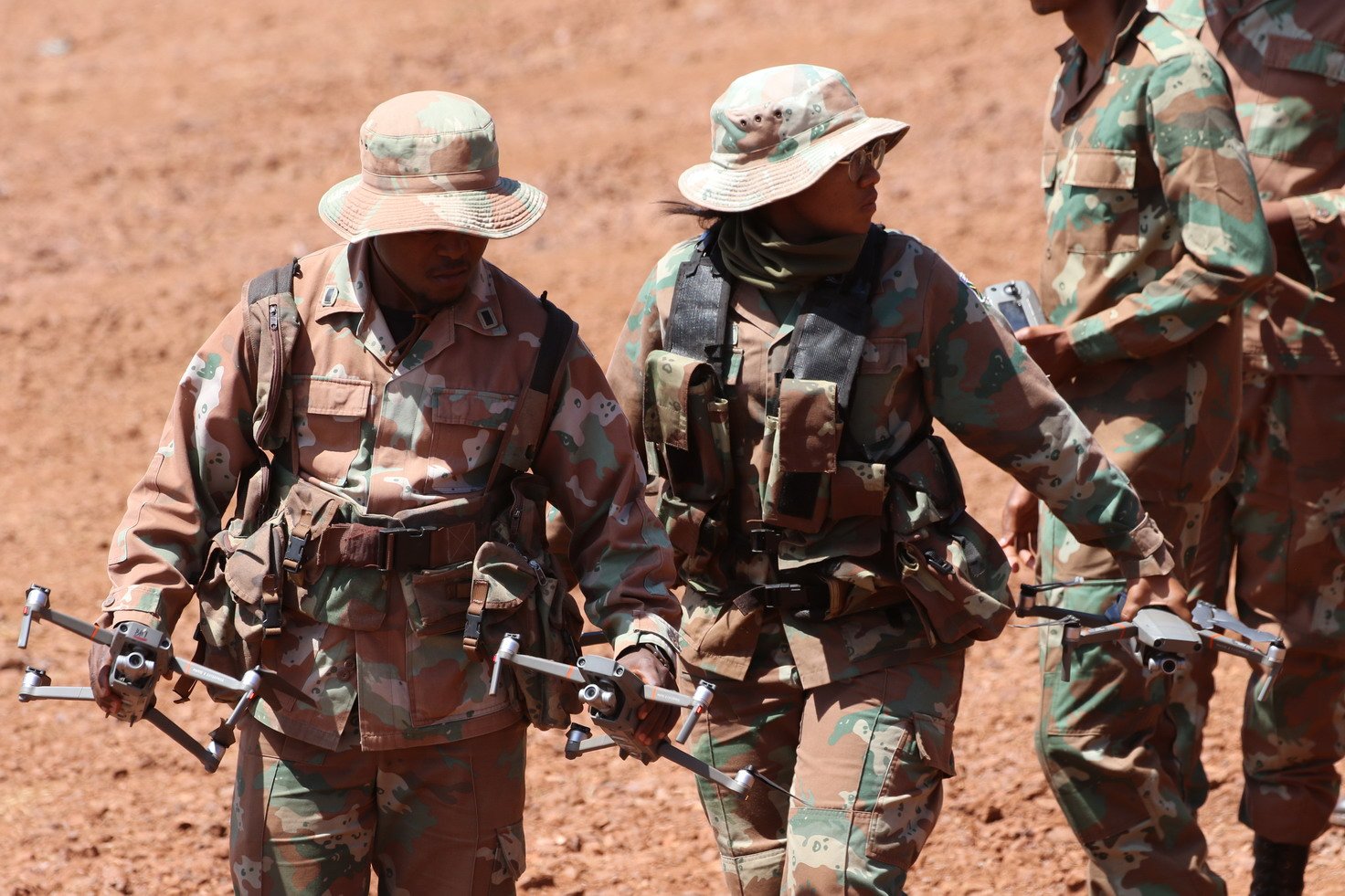

Modern military and security operations are increasingly shaped by digital technologies. From command and control (C2) systems and intelligence analytics to cyber operations tools and battlefield communications, software-driven systems now sit at the core of operational effectiveness. In South Africa, as in many states facing fiscal pressure and complex security demands, there has been a growing reliance on Commercial Off-The-Shelf (COTS) and foreign-developed technologies to fill capability gaps quickly. While this approach offers short-term convenience, it carries long-term strategic, operational, and economic risks that cannot be ignored.
The attraction of COTS solutions is understandable. They promise rapid delivery, lower upfront costs, and access to globally developed technologies. For the South African National Defence Force (SANDF) and other security agencies operating under constrained budgets, COTS systems appear to be a practical way to sustain ageing capabilities. As a result, commercial and foreign technologies have become embedded across communications, logistics, cyber tools, ISR (intelligence, surveillance and reconnaissance) platforms, and increasingly, AI-enabled decision-support systems.
Yet the hidden costs of this dependency emerge sharply in operational contexts. A primary concern is the erosion of operational sovereignty. Foreign technologies are often governed by licensing regimes, export controls, proprietary software updates, encryption constraints, or external cloud services. In times of geopolitical tension, sanctions, or shifting alliances, access to these capabilities can be restricted or withdrawn. For a country such as South Africa, which values strategic autonomy and non-alignment, this represents a direct risk to freedom of action in security and military operations.
Cyber and supply-chain vulnerabilities further deepen this risk. Limited insight into proprietary code and system architectures undermines assurance and trust. Hidden dependencies, compromised updates, or embedded vulnerabilities can be exploited by adversaries or criminal networks. In cyber and information warfare environments, such weaknesses can degrade C2, disrupt intelligence processes, and compromise mission success. Trustworthy systems are no longer optional for forces tasked with national security, they are foundational.
There is also a critical issue of contextual misalignment. Many foreign systems are designed around doctrines, infrastructures, and threat models that differ significantly from South Africa’s operational realities. African operating environments are characterised by vast distances, limited infrastructure, hybrid threats, and the need for adaptability across military, policing, and humanitarian roles. Technologies not designed with these realities in mind increase cognitive burden on operators and reduce overall effectiveness.
In a contested and asymmetric battlespace, reliance on widely available COTS technologies also creates a competitive disadvantage. Adversaries can study, replicate, or target known commercial systems with relative ease. By contrast, custom-made and sovereign technologies, tailored to national missions and operational concepts, are more resilient, less predictable, and harder to exploit. Competitive advantage increasingly lies in the ability to adapt systems rapidly, rather than merely acquiring advanced technology.
A sovereign approach to defence technology offers more than operational benefits; it delivers significant economic, capacity, and capability development gains. Investment in indigenous research, development, and engineering strengthens South Africa’s defence industrial base and preserves critical skills that would otherwise erode. Local development builds systems engineering, software, cyber, and advanced manufacturing expertise, skills that are transferable across civilian and industrial sectors. Over time, this reduces lifecycle costs, limits foreign currency exposure, and improves sustainment and upgrade capacity.
Critically, a sovereign focus enables meaningful capability development rather than perpetual technology consumption. Instead of acting as a technology integrator or end-user of foreign systems, South Africa can position itself as a developer of niche, mission-relevant capabilities, a position this country has a good history for with the Rooivalk attack helicopter, 155 mm and 127 mm artillery systems, and globally-adopted mine-protection vehicle technology. The locally developed technologies can be subsequently exported selectively, supporting economic growth while reinforcing strategic partnerships on more equal terms. This approach mitigates the risk of becoming a “technology colony” dependent on external innovation cycles.
However, realising these benefits requires a clear and sustained strategic focus. Sovereign capability cannot be achieved through ad hoc projects or fragmented procurement decisions. It demands deliberate investment in defence-oriented research and development (R&D), aligned with national security priorities and future operational needs. This includes long-term funding certainty, clear technology roadmaps, and closer integration between the SANDF, government research institutions, universities, and local industry.
Equally important is the role of local industry as a genuine partner rather than a subcontractor. South African companies must be enabled to participate in early-stage design, systems architecture, and intellectual property development. This requires policy clarity, consistent demand signals, and procurement frameworks that reward innovation, adaptability, and local value creation rather than lowest upfront cost alone.
Advocating for sovereign technologies does not imply isolationism or the rejection of international cooperation. A balanced approach is essential, one that leverages COTS where appropriate, while ensuring sovereign control over critical systems, data, and decision-making layers. The decisive factor is ownership of system architecture and integration authority. Without this, even advanced technologies risk becoming operational liabilities.
Ultimately, the technology choices made today will shape South Africa’s security, economic resilience, and strategic autonomy for decades. Continued dependence on foreign and commercial systems risks entrenching vulnerability and industrial decline. By contrast, a coherent sovereign technology strategy, anchored in focused R&D, empowered local industry, and mission-driven design, offers a path to competitive advantage, resilient security capabilities, and sustainable economic benefit. In an uncertain and contested world, sovereignty in defence technology is not optional; it is a strategic necessity.


