

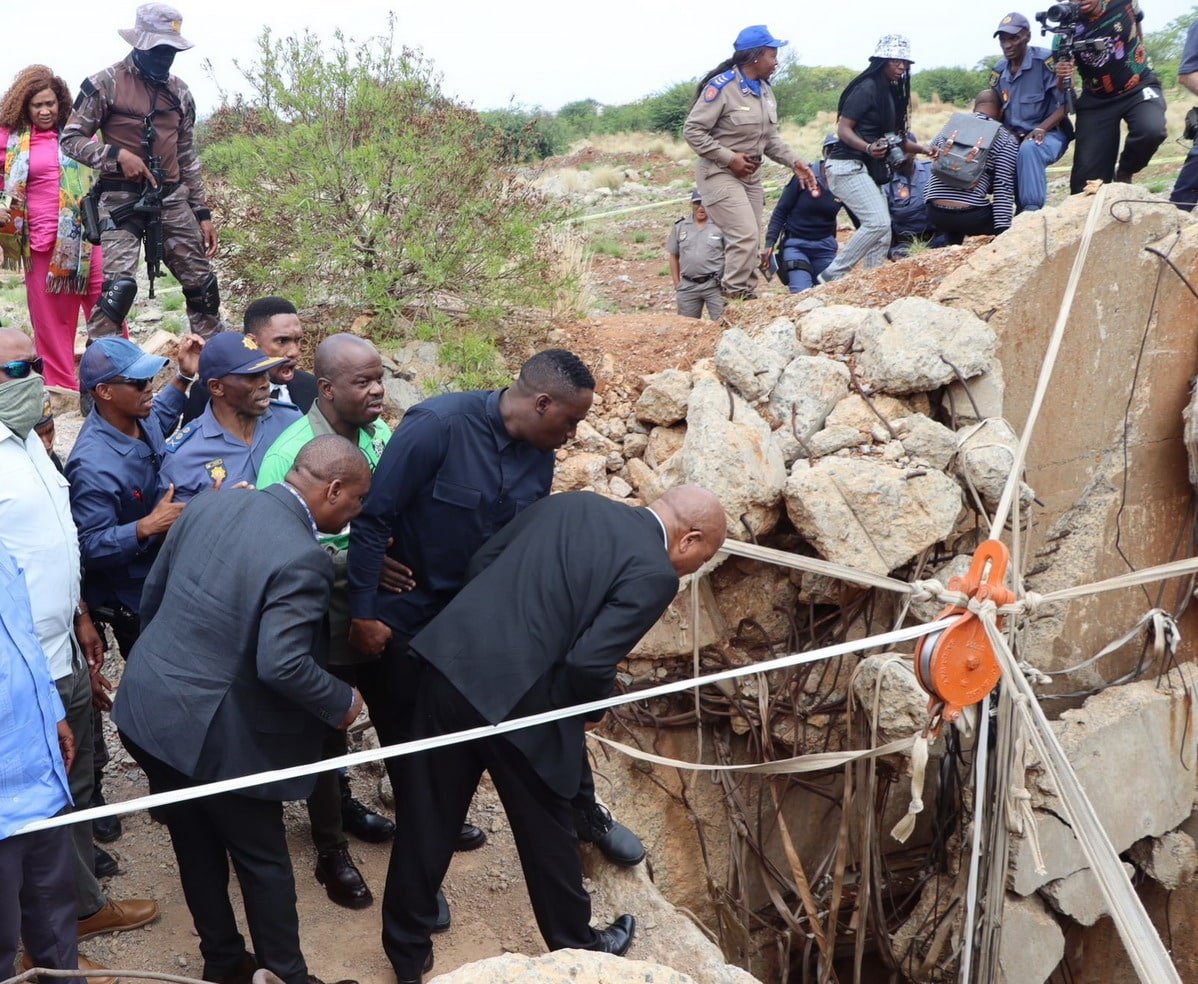

In mid-January a year ago, shaft 11 of the Buffelsfontein gold mine complex in Stilfontein, southwest of Johannesburg, was a crowded rescue site. At the abandoned mine, forensic pathology workers in hazmat suits and rubber gloves loaded corpses wrapped in plastic bags onto a truck. Unsteady survivors were guided to emergency rescue vans under a high police presence.
Over the three-day rescue, mortality announcements increased by the hour, eventually reaching 93 confirmed deaths – with many bodies likely still lying in the deep tunnels.
The major effort by Mine Rescue Services stemmed from a five-month protracted law enforcement campaign in Stilfontein. The campaign was part of Operation Vala Umgodi, isiZulu for ‘close the hole’, a national operation against suspected illegal miners, known as zama zamas in South Africa.
In Stilfontein, Vala Umgodi began in August 2024, when the national police started blocking off key shafts and stopping the entry of essential supplies into the mine. This would supposedly force miners – deemed ‘illegal’ without court process – to choose between a slow and painful death by starvation, dehydration or malnutrition, or surfacing to face arrest.
President Cyril Ramaphosa has so far not launched a judicial commission of inquiry into the implementation of Vala Umgodi at Stilfontein. Many questions therefore remain about the approaches law enforcement took at the mine. One of these is the state’s failure to gather and act on information critical to protecting and saving people’s lives.
Assuming an operation using potentially harmful and deadly siege tactics was legally and morally acceptable, one would expect actions to be based on detailed and reliable information. Specifically, close monitoring of conditions in tunnels up to 2 km deep would be vital. Inaccurate assessments of miners’ conditions could prove deadly, as they did in Stilfontein.
But instead of careful data and fact gathering, operations appeared to be based on police and politicians’ beliefs that most miners were simply refusing to surface. These assumptions were often linked to narratives of criminality with xenophobic overtones suggested in reports of foreign nationals being arrested and deported.
In reality, according to miners and community members, many were unable to resurface and needed urgent help from rescue services, according to an inquiry launched by the South African Human Rights Commission (SAHRC).
For example, shaft 11 descended for 2 km and had 19 levels, making it dangerous for miners to exit without the help of an elevator or other infrastructure, the SAHRC inquiry reports. In November 2024, community members set up a manual pulley system that retrieved some miners – but it was too slow to cater for the hundreds trapped below.
Shaft 10 was perilous for many miners to surface, with some reportedly falling to their deaths in the process. The open Margaret Shaft was inaccessible from shafts 10 and 11. Camera evidence of miners at shaft 11 was collected only in November 2024, months after the operation began. It was also only at this time that two-way note communication with miners started.
Operation Vala Umgodi then failed to adapt its goals after information emerged in November 2024 that children and human trafficking victims were among those underground. With these details, the operation should have shifted to the more severe suspected crimes at the site – including people trafficking and slave labour.
In testimony before the SAHRC in October 2025, the South African Police Service (SAPS) said most of those who resurfaced were human trafficking victims, and 27 were children.
Despite new information on crimes at the site, the state persisted with its ‘illegal mining’ narrative and focus. In December 2024, the National Joint Operational and Intelligence Structure released a statement claiming that ‘illegal miners’ were choosing not to emerge from the mine in order to avoid arrest. It said a situation could not be allowed in which the government was ‘held hostage.’
SAPS testified at the SAHRC hearing that it had continued using the method of closing shafts and stopping supplies of food and water ‘long after Stilfontein.’ They said most corpses recovered from the site were in advanced stages of decomposition, making it impossible to ascertain whether the deaths occurred before or after SAPS’ intervention. Until causation was proved linking the SAPS to specific deaths, police would use the same tactics.
But the clear correlation between the operation and nearly 100 deaths is deeply concerning and points to the serious hazards of the approach. The SAPS’ decision to overlook this pattern and continue with its strategy reflects an inability or reluctance to analyse data and assess risk.
The mass deaths at Stilfontein call into question public institutions’ commitments to human rights in South Africa. They also demonstrate the tragedies that arise when institutions prioritise entrenched assumptions over reliable information, particularly when people’s lives are at risk.
Written by Vanya Gastrow, Senior Researcher, Justice and Violence Prevention, ISS Pretoria.
Republished with permission from ISS Africa. The original article can be found here.



![[ENCORE] Historically Black Universities: Adapting Amid Affirmative Action Changes](https://lbnntv.com/wp-content/uploads/2023/12/ENCORE-Historically-Black-Universities-Adapting-Amid-Affirmative-Action-Changes-120x86.jpg)


