

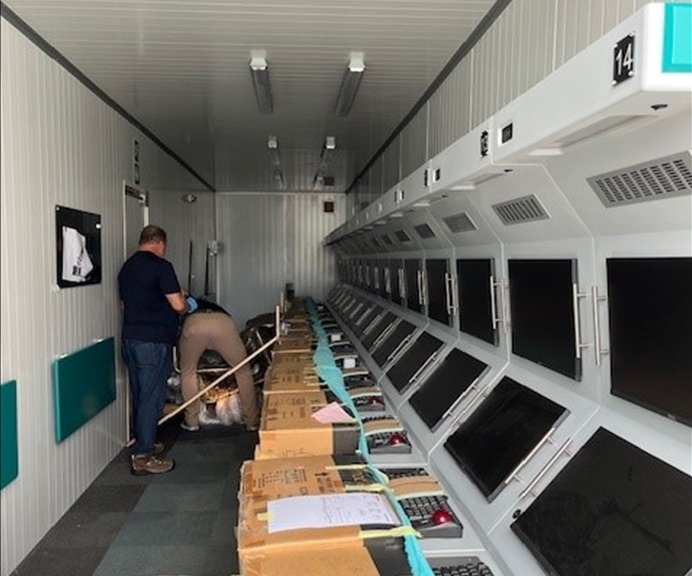

The Test Flying Academy of South Africa (TFASA) is once again in the crosshairs of the United States, after the US Justice Department filed a forfeiture complaint against mission crew trainers (MCTs) that were interdicted in transit from the TFASA to China’s People’s Liberation Army (PLA).
In a press release on 15 January, the Justice Department said the MCTs are mobile classrooms intended to assist the PLA to train personnel on the use of airborne warning and control system and anti-submarine warfare aircraft.
“TFASA masquerades as a civilian flight-training academy when in fact it is a significant enabler of the Chinese air and naval forces and a pipeline for transferring NATO aviation expertise, operational knowledge, and restricted technology directly to the People’s Liberation Army,” said Assistant Attorney General for National Security John A Eisenberg. “The National Security Division will continue to act decisively to preserve the US military’s qualitative edge by preventing US technology from falling into the hands of our adversaries.”
“The Test Flying Academy of South Africa illegally exported US military flight simulator technology and recruited former NATO pilots for the purpose of training China’s military, jeopardising US national security and placing the lives of American service members at risk,” said Assistant Director Roman Rozhavsky of the FBI’s Counterintelligence and Espionage Division.
The US Justice Department said the MCTs and associated software were designed and manufactured, using US-origin software and defence technical data, by TFASA. “The purpose of the MCT project – dubbed Project Elgar by TFASA personnel – was to train PLA aviators on anti-submarine warfare techniques, expanding their capability to locate and track US submarines working in the Pacific.”
The MCTs’ layout was modelled after the P-8 Poseidon, which is manufactured by Boeing and serves as the United States’ primary anti-submarine warfare maritime patrol aircraft, the Justice Department continued. “The MCTs were designed to run software specially designed by TFASA for Project Elgar. The software used a basic flight simulator programme [Prepar3D] designed and marketed by a US company [Lockheed Martin], which TFASA software engineers then enhanced using technical data relating to Western anti-submarine warfare aircraft, including the P-8 Poseidon. Former NATO aviators with training in anti-submarine warfare techniques were part of TFASA’s Project Elgar team.”
TFASA released a 2025 independent investigation report into the confiscation, stating that the container-mounted mobile learning units were shipped from Oudtshoorn on 23 September 2024 and departed the Durban port on 15 October 2024 via COSCO Shipping Lines. The cargo was transported on the container ship COSCO AQABA. The Containers were scheduled for transshipment in Singapore, where they were reportedly confiscated by US authorities in November 2024.
“The Containers in question did not include any flight simulation equipment, nor advanced systems, nor other forms of sophisticated technology. They housed only basic training infrastructure, which can be readily verified through physical inspection. Each mobile learning unit consists solely of individual workstations – each featuring a desk with a monitor cutout – and a commercial off-the-shelf (COTS) Windows PC,” the report explained.
“There was one extra PC per Container over and above the individual workstation units, which also had a licensed copy of Windows as well as a licensed copy of the COTS LM [Lockheed Martin] Prepar3D (P3D) software. There was no modification or unauthorised use of P3D or Windows; the licenses installed were legally purchased and properly activated.”
Prepar3D is a simulation platform that allows users to create training scenarios across aviation, maritime and ground domains. Lockheed Martin says it is ideal for commercial, academic, professional, or military instruction. “Prepar3D can be used to quickly create learning scenarios anywhere in the virtual world, from underwater to sub-orbital space.”
“Prepar3D can be used for a wide range of learning scenarios including vehicle procedures training, cockpit familiarization, flight planning, air traffic controller training and emergency response preparation. As a commercial-off-the-shelf product, Prepar3D provides a cost- effective training platform that evolves with technology,” according to Lockheed Martin.
The TFASA report said, “there is no evidence of illegal software use or export violations…The internal software development process [by TFASA of Prepar3D] was legal and transparent, and, where required, all corrective actions were taken such that no restricted software was ever used by or delivered to any client.”
“The current software claims appear to stem from an overreach based on unauthorised access to historic backup data, not from the actual condition or contents of the shipped containers. Confiscation of the containers occurred unannounced and remains without any cause communicated to the affected parties. Individuals have since been unjustly confronted with accusations and intimidation based on this action.”
In addition to releasing the report into the confiscation, TFASA in a statement said it rejected the Department of Justice allegations as “factually incorrect and misleading.”
“The Company rejects any suggestion that NATO expertise was transferred, or that any US military technology, defence technical data, or other restricted information was exported in breach of applicable laws.”
“Prior to shipment, the Company [TFASA] was aware that the programme and related exports could be subject to heightened international attention and differing policy views. The containers and associated software were therefore reviewed, inspected, and vetted for export by the appropriate authorities. That process confirmed that the units contained no sensitive or restricted tactical simulation capabilities or technologies, and no classified or export-controlled information. The shipment proceeded lawfully and in good faith, with the expectation that the contents would withstand scrutiny by any competent external authority. The Company has at all times acted transparently and without any intent to conceal the nature or purpose of the equipment,” the TFASA statement read.
The interdiction is the latest instance implicating TFASA in its role as a primary trainer of the PLA, according to the Justice Department. “In June 2023, the Department of Commerce added TFASA and numerous of its subsidiaries and affiliates in South Africa and elsewhere to the Entity List ‘for providing training to Chinese military pilots using Western and NATO sources,’ which the Department of Commerce noted was ‘contrary to US national security and foreign policy interests.’”
At the time, TFASA said it was disappointed that the United States had, without consultation, put it on a sanctions list as the TFASA trains Chinese fighter pilots. “As a South African company, registered with the South African National Conventional Arms Control Committee (NCACC), and not reliant on US exports, this change does not affect TFASA’s day to day operations,” it said in 2023.
According to African Defence Review Director Darren Olivier, the TFASA saga is adding another obstacle to US-South Africa relations amid the controversial Iranian participation in the naval exercise Will for Peace last week. “Unless there’s a specific legal action that the South African government could have or should have taken but chose not to, and I’m not seeing evidence of that as yet, I think this is the US committee wrongly using this as a convenient stick against SA. Of course, that doesn’t mean it can be ignored. And it provides another headache for the diplomats, on both sides, who are trying to reduce the temperature here and find common ground.”


