This year brought hope to skeptics who have doubted young people’s ability to spur political change.
We often hear that Gen Z is disillusioned with democracy and checked out of politics, especially in the West. But following Bangladesh’s 2024 movement—which is widely considered the first successful “Gen Z revolution”—powerful youth-led movements have swept the world, from Africa, to Latin America, to South Asia. Although each movement has its own domestic causes, all have been triggered by deep public anger over a combination of perceived corruption, cost-of-living crises, and widespread economic discontent.
This year brought hope to skeptics who have doubted young people’s ability to spur political change.
We often hear that Gen Z is disillusioned with democracy and checked out of politics, especially in the West. But following Bangladesh’s 2024 movement—which is widely considered the first successful “Gen Z revolution”—powerful youth-led movements have swept the world, from Africa, to Latin America, to South Asia. Although each movement has its own domestic causes, all have been triggered by deep public anger over a combination of perceived corruption, cost-of-living crises, and widespread economic discontent.
In September, what began as demonstrations against Nepal’s social media ban quickly transformed into a mass mobilization that toppled Prime Minister K.P. Sharma Oli. In October, civil unrest in Peru contributed to President Dina Boluarte’s impeachment. That same month, military officials in Madagascar joined the country’s youth protesters in a “coupvolution” that overthrew President Andry Rajoelina’s government.
These revolutions were startling in their power and speed; Nepalese demonstrators, for instance, took to the streets for just five days. Other mass protest movements have proved enduring and forceful in their own right, even without ousting governments, including in Ecuador, Indonesia, Kenya, the Maldives, Morocco, the Philippines, and Timor-Leste.
The question that many observers are asking now is how these movements will—and won’t—influence young people in the rest of the world. That requires analyzing what led to Gen Z protesters’ successes and the barriers that they may encounter on the other side of revolution.
In 2025, Foreign Policy examined these movements from a variety of perspectives—academic, journalistic, and theoretical—to make sense of what transpired and what may come next.
1. Is Protest Dead?
by Jan-Werner Müller, Feb. 21
It may seem strange to start a round-up of articles about successful protest movements by asking if resistance is dead. But political scientist Jan-Werner Müller’s essay on failed movements offers important context for understanding not only what happened this year, but also the hurdles that revolutions may face after their initial success.
Müller reviews two recent books—Vincent Bevins’ If We Burn: The Mass Protest Decade and the Missing Revolution and Joachim C. Häberlen’s Beauty Is In the Street: Protest and Counterculture in Post-War Europe—to examine the conditions for meaningful political change and why past movements, such as the Arab Spring, failed.
“[T]ime in politics is always short,” Müller writes. “Anyone reading these two books may want to take both of their lessons on board: Coherent organizing—as opposed to performative resistance—matters, but so does the patient, sometimes subversive, work of long-term transformation.”
2. Gen Z Is Taking to the Barricades
by Christian Caryl, Oct. 17
Gen Z-led movements have toppled one government after another across the global south in recent years. Journalist Christian Caryl considers what unites these disparate revolutions beyond generational commonality—and how they might influence other Gen Zers, including in the United States and Europe.
“Some observers might dismiss this new wave of activism as irrelevant to the future of established democracies. But such complacency might be ill-advised,” Caryl writes. “If this new revolutionary movement has demonstrated anything, it’s that no one should underestimate its infectiousness.”
3. Nepal’s Discord Vote Might Be the Future of Protest
by Aja Romano, Sept. 22
“It’s a safe bet that absolutely no one had ‘Nepali citizens hold a meaningful state election on an online gaming server’ on their 2025 bingo card,” Aja Romano, a longtime journalist of internet culture, writes. But Nepal’s new interim prime minister was elected on Discord, a messaging platform, shortly after youth-led protests ousted her predecessor in early September.
Romano considers how Discord—“an unlikely candidate for this kind of mass mobilization”—became the space for an experimental, and ultimately successful, political convention. And in examining what transpired in Nepal, he draws conclusions for how social media might once again become a powerful tool for democracy elsewhere in the world.
4. India’s Biggest Problem Is Its Own Backyard
by Safina Nabi, Sept. 26

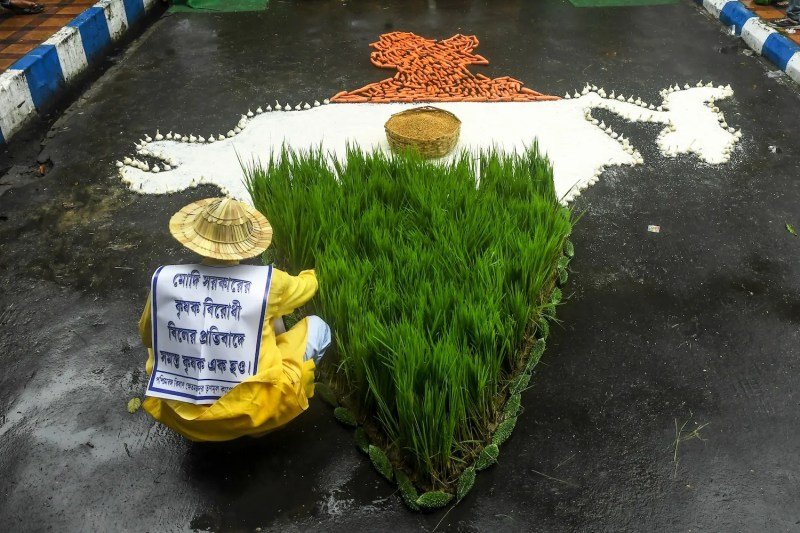
A farmer arranges crops in a shape of the map of India while participating in a protest against the Indian Prime Minister Narendra Modi’s government during a nationwide farmers’ strike following the recent passing of agriculture bills in Kolkata on September 25, 2020.Dibyangshu Sarkar / AFP
As Gen Z uprisings have upended South Asian politics, analysts are starting to ask what this could all mean for India, the world’s largest democracy. Safine Nabi writes, “India now finds itself grappling with an unexpected question: What does its rise as a global power mean when its immediate neighborhood is in political free fall?”
The movements have brought South Asia’s political stability into question—as well as New Delhi’s traditional role in ensuring that stability. “Ultimately, India’s ability to project power globally depends on the maintenance of a significant degree of calm in the region,” Nabi writes.
5. Madagascar’s ‘Coupvolution’ Is Following a Familiar Pattern
by Salah Ben Hammou and Jonathan Powell, Nov. 6
While many cheer the fall of entrenched governments, Madagascar’s movement illustrates the challenges in ensuring that protesters’ priorities win out after a revolution—especially when the military joins the cause in what analysts call a “coupvolution.”
Political scientists Salah Ben Hammou and Jonathan Powell look to Egypt’s 2013 Tamarod movement, among other recent examples, as a cautionary tale. But that doesn’t mean Malagasy protesters should just throw up their hands: “For citizens who mobilized against an unpopular leader and cheered his downfall at the hands of the military, the true test begins after victory: maintaining influence over the postcoup order without being sidelined by military officers consolidating power,” Hammou and Powell write.