When Venezuelan President Nicolás Maduro appears in a federal courtroom in New York to face narco-terrorism charges, the world will see a geopolitical spectacle.
However, for cryptocurrency investors, the proceedings carry a hidden financial stake that could reshape the global Bitcoin market for years to come.
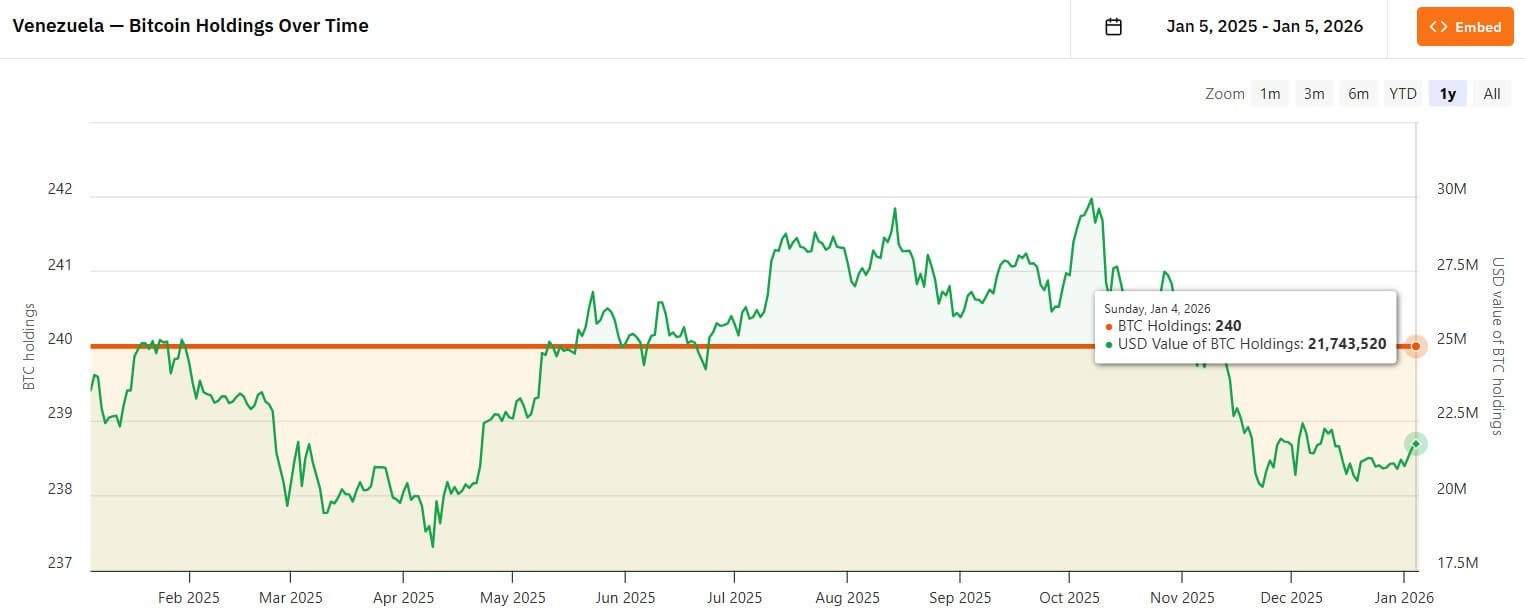
Data from Bitcoin Treasuries credit the Venezuelan government with holding just 240 Bitcoin, a position valued at approximately $22 million. On its own, such a balance is a rounding error, irrelevant primarily to global liquidity or price discovery.

However, a new Whale Hunt report suggests this official figure may be a mirage.
According to the report, the Maduro regime may have quietly constructed a massive BTC “shadow reserve” during the height of US sanctions.
Consequently, the actual figure of its holdings could be as high as 600,000 Bitcoin, a stash worth roughly $60 billion at current prices.
This would place the Latin American country’s holding near the scales of Strategy (formerly MicroStrategy) and significantly ahead of the United States.
If these projections are even directionally accurate, the US government’s capture of Maduro is not just a diplomatic victory but a potential seizure of nearly 3% of Bitcoin’s circulating supply.
How Venezuela allegedly acquire its Bitcoin reserves
The disparity between the official 240 coins and the rumored 600,000 stems from the opaque methods Venezuela allegedly used to survive economic isolation.
While public attention focused on the failed state-backed “Petro” token, analysts believe the regime was simultaneously conducting a massive diversification into decentralized assets.
According to the Whale Hunt report, this accumulation began in earnest around 2018, and the primary mechanism for the acquisition involved the aggressive liquidation of gold reserves from the Orinoco Mining Arc.
The reports continued that the regime swapped approximately $2 billion in physical gold for Bitcoin at average prices near $5,000. That specific tranche alone, if held intact, would now be worth billions.
Beyond gold, the country’s oil trade allegedly served as a constant funnel for digital asset accumulation.
To bypass the traditional banking system and avoid US sanctions, the state oil company frequently required payments in Tether (USDT).
Recognizing that stablecoins remain vulnerable to freezing by centralized issuers, the regime reportedly “washed” these funds into Bitcoin to secure them against foreign intervention.
Meanwhile, this pattern aligns with the government’s erratic domestic policy.
While authorities banned Bitcoin mining in May 2024, citing energy stability and seizing thousands of ASIC machines, they simultaneously ceased circulation of the Petro.
This behavior of crushing the private crypto sector while killing its own public token was consistent with a strategy to consolidate all digital wealth into a centralized, state-controlled reserve off the public books.
So, if the “shadow reserve” thesis holds, Venezuela is one of the largest Bitcoin whales in history, and control of those keys may now sit within the reach of US federal prosecutors.

The mechanics of a supply shock
The transfer of such a vast fortune from a rogue state to US custody would trigger a series of complex market mechanics.
Unlike a typical criminal seizure, the sheer scale of 600,000 Bitcoin creates a unique dilemma for regulators and a potential “supply shock” for investors.
The most immediate and likely outcome is a “frozen float.” If US authorities successfully identify and immobilize the assets, the coins would likely enter a state of deep legal paralysis.
Venezuela’s external debt obligations are massive, with creditors ranging from defaulted bondholders to corporations like ConocoPhillips that have won arbitration awards for past expropriations.
Just as these creditors have fought for years over the auction of Citgo shares, they would almost certainly file immediate injunctions against any seized Bitcoin. This litigation could drag on for a decade or more.
For the Bitcoin market, this is effectively a bullish signal: it mechanically removes a massive block of supply from circulation, locking it in a US Treasury escrow account where it cannot be sold.
Meanwhile, alternative scenarios present different risks.
A “strategic reserve pivot” remains a possibility, particularly given the shifting political winds in Washington. Under this scenario, Trump’s pro-crypto administration could intervene to prevent the liquidation of the assets, directing the Treasury to hold the Bitcoin as a permanent sovereign asset.
This would transform a narco-terrorism seizure into the seed capital for a US national Bitcoin stockpile, validating the asset class at the highest level of government.
Conversely, the “fire sale” scenario, a rapid liquidation similar to Germany’s sale of 50,000 Bitcoin in 2024, is viewed by analysts as unlikely given its market impact. Dumping twelve times that amount would crash prices, undermining the value of the seized collateral.
Thus, regardless of the specific legal path, Maduro’s arrest likely signals that these coins will be taken off the table for the foreseeable future.
Redefining sovereign risk
For long-term Bitcoin holders, the Venezuela case introduces a new variable to investment models: hidden sovereign risk.
Until now, the market has tracked government holdings based on voluntary disclosures, such as El Salvador’s purchases, or public seizure records from the Silk Road and Bitfinex cases.
The Maduro revelation forces investors to consider “dark pools” of sovereign wealth. If a financially crippled state under total blockade could accumulate $60 billion in Bitcoin, it stands to reason that other sanctioned or resource-rich nations may have adopted similar strategies.
This creates a “sovereign overhang,” a hidden supply of Bitcoin held by non-transparent state actors that can suddenly become relevant due to regime change or war.
Furthermore, Tether’s USDT involvement in the alleged accumulation creates secondary risks. If the Department of Justice unwinds the transaction history of the Venezuelan oil trade, it could lead to tighter scrutiny of stablecoin issuers and the “on-ramps” used by nation-states to exit the dollar system.
So, as legal proceedings in New York advance, the crypto industry’s primary focus will shift beyond the headlines of Maduro’s capture.
The market will be watching for the forensic details: the identification of wallets, the confirmation of the gold-swap accumulation, and the legal maneuvering of creditors.