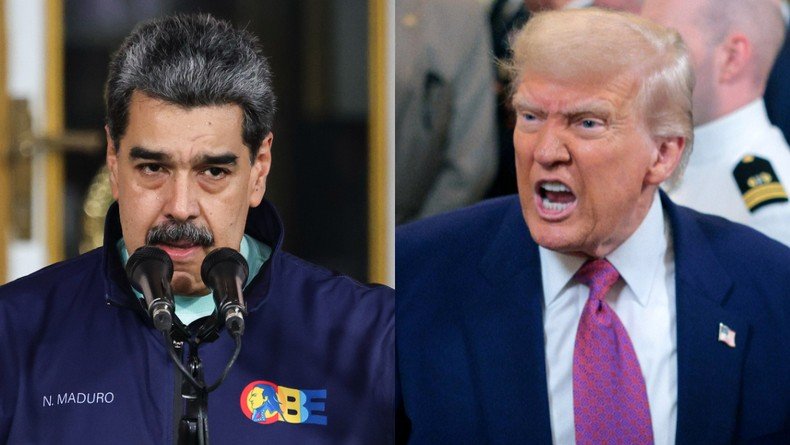
For decades, the continent’s leading nations have debated pathways toward genuine economic sovereignty. Today, amid Washington’s aggressive displays of power, the case for unity, financial, monetary, and political, has never been stronger.
The Venezuelan episode is more than a regional crisis as it represents a contemporary expression of a long historical pattern in which global powers leverage economic and military might to shape resource distribution, political alignment, and global governance.
For Africa’s heavyweights, this moment demands reflection and action to break the structural constraints of economic dependency, particularly on the United States dollar and Western financial institutions, while striving to fulfil aspirations once championed by visionary leaders like Muammar Gaddafi.


US invasion of Venezuela and reawakening of hard power politics
The administration justified this intervention through allegations of narco-terrorism and national security threats, but critics argue that real motivations lie in securing access to Venezuela’s vast oil reserves and reasserting US geopolitical dominance.
The broader context includes warnings from US leadership that other regional governments, including Mexico and Cuba, could face similar pressure if they do not align with US priorities, particularly on drug trafficking and political cooperation.
This has prompted strong condemnation across Latin America, with governments such as Mexico’s framing the actions as violations of the UN Charter and threats to regional peace.
International legal scholars and diplomatic voices have underscored that the operation contravenes widely accepted norms of state sovereignty and non-intervention, principles enshrined in the United Nations Charter.
Many Latin American leaders have drawn parallels to historical interventions that served strategic economic interests rather than humanitarian or security rationales.
If Washington is prepared to bypass diplomatic norms to influence its hemisphere, what might it do in other parts of the world where vital natural resources and emerging markets abound?
Economic hegemony, dollar slavery, and need for African monetary autonomy
The global financial system is deeply anchored in the US dollar. Oil trade, the world’s most strategically traded commodity, overwhelmingly uses the dollar as the medium of exchange, tying exporter and importer economies alike to the currency’s dominance.
Africa’s best-resourced nations, including Nigeria, South Africa, Egypt, and Kenya, remain structurally intertwined with this system. Their foreign reserves, trade finance, and international debts are denominated in dollars.
Currency volatility, debt servicing pressures, and external financial shocks continuously squeeze policy space.
United Africa proponents argue that a common currency and integrated economic institutions would reduce reliance on external currencies, enable greater control over fiscal and monetary policies, and foster cross-border investment within the continent.
Gaddafi’s broader campaign for continental unity sought to tie Africa’s abundant natural resources and growing markets through shared institutions, a collective bargaining approach, and a diminished dependency on former colonial powers.
While critics debated the feasibility of his proposals, the underlying rationale remains relevant: structural transformation requires financial sovereignty.
The case for unity in the face of external pressure
Africa has a wide range of economies, political systems, and levels of development. But powerful patterns emerge when viewed through the lens of external economic influence.
Raw materials are often exported in unprocessed form, while finished goods are imported. Trade within Africa remains limited compared to trade with Europe, the US, and China.
External debt burdens and conditions attached to financial assistance continue to erode policy autonomy in key areas of development.
In this context, unity is not about political homogenisation; it is about strategic cooperation that reinforces each member’s economic resilience.
A continental free trade area, deepened infrastructure links, and coordinated industrial policies would empower African economies to leverage their collective market size as a bargaining chip rather than remain fragmented targets of external conditionalities.
The fatal consequences of fragmentation were evident in Libya after NATO intervention in 2011. The overthrow of Gaddafi, followed by protracted instability, showcased how vulnerable African states can be when external powers intervene under pretexts that mask deeper economic interests.
This underscores the importance of building continental mechanisms capable of deterring or responding to such interventions, based on shared diplomatic, economic, and security frameworks.
Lessons from Latin America for Africa’s future
Latin American responses to the US invasion of Venezuela reveal a mix of condemnation and caution, dialogue and solidarity. Mexico’s insistence on peaceful conflict resolution and respect for international law reflects a long tradition of non-interventionist principles that could inform African diplomatic positions.
Regional institutions seek to hold external powers accountable to legal norms because failure to do so sets a precedent that could be invoked elsewhere.
For African heavyweights, these developments reinforce vital truths. First, global power dynamics are competitive and sometimes coercive. Second, dependence on external financial structures constrains national agency. Third, coordinated regional strategies can elevate collective bargaining power and secure more equitable terms in international relations.
A Strategic Imperative for African Unity
The dream of a United Africa, long articulated by leaders and reformers, might not be fully realisable in the short term. But its core principles, economic autonomy, monetary innovation, intra-continental trade expansion, and cooperative security, are attainable and urgently needed.
In a world where power is exercised through both complex and economic instruments, unity is not an idealistic luxury; it is a strategic necessity.