

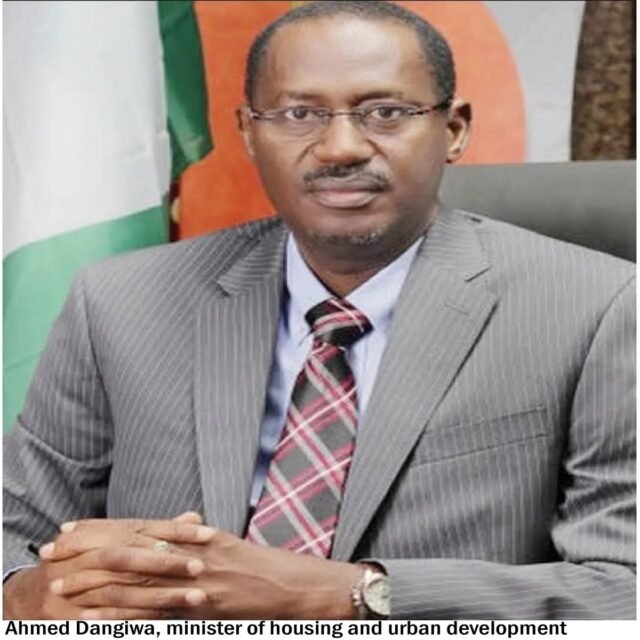


Minister of Housing and Urban Development, Arc. Ahmed Musa Dangiwa, has brought to light a significant issue: over 15.2 million housing units across Nigeria are not up to par structurally.
These residences, while physically present, do not meet the required benchmarks for safety, livability, access to essential utilities, robust infrastructure, and long-term durability.
The Federal Ministry of Housing and Urban Development’s research highlights a crucial aspect of Nigeria’s housing problem that goes beyond simply constructing new buildings.
Dangiwa revealed this information during the National Housing Data Initiative (NHD) presentation by the National Housing Data Technical Committee, held at the Ministry’s Conference Room in Abuja.
This committee, formed in August 2024, was tasked with creating a standardized national framework for housing data, designed to inform housing policy, planning, and investment decisions based on solid evidence.
The minister stated that the findings confirm Nigeria’s housing challenge has both quantitative and qualitative dimensions, and that estimations of the national housing deficit differ based on the data sources and methodologies used.
Dangiwa explained, “Beyond the overall deficit numbers, using standardized and globally recognized methods now allows us to confidently state that Nigeria is facing a housing inadequacy problem affecting approximately 15.2 million homes nationwide.”
He clarified that these 15.2 million inadequate housing units are existing homes that don’t meet the necessary standards for safety, habitability, access to basic amenities, infrastructure, and durability.
He further explained that the results were obtained by using the Household Crowding Index, the Adequate Housing Index, and a Composite Index Methodology, with data from the National Population Commission (NPC), the National Bureau of Statistics (NBS), the Central Bank of Nigeria (CBN), and other institutions within the housing sector.
The minister emphasized, “These findings clearly show that Nigeria’s housing challenge isn’t just about constructing new houses, it is equally about improving existing housing stock, revitalizing deteriorated neighborhoods, enhancing basic services and infrastructure, and assuring dignified, safe, and adequate housing results.”
The minister emphasized the significance of these findings, while also noting that housing inadequacy is just one aspect of Nigeria’s larger housing deficit.
He emphasized the need to maintain the same level of analytical clarity in other important areas, including overall housing shortages, affordability gaps, access to land and secure tenure, availability and cost of housing finance, infrastructure and service shortfalls, regional and urban-rural inequalities, as well as population growth rates, urbanization trends, household formation patterns, and demographic projections.
According to him, a thorough examination of these aspects is essential to accurately assess current needs, predict future demand, and develop sustainable and effective housing policies.
On behalf of the ministry, the minister formally accepted the National Housing Data Initiative’s presentation and report, calling it “a major intellectual, technical, and institutional milestone” in Nigeria’s journey to reform housing and urban development.
He further disclosed that the Federal Government has started the process of institutionalizing housing data by establishing a National Housing Data Centre. Initially, this center will be located within the ministry, but it will eventually be formalized through a Special Purpose Vehicle or a statutory framework.
According to the minister, the proposed center will become a permanent national institution capable of supporting housing policy development, investment decisions, access to housing finance, and large-scale housing delivery.
The minister praised the National Housing Data Technical Committee, led by Mr. Taofeeq Olatinwo, and acknowledged the contributions of participating institutions, including the Federal Ministry of Housing and Urban Development, Nigerian Mortgage Refinance Company, Nigeria Bureau of Statistics, Nigeria Population Commission, Federal Mortgage Bank of Nigeria, Central Bank of Nigeria, Federal Housing Authority, Family Homes Funds Limited, Real Estate Developers’ Association of Nigeria, Association of Housing Corporations, Mortgage Bankers Association of Nigeria, Housing Development Advocacy Network, and other industry experts.
He announced that the ministry will issue formal Letters of Participation and recognition to all committee members and participating institutions in recognition of their contributions to the report and its outcomes.
The minister noted that the National Housing Data Initiative fully aligns with President Bola Ahmed Tinubu’s Renewed Hope Agenda and strengthens the government’s ability to support affordable and social housing delivery, expand access to housing finance, increase investor confidence, stabilize housing markets, and monitor outcomes with credibility and accountability.
Describing the presentation as a turning point in Nigeria’s housing reform journey, the minister stressed that data is no longer just a side aspect of housing delivery, but a key component.
He stated, “With the National Housing Data Initiative, Nigeria is in a better position to plan more accurately, invest more confidently, and deliver housing more effectively and equitably for Nigerians.”
Dr. Shuab Belgore, the Permanent Secretary, stated that the National Housing Data Committee’s report will be published and distributed to all relevant agencies to officially validate the work done by the committee.
He also instructed the Department of Planning, Research, and Statistics (PRS) to follow up on the establishment of the Data Centre within the ministry, as recommended in the report, with the goal of ensuring it is ready by mid-January 2026.
Taofeeq Olatinwo, Chairman of the National Housing Data Technical Committee, noted that the housing deficit research involved the participation of various organizations, financial institutions, and industry experts, and that the committee worked with the World Bank to ensure data consistency and standardization.
He elaborated on the multidimensional index used to assess key aspects of housing quality, including access to water, electricity, sanitation, and other basic services.
He revealed that, based on the Adequate Housing Index, Nigeria’s housing deficit stands at 15.2 million units as of 2025, with Kano State having the highest deficit and Bayelsa State having the lowest.



