

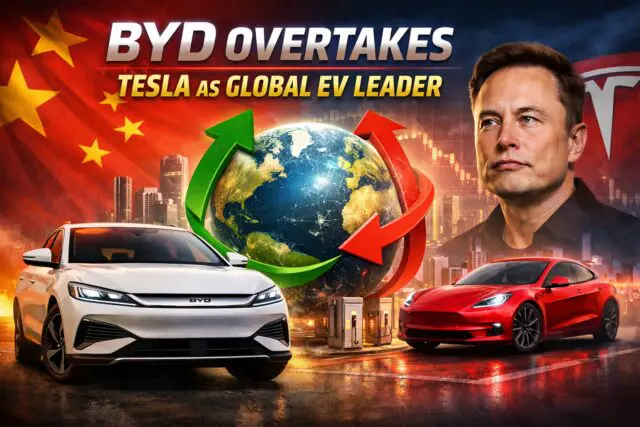

The global automotive landscape has reached a historic turning point. In a shift that has been building for years, China’s BYD (Build Your Dreams) has officially overtaken Elon Musk’s Tesla as the world’s largest electric vehicle (EV) manufacturer by sales volume.
This transition marks a new era in transportation, where vertical integration and mass-market affordability are challenging the Silicon Valley model of premium branding and autonomous software.


Why BYD is Winning the EV Race
BYD’s ascent to the top of the global EV market share is no accident. While Tesla pioneered the luxury EV space, BYD has conquered the market through several strategic advantages:
- Aggressive Pricing & Affordability: BYD models, such as the Dolphin and Atto 3, consistently undercut Tesla’s Model 3 and Model Y. By offering feature-rich vehicles at a fraction of the cost, BYD has tapped into the “mass-market” segment that remains largely out of reach for Tesla.
- Vertical Integration & Battery Tech: Unlike many competitors, BYD began as a battery company. They manufacture their own “Blade Batteries,” which are widely considered some of the safest and most efficient in the industry. This allows them to control costs and avoid the supply chain bottlenecks that have plagued other automakers.
- Diverse Product Portfolio: While Tesla focuses on a handful of passenger car models, BYD’s lineup is vast. It includes everything from entry-level hatchbacks to luxury SUVs, as well as plug-in hybrids (PHEVs) and commercial electric buses.
- Consumer-Centric Tech: BYD has been quicker to integrate familiar consumer technologies, such as Apple CarPlay and Android Auto—features that Tesla famously omits in favor of its proprietary software ecosystem.
Tesla’s Strategic Shift: From Cars to AI
Despite losing its crown as the volume leader, Tesla remains a formidable force with the highest profit margins in the industry. However, Elon Musk has signaled a clear pivot in the company’s direction.
– Advertisement –
Tesla is increasingly positioning itself as an AI and Robotics company rather than a traditional automaker. With a heavy focus on Full Self-Driving (FSD) technology, the Optimus humanoid robot, and the Robotaxi initiative, Tesla is betting that the future of value lies in autonomy rather than just hardware sales.
Furthermore, Tesla’s Supercharger network remains the gold standard for charging infrastructure, providing a “moat” that BYD and other manufacturers are still struggling to match in Western markets.
Regional Dominance: China and Europe
The battle for EV supremacy is being fought primarily in two theaters:
- China: As the world’s largest car market, China is BYD’s home turf. Backed by government incentives and a robust domestic supply chain, BYD has become a national champion.
- Europe: BYD has made significant inroads into European markets, offering competitively priced alternatives to local brands and Tesla alike.
Outlook for 2026
As we move through 2026, the competition is expected to intensify. Tesla’s long-promised “next-generation” affordable platform will be critical to reclaiming market share. Meanwhile, BYD faces potential headwinds from international trade tariffs as Western nations seek to protect their domestic auto industries from the influx of Chinese EVs.
The “EV War” is no longer just about who can build a car with a battery—it is now a battle between two different philosophies of the future of mobility.


