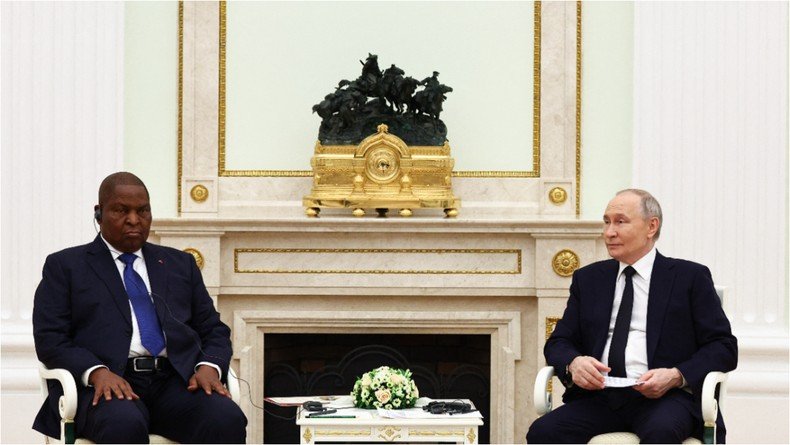
At 68, the former mathematics professor is counting on a revised constitution and a campaign built around stability to extend his rule beyond the original term limits.
Analysts say the political arithmetic favours the incumbent, aided by state resources and the backing of civil servants.
“The president will win because he has much more financial capacity than the opponents,” said Charles Bouessel of the International Crisis Group.
His presidency has been notable for firsts.
In 2022, the country made headlines by adopting bitcoin as legal tender, becoming the first African nation and only the second globally to do so after El Salvador.
Campaigning in Bangui this month, Touadera highlighted improvements in security and mobility.
“When I came to power in 2016, you couldn’t travel 10 km without being harassed. There was no security, no roads, nothing. We have worked so hard to achieve this result today,” he told supporters.
He has also promised infrastructure investment, recently signing a deal to roll out Starlink internet services.
Despite his closeness to Moscow, Touadera has signalled openness to Western partnerships, saying he would welcome any country willing to develop the country’s lithium, uranium, and gold reserves.
That recalibration comes as scrutiny grows over the cost of Russian security assistance.
Security remains the dominant issue for voters in a country scarred by repeated unrest since independence in 1960. Rwanda deployed troops five years ago to secure elections and maintains a presence.
Peace deals signed this year with several rebel groups have reduced violence in some areas, contributing to economic growth of about 3 percent, up from 1.9 percent in 2024, according to IMF data.
Still, analysts warn that the gains are fragile amid incomplete disarmament and cross-border incursions from Sudan.
“There are a lot of ingredients that could lead to a renewed cycle of violence,” said Nathalia Dukhan of the Global Initiative Against Transnational Crime.
Touadera’s economic bets, including cryptocurrency ventures and plans for a regional railway, have yet to ease hardship.
Two-thirds of the population lived in extreme poverty in 2023, according to World Bank data.
“We are always promised jobs and schools, but many young people remain unemployed,” said Clarisse, a university student in Bangui.