

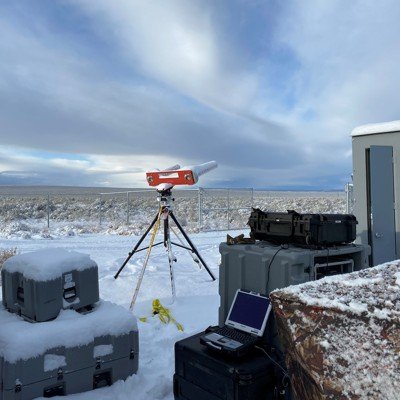
U.S. special warfare trainers are asking government regulators to expand the areas where the military can jam cellular and GPS signals to simulate a modern warfare environment, officials said.
The need is urgent, officials from the U.S. Army John F. Kennedy Special Warfare Center and School, or SWCS, said, because—as seen in Ukraine—drones and electronic warfare are soaring in importance.

U.S. troops must learn to operate amid jamming that is far more powerful and ubiquitous than just a few years ago. In Ukraine, this has led to drones controlled by fiber-optic cables or even their own autonomous systems.
Some Russian drones use high-powered (and often illicitly acquired) chips to pick out targets based on things like shape and size, reducing their dependence on jammable communications or navigation systems.
Students at the school are deeply familiar with these trends. “They follow people in Ukraine,” Lt. Col. Nicholas Caputo, commander of the 6th Battalion, 2nd Special Warfare Training Group, told Defense One. Those students, training for future conflict, “expect us to make sure all of that is integrated through their pipeline.”
This year the center launched a new course for Army tactical signal intelligence and electronic warfare. “We have done one pilot, one iteration of this to figure out: What do we really need to teach? What’s the resourcing? What are the instructors? … What can the Department of the Army gain” beyond special operations forces? Caputo said.
The pilot ran from July to October, with 15 students enrolled. A new class is to begin next May.
The Army has also created a new robotics detachment, launched in March 2024, and, in May, a new specialist role for robot technicians.
In a statement, center commander Maj. Gen. Jason Slider said these new initiatives reflect the new reality of warfare: “Never again will there be a time in warfare where a soldier doesn’t throw a piece of robotic kit onto the ground, into the water, or into the air to perform some tactical task associated with aiding a partner force, gaining advantage over an adversary, and closing with and killing the enemy.”
But it is difficult to train for this future on U.S. soil, where civil authorities heavily restrict the use of GPS jammers and other electronic warfare weapons.
“If this is the future of warfare, then we need to collaboratively find a way to carve out airspace in order to employ these systems,” Caputo told Defense One in an interview. He said the center has submitted the paperwork to get the Federal Aviation Administration, the Federal Communications Commission, and other relevant agencies to increase the number of places where such training could occur, at least temporarily. He hopes to see some of those efforts come to fruition within a year.
“We’re going to start having some of these uncomfortable discussions” with civilian and federal authorities, he said. But it is thanks to new Pentagon policy efforts, like one launched in July, that the discussions are possible at all. “A year and a half ago, our predecessors were not making a lot of headway” on the issue. “This is now a priority.”
Congress has recognized the problem, somewhat. The most recent version of the NDAA includes provisions to link testing sites to improve range availability and mandates that EW become a feature in certain future exercises involving special operations forces.
More jammable space is also needed to practice creating and modifying drones on the battlefield, said the center’s Command Chief Warrant Officer Gary Ostrander. During the new six-week course for robotic technicians, instructors had to seek training areas away from Fort Bragg, N.C.
“Specifically, we’re going to go to Alabama, which has a range complex capability where we can employ electronic measures to challenge those systems the way we program them, the way we are piloting them. The only limitation is that we cannot turn on GPS jammers, and that requires specific range training,” Ostrander said.
The Joint Staff manual on electronic warfare training says the United States has really only two sites where cellular and GPS jamming exercises or experiments occur regularly: the White Sands Missile Range in New Mexico and the Nevada Test and Training Range. The military occasionally tests GPS jamming in other locations, such as Fort Liberty (also called Fort Bragg) in North Carolina and Edwards Air Force Base in California. But the FAA has to grant that permission and then send out advisories describing how long the interruptions will last.
The FAA has sent out only 10 advisories of pending GPS interruptions in 2025, according to publicly available notices, which speaks to a now-obsolete view of GPS in general, as an attribute the U.S. had long-term control over. That assumption led the military to build out arsenals of missiles and other weapons that used GPS for greater precision. But the government also saw the value in allowing telecommunications companies access to the GPS signal to build out commercial applications. As more and more services, businesses, and people came to rely on GPS, the U.S. military set up elaborate bureaucratic processes for testing in a GPS-denied environment, processes involving multiple federal agencies and the use of a heavily restricted Air Force-owned GPS modeling tools to calculate the duration and impact of the test on spectrum availability, notes the manual.
The problem now is that America’s enemies need not go through those processes to see how GPS and electronic warfare affect drone or software designs. They can just pay a visit to Ukraine’s front lines.


