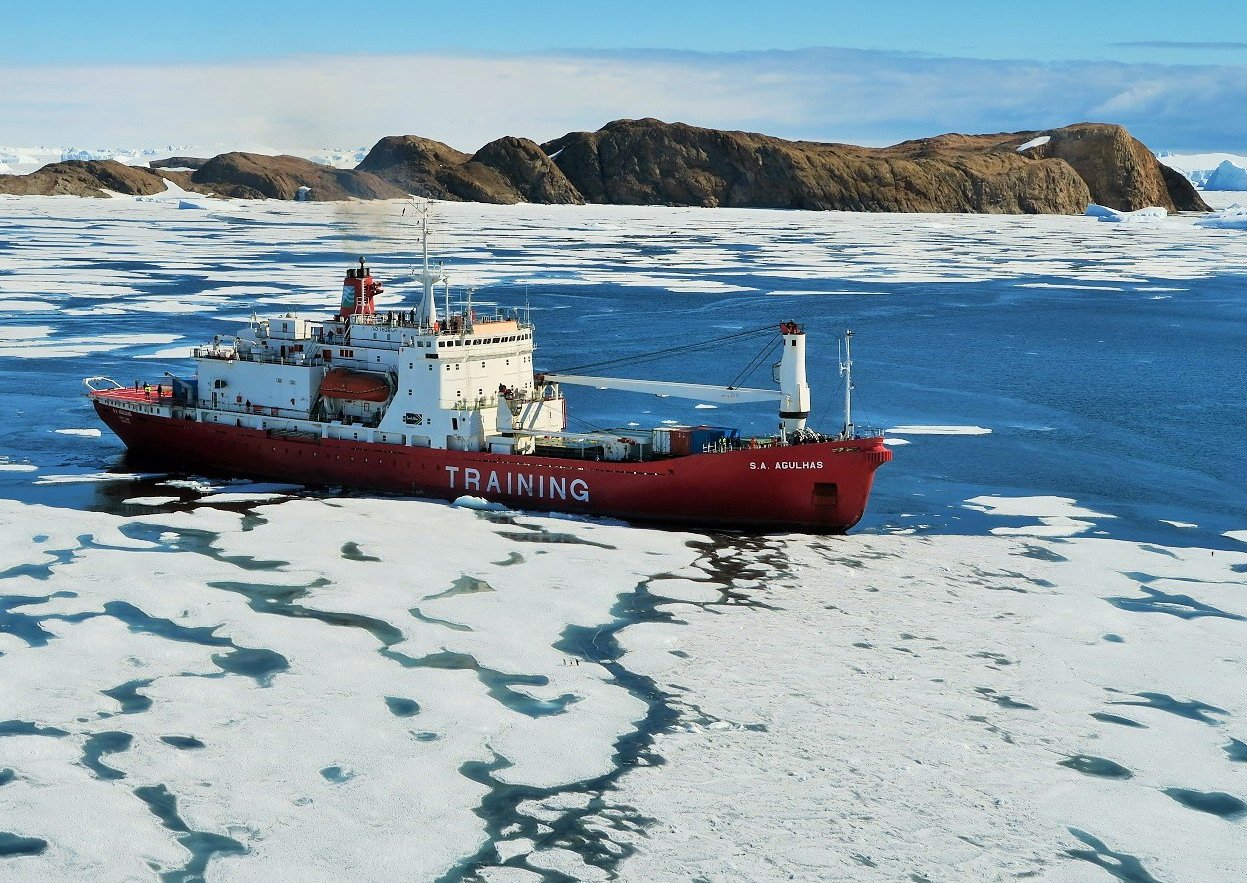
The Southern Ocean, encircling Antarctica and extending northwards to about 60° south latitude, contains some of the world’s richest polar marine living resources. Around 85% of the planet’s ocean biological productivity depends on nutrients from this ocean. It is also a crucial sink for sequestering CO2, helping to regulate the global climate.
However, many national and regional strategies overlook the need for a healthy and protected Southern Ocean. The strategies of France, Japan and the United States do not mention the region, nor does the Indian Ocean Rim Association’s Indo-Pacific Outlook.
South Africa is an original signatory to the Antarctic Treaty and the only African country with voting rights in the Antarctic Treaty System. With 1 December marking International Antarctica Day, the country’s role in shaping Southern Ocean governance and the Antarctic Treaty System should be considered.
Antarctica and the Southern Ocean face heightened geopolitical scrutiny – from increased scientific bases to interest in potential mineral resources. South Africa is uniquely positioned to protect the region and champion Africa’s interests in the Antarctic. But several challenges must be overcome.
Although the country adopted an Antarctic and Southern Ocean Strategy in 2021, the region remains a blind spot. Given how much is at stake, this ocean must be explicitly incorporated into South Africa’s broader strategic scanning, for three main reasons.
First, South Africa is responsible for search and rescue in the vast and remote Southern Ocean – one of the world’s most treacherous maritime zones with some of the highest waves worldwide. This is a challenging obligation, considering increased shipping traffic around the Cape of Good Hope due to Houthi attacks in the Red Sea.

South Africa is expected to have vessels and planes capable of travelling throughout its search and rescue area at any time. For example, SA Agulhas helped rescue the stranded German vessel Magdalena Oldendorff in 2002, airlifting the crew to safety with its two Oryx helicopters.
In 2011, the South African Navy’s SAS Isandlwana helped a Taiwanese fishing vessel after an onboard gas explosion off Tristan da Cunha – 2 810 km from Cape Town, the closest port. In 2020, the Department of Forestry, Fisheries and the Environment-owned SA Agulhas II helped rescue 60 seafarers aboard a Belize-flagged fishing vessel. The ship sank near Gough Island, where South Africa has a weather station.
Several gaps limit the country’s search and rescue capacity. In 2021, uncertainty surrounding helicopter contract renewals forced SA Agulhas II to sail to Antarctica for the first time in 40 years without its helicopters, which had been key to past rescue missions. Although the navy can assist, it has limited assets – only one fully operational frigate – and its ability to track maritime incidents is constrained.
The second reason why South Africa should prioritise the Southern Ocean is that Cape Town is one of five gateway cities for tourism to Antarctica. Across Africa, Antarctic tourism has grown from under 10 000 visitors in the early 1990s to over 100 000 in 2023. South Africa must ensure it operates adequate rescue and emergency response capabilities.
Third, what happens in Antarctica and the Southern Ocean does not stay in the region. This ocean comprises the Antarctic Circumpolar Current, which connects the Atlantic, Pacific and Indian oceans, so any changes it experiences have global repercussions.

The warming of the Antarctic region, which holds 70% of the world’s freshwater, may lead to rising sea levels, impacting coastal infrastructure and communities in South Africa and neighbouring low-lying island and continental areas. Higher CO₂ levels cause ocean acidification, disrupting marine ecosystems and food security, which is worrying for Africa, where millions depend on fish as a primary source of nutrition.
Ocean circulation changes will also likely influence precipitation patterns and more extreme weather events, exacerbating Africa’s vulnerability to climate change. And as oceans warm worldwide, fish may migrate to the Southern Ocean, shifting the distribution of key fisheries.
Emperor penguins, a crucial element of the Antarctic food chain, are already being impacted by sea ice loss. In the Antarctic Peninsula, one colony has disappeared.
South Africa must pay more attention to the region and build on its scientific presence to ensure it can meet its security obligations. The country’s 2021 strategy is a significant statement of intent, but can it be implemented?
Several steps could ensure that the Southern Ocean and Antarctica are incorporated into South Africa’s strategic scanning.
The 2021 strategy must be updated and popularised. Its current action plan ends in 2025, so a follow-up is needed. South Africa could also raise the importance of the Southern Ocean and Antarctica at the Indian Ocean Rim Association.
The country should consider advocating for a dedicated maritime information fusion centre for the Antarctic and Southern Ocean. This could include an operational component, where stakeholders simulate distress incidents, testing communication chains, decision authority and logistics.
Finally, the Southern Ocean should be integrated into South African maritime policies such as Operation Phakisa and the Oceans Economy Master Plan, to recognise the region’s implications for food, climate and human security.
South Africa not only participates in Southern Ocean governance, but shapes the Antarctic Treaty System’s adaptation to climate change, bioprospecting, environmental liability and tourism, among other issues. This has been achieved through persistent involvement in the various treaty decision-making bodies, and contributions to scientific research on Marion and Gough islands, and at the South African National Antarctic Expedition IV on Antarctica.
As the only African state party to the Antarctic Treaty System, it could promote both national priorities and wider continental interests, which could be presented at the 48th Antarctic Treaty Consultative Meeting in Japan in 2026.
The country should maximise the opportunity to ensure African perspectives are credibly represented when the future of the Southern Ocean and Antarctic Treaty System is debated.
Written by Daniela Marggraff, Postdoctoral research fellow, Ocean Regions Programme, University of Pretoria; and Timothy Walker, Senior Researcher, Maritime, ISS Pretoria.
Republished with permission from ISS Africa. The original article can be found here.