

Egyptian companies have revealed a wide range of cutting-edge military equipment at the Egypt Defence Expo (EDEX) 2025 in Cairo this week, ranging from one-way attack drones to multiple rocket launchers (MRLs).
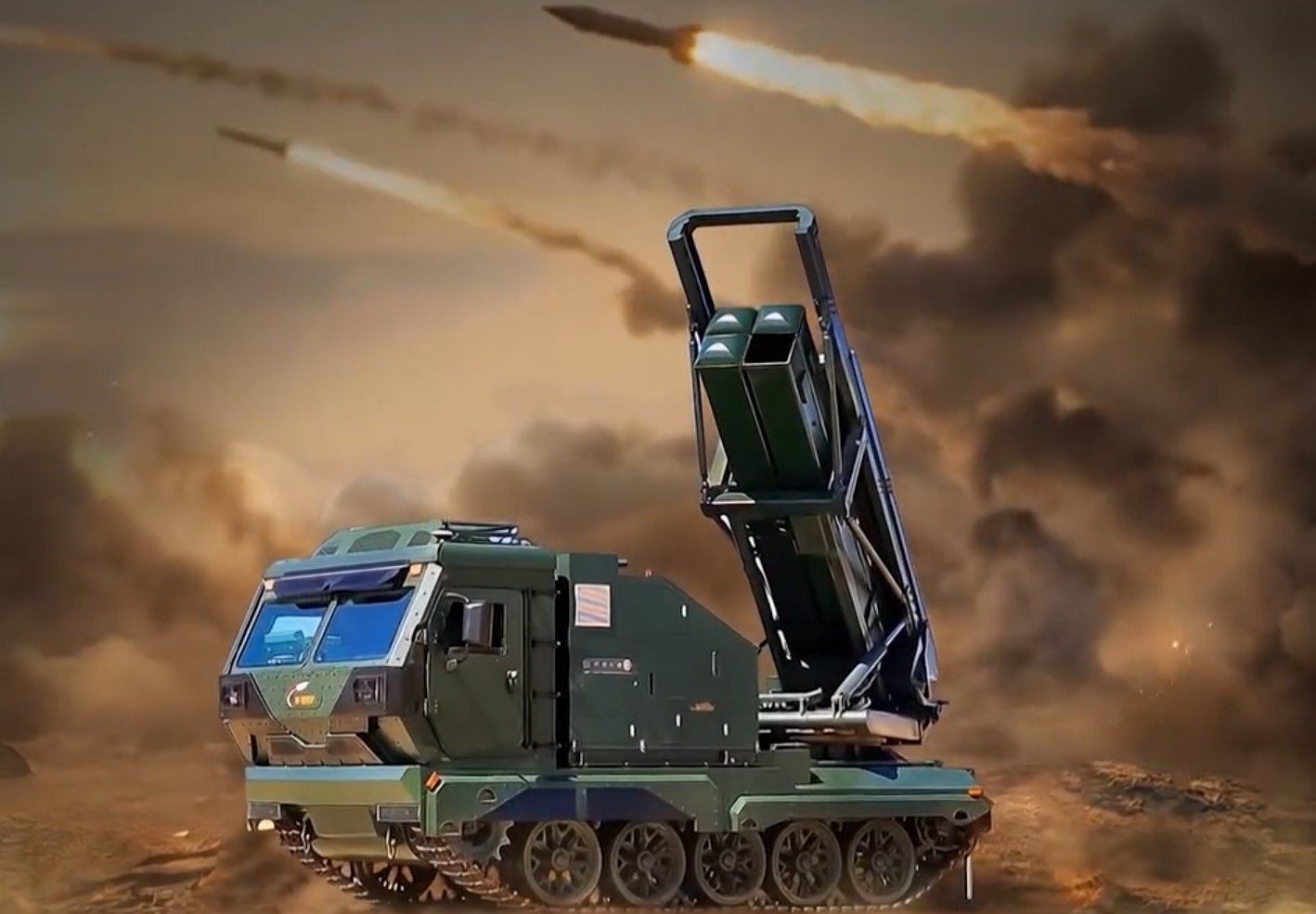
A highlight from the Arab Organisation for Industrialisation (AOI) was the unveiling of its Rad’a 300 MRL, which combines a smaller version of the self-loading launcher used by Norinco’s SR5 MRL with AOI’s improved version of the ATS-59G Soviet tracked carrier, Janes reported.
The Rad’a 300 has one munitions pod instead of the two carried by an SR5. This can be loaded with 20 122 mm artillery rockets or Norinco’s Fire Dragon family of guided surface-to-surface missiles. The missile options listed for the Egyptian system were 220 mm (six per pod) with a range of 25–75 km, 300 mm (four per pod) with a range of 30–150 km, and 610 mm (one per pod) with a range of 100–290 km, according to Janes.
The system can deploy in 2 minutes, takes 5 minutes to respond to an order to fire, and can reload itself in 3 minutes. It is fitted with a fire-control system that enables target co-ordinates to be entered manually or automatically via a command-and-control system. It can also be remotely fired from up to 60 m away.
AOI has an agreement with Norinco to export the Rad’a 300 to other countries. While tested and approved by the Egyptian Armed Forces, the Rad’a 300 has not been ordered by them.
Also introduced at EDEX 2025 was the Sinai 806, an armoured recovery and maintenance vehicle produced entirely in Egypt. The platform supports the Sinai 200 tracked vehicle family and features a 2-ton lifting winch, towing power of up to 30 tons, and full repair equipment, all with the same protection level as armoured combat vehicles.
A light 4×4 platform was fitted for the first time with a 23 mm twin-barrel anti-aircraft gun adapted to reduce recoil, allowing for use against both ground and air targets. The gun delivers a high rate of fire—1 600 rounds per minute—and can hit targets at more than 2 kilometres on the ground and 2.5 kilometres in the air.
Minister of State for Military Production Mohamed Salah El-Din said Egypt has advanced its ability to produce armoured steel, now manufacturing thicknesses up to 30 mm and widths up to 240 cm, double its previous capacity—part of a broader push to localise key components used in tanks and combat vehicles.
The ministry displayed a model of the K9A1EGY 155 mm howitzer, being jointly produced by Hanwha in South Korea and in Egypt. A dedicated production line is nearing completion, with the first battalion set for delivery in the first half of 2026. Ammunition for the system is already being produced domestically.

Egypt has also upgraded the Raad 200 rocket launcher with a new hydraulic control system and improved targeting mechanisms, the minister said.
Another highlight from EDEX 2025 was a new range of drones from Egyptian company Tornex. Its Jabbar 150 one-way attack drone has a maximum takeoff weight (MTOW) of 150 kg and is powered by a piston engine giving an endurance of 10 hours. A gimballed camera allows for target selection.

Photo: Tornex
Tornex also displayed the larger Jabbar 250, which has a MTOW of 250 kg. It is powered by a small turbojet engine that gives it a speed of 576 km/h. The aircraft has a wingspan of 3.45 metres, a payload of 50 kg, and a maximum range of 1 500 km. Endurance is 2.5 hours.

Photo: Tornex
Powered by a piston engine, the smaller Jabbar 200 has an MTOW of 200 kg and looks similar to the Iranian Shahed-136 long-range one-way attack drone. It has an endurance of 14 hours, speed of 200 km/h and 50 kg payload.
The new Jabbar range is designed to sit between Egypt’s ballistic missile inventory and its growing range of medium-altitude, long-endurance (MALE) UAVs, including platforms such as EJune 30 SW, Ahmous, and 6th October.
On the smaller end of the scale, Tornex offers the electrically powered Voltex-10 fixed wing unmanned aerial vehicle (UAV) with an endurance of 120 minutes, speed of 200 km/h, range of 400 km, and payload of 10 kg. Its Voltex-5 loitering munition is similar to the Switchblade and has an endurance of 60 minutes, speed of 180 km/h, range of 400 km, and payload of 10 kg. Two bomb guidance kits were displayed: the GK-10 kit offers a circular error probability (CEP) of less than 30 metres and a diving speed of 700 km/h. The GK-6 kit offers a CEP of 2 metres.

Photo: Tornex
AOI had a big range of new products in display, including the FL350 manually-launched guided munition, saying it can be used for targeted, close-range attacks. It weighs 500 grams, carries a payload of 60 grams, has a battery life of 15 minutes and a range of 3 kilometres.
Also seen at EDEX 2025 was the AOI Hamza 1 reconnaissance and surveillance drone developed locally in collaboration with the Turkish company Havelsan; Nizek 1, 2, and 3 munitions designed to equip attack drones; and the Saqr 105 RPG launcher. The Hamza 1 is a fixed wing vertical takeoff and landing UAV fitted with an electro-optical gimbal on the nose, based on Havelsan’s Baha UAV. In August, Havelsan and AOI announced a partnership for the production of UAVs.
AOI’s Aqrab (Scorpion) unmanned ground vehicle (UGV) – equipped with a remotely controlled 12.7 mm gun, electro-optical and infrared cameras, and a laser rangefinder – attracted significant attention at EDEX 2025. The 6×6 vehicle can perform patrol, fire support, or reconnaissance missions in high-risk areas without exposing military personnel. The Scorpion was also developed in collaboration with Havelsan. The system’s modular architecture allows customers to replace the weapon station with their own machine guns, electro-optical turrets, non-lethal payloads, or even engineering tools.

Other AOI products showcased included a Fahd armoured vehicle with a remotely operated turret fitted with a 30 mm cannon and anti-tank missile launchers; backpack and handheld jammers; SAKR 105 recoilless rifle; van and armoured vehicle-mounted HARIS-4 and HARIS-2 counter-drone systems; cellphone signal jammer; and wireless eavesdropping device. An unmanned surface vessel (USV-001) was displayed fitted with an Eagle-2 remote weapon station, produced locally in collaboration with Spain’s Escribano.
On the vehicle side, a new Special Forces variant of the 4×4 Temsah-3 armoured vehicle was displayed – this features a protected cab for two crew and an open-topped rear with four 7.62 Sinai 300 machineguns installed on pintle mounts. A 6.5 litre diesel engine gives a top speed of 125 km/h. Production is believed to begin soon.
Amstone International Group introduced its ST-108 GPR mine detection vehicle built on an armoured vehicle chassis with a wide ground penetrating radar system. A hydraulic boom above the cab fitted with a grabber attachment can be used for demining activities without the crew having to leave the vehicle.
Apart from products being displayed for the first time, EDEX 2025 also witnessed the signature of numerous memoranda of understanding: Aselsan signed cooperation agreements with Amstone and Tornex, while AOI and Norinco signed an MoU to localise defence production, and Pakistan’s GIDS signed an MoU with AIO. Further AOI MoUs were signed with Emirati-Chinese company Qalaa Red Flag and Chinese company Shadow Wings.
AOI also signed seven agreements with the UAE’s Abu Dhabi Aviation Group to cooperate on manufacturing, maintenance and logistics. The partnership involves AOI’s Aircraft, Engine, and Helwan factories working with Abu Dhabi Aviation subsidiaries, including Maximus Air, Global Aerospace Logistics (GAL), and the Advanced Military Maintenance, Repair and Overhaul Centre (AMMROC).
EDEX runs from 1 to 4 December. The last edition of the show in 2023 hosted over 34 000 participants from 97 countries – this year there are more than 450 companies exhibiting, along with 25 national pavilions, and official delegations from 100 countries. About 40 000 exhibitors are expected over the four days of the show.


