


Zimbabwean farmer Dan Burger is involved in 13 joint farming ventures with beneficiaries of that country’s land reform programme, an initiative the government is championing to address the underutilisation of expropriated farms.


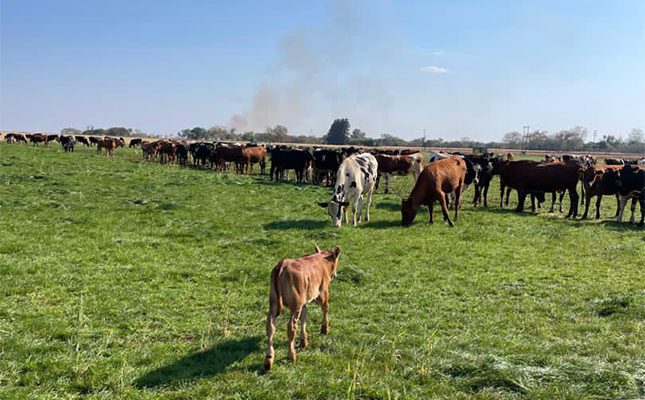
In 2020, Zimbabwe President Emmerson Mnangagwa’s government launched a joint venture (JV) initiative that links landowners without resources or agricultural know-how to investors, in a bid to revive farming operations on dormant properties by developing farmers’ skills, increasing mechanisation, and unlocking finance to boost productivity.
This marked a departure from the approach of the late former president Robert Mugabe, who believed such arrangements would allow white former farmers back onto the land, thereby reversing his land reform programme.
More than 2 400 JVs approved so far
For the JVs to be legally binding, they must be approved by the Ministry of Lands, Agriculture, Fisheries, Water and Rural Development (MLAFWRD).
In September 2025, the MLAFWRD said in a press release that the government had approved more than 2 400 land JVs, encompassing a total of 217 739ha.
Farmer Dan Burger, who has operations in Kwekwe in the Midlands Province, says he has been growing different crops on the 13 JV farms he is involved in, including paprika for export, table potatoes for the local market, and seed crops such as maize, wheat, and soya bean to support the local seed supply. 
He also grows commercial wheat, maize, barley, white and red sorghum, mung beans, chia, and soya bean.
“We work with 13 landholders on varying sizes of land, which have been developed to different levels, so our JV crop-share structures vary to suit the individual agreements.
“We entered into these JVs to expand our existing home farm, achieve better scale, and make use of the equipment and management expertise we already had, which could cover more hectares than were available on our own farm. At that stage, buying land wasn’t an option for expansion,” says Burger.
“We have worked very well with most of our JV partners, though we’ve had issues with some, which forced us to terminate those agreements. We have already renewed some JVs, which shows their success. We hope to continue with these [partnerships] in a mutually beneficial way.
“While it is a lot more expensive than farming one’s own land over the long term, it allows for short-term expansion without huge capital outlay,” he adds.
The JV process
Burger adds that, where landowners were failing to fully utilise their farms, the government introduced the concept of operating partners.
He says some of the reasons the land was not fully utilised included a lack of interest in farming, a lack of finance, insufficient knowledge, or a combination of these factors.
Burger explains how the JV works: “The landholder just contributes the land and has no other obligations. The operating partner handles all matters relating to production and the running of the farm. In return, the landholder gets a certain percentage of the total crop produced.
“For instance, if I get 100ha of land from a landholder and it includes some infrastructure like pipelines and sheds, I may agree to a 7% crop share. So, if I produce maize on that 100ha and achieve a yield of 10t/ha, giving me total production of 1 000t, the landholder will receive 70t of maize for providing the land.”
Burger says he has doubled his production thanks to the JVs. “However, the JV agreements are very expensive, as they add to our variable costs. We pay a share of gross production, whether we have made money or not.
“Even so, there has been a positive impact on both us and our JV partners, who have used the proceeds to invest in other areas of their lives like housing, additional farming and livestock, cars, and more,” he explains.
Farming contracts protect investors
When asked for comment on the JVs, lawyer Godknows Hofisi referred Farmer’s Weekly to a document he authored on the subject.
In the document, Hofisi says Zimbabwe’s Land Commission Act states that no landholder can enter a partnership for the working of his or her holding or portion of gazetted land without the consent in writing of the MLAFWRD minister.
The document also states that the areas covered by the standard JV agreement template provided by the ministry include the following:
- The type of farming operation and the land size to be used;
- Financial input by the JV partners;
- A declaration that the landholder will not enter into more than one JV for the same piece of land;
- Rights granted to the investor, such as the exclusive use of the landholder’s irrigation infrastructure on the land, the ability to build staff accommodation, and permission to clear trees or timber to open arable land; and
- Notice period and conditions for JV termination.
An example of a JV agreement in the tobacco industry, which the Commercial Farmers Union of Zimbabwe shared with its members, states that the JV partner will continuously manage all normal farming operations; oversee and control all aspects of tobacco farming; arrange and provide financing for farming activities, including the repayment of any loans; manage all finances related to the farming operations; and handle all labour associated with the farm.
It also states that the investor is responsible for supplying, maintaining, and repairing machinery and equipment, marketing the entire tobacco crop and any other crops grown, and collecting the proceeds.
Burger said there are no new farm evictions taking place in Zimbabwe, which gives JV partners a sense of security.
While the government sees the JVs as an innovative way to boost agriculture, it is apparent that some people who took over farms did not have the capacity to undertake large-scale farming enterprises, a systematic failure under Zimbabwe’s agrarian reform.
Burger said contracts or forms that one can sign differ to suit various situations on the ground so that the JVs can take off without hindrance.


