

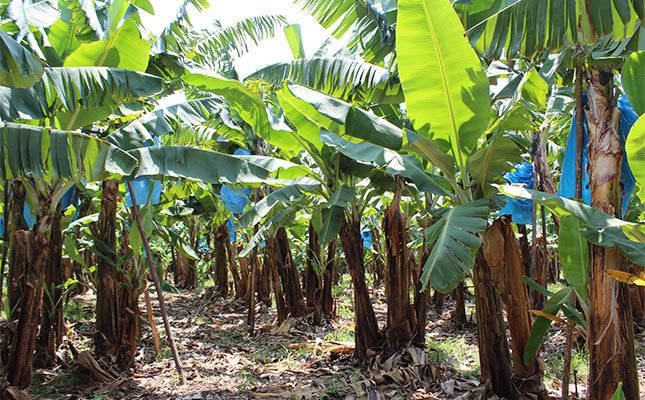
South African banana farmers face low prices and plant diseases that could threaten the industry’s sustainability if proper safeguards are not put in place.


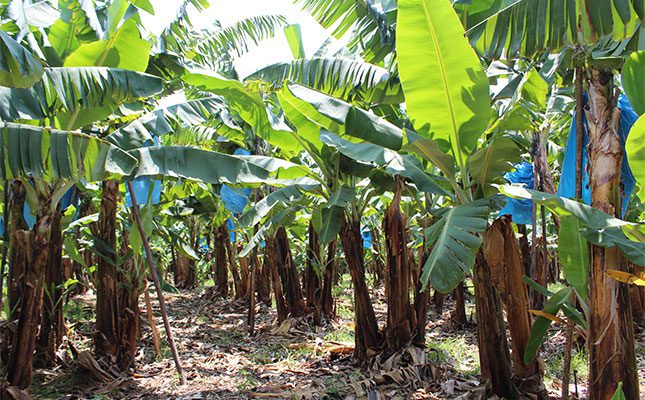
Photo: Lindi Botha
South Africa’s banana supply is dominated by Mozambican imports, which cost far less to produce than local bananas because of lower wages.
In Mozambique, the minimum wage for farmworkers is R1 792/month, compared with R4 836,72 for South African farmworkers, based on 21 eight-hour days per month.
Speaking to Farmer’s Weekly, Blaine Peckham, chairperson of the Southern KwaZulu-Natal Banana Association, said a banana farmer’s biggest expense is the wage bill.
“This gives Mozambican farmers an advantage over South African farmers,” he added.
Several role players in the industry put the percentage of Mozambican bananas sold on South African markets at around 60%.
Jan Lourens, a banana grower in the Onderberg region of Mpumalanga, said the local industry could not be forsaken in the name of a free market.
“There are thousands of jobs at stake if the South African industry is decimated.”
Statistics on employment in the banana industry haven’t been updated since 2011. At that time, the Department of Agriculture recorded 27 033 direct jobs, supporting around 108 131 people dependent on those salaries.
A producer, speaking on condition of anonymity, said farmers earn about R165 per 17,5kg box of bananas on the fresh produce market over a 12-month period.
“This translates to R9,42/kg. So, the farmer gets about 52% of the price consumers pay for 10 to 14 months of work, which is the time it takes to produce bananas. The retailer, who takes around four days to sell the bananas, receives 48% of the price [R18/kg]. Farmers take all the risk to produce the bananas but aren’t rewarded fairly,” he explained.
Another concern is that certain unregulated Mozambican banana imports pose a phytosanitary risk.
Suné Wiltshire, general manager of the Du Roi banana laboratory, explained that while South Africa has fusarium wilt, it is not the devastating TR4 strain that is decimating plantations globally and is present in northern Mozambique.
Lourens said that if TR4 were to enter South Africa, the industry would be “doomed”: “We need assistance from government to ensure phytosanitary protocols are in place to prevent the disease from entering South Africa. Unchecked imports are a big threat, and we are pleading with government to protect the local industry.”
Another challenge from the influx of bananas from Mozambique and Eswatini is that municipal fresh produce markets are flooded during peak season. This limits cooling area, forcing farmers to accept lower prices or risk their bananas perishing.
Local market collusion
Farmers are also battling low prices at the municipal fresh produce markets as buyers allegedly collude to keep prices low. A market source, also speaking on condition of anonymity, said a “Nigerian mafia” dictated banana prices on the Mandela People’s Market (MPM) in Johannesburg, Gauteng.
“Around 80% of bananas sold on the Joburg Fresh Produce Market go to the MPM, where they are then sold to hawkers. The MPM provides a safety net for farmers, because retailers won’t necessarily buy a box of bananas if one or two have spoiled.
“If farmers sold directly to hawkers, the prices would be much lower. So, the MPM takes the box, splits it, and ensures only the good bananas are sold to the hawkers, thereby getting a better price.
“But a group of Nigerian buyers has started to dominate this market. They decide on the price and won’t budge until it drops to their level. Sellers know they can’t hold bananas for too long, as they will spoil, so they are forced to sell at insanely low prices. It makes it very difficult to get proper returns on bananas.”
Fluctuating volumes
The anonymous market source noted that bananas’ profitability depends on timing at the markets.
“Bananas are seasonal, and when volumes are high, there’s little room to negotiate higher prices because of their short shelf life and limited market storage capacity.
“Once farmers meet their supply quota to retailers, they have little choice but to send their produce to the municipal fresh produce markets, where they face the challenges of colluding buyers and storage capacity.
“Ideally, farmers would manage volumes better, but as soon as prices rise, more farmers plant bananas, boosting supply within a few months and causing prices to drop,” he said.
Wiltshire confirmed that banana plantings fluctuate with market prices.
“One year, orders for plants go up, and the next they drop. Bananas take 10 to 14 months to produce fruit, so it’s a short cycle that can be easily started and stopped,” she explained.


