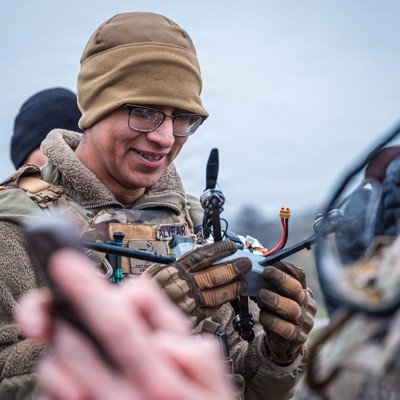
TRUPPENÜBUNGSPLATZ PUTLOS TRAINING GROUND, Germany—In a grassy field near the Baltic Sea, U.S. soldiers used net-shooting hunter drones, specially outfitted 557 rifles, and .50-caliber machine guns to drop dozens of drones, large and small, into the cold mud.
For the U.S. Army, the daylong event marked the beginning of the end of firing $4-million missiles at $20,000 drones; for its European counterparts, it showed off options to counter Russia’s accelerating threat.

The event was part of Project Flytrap, a U.S. Army effort to advance the state of counter-drone art. More than 200 vendors applied to participate in the November iteration; 20 were chosen by the Global Tactical Edge Acquisition Directorate, a new procurement office the service set up to get such gear to the field quickly.
On Nov. 21, media and foreign militaries watched a series of demonstrations that showed off not just individual products, but how they could be made to work together in just days.
Brig. Gen. Curtis King of the 10th Army Air and Missile Defense Command told Defense One that Ukrainian descriptions of battlefield conditions have helped the U.S. Army develop new tactics, gear, and weapons.
Because supply lines are vulnerable, it’s useful to be able to make drones at, or near, the front lines. In a tent on the field, a soldier with the 10th AAMDC showed off the results of some experimentation: a 3D printer that can print a drone frame in a few hours. With pre-ordered electronic components, it could serve as an interceptor or as part of a sensor mesh to locate enemy drones and their launching points.
More sensing is key to effective, affordable counter-drone efforts. King said one of the most important aspects of the event was integrating data from active radar systems with that of passive radar, a novel form that deduces a drone’s location from perturbations in FM radio signals. And he said the event showed off a real breakthrough: integrating all that sensor data so it could be used at all levels, from anti-drone snipers to the operators of first-person-view drones to unit commanders.
“We were able to send that to the units that were working on classified systems, and we were able to send that information to units who were working on sensitive but unclassified information. We’ve been demonstrating that for a while, but what was so significant this time is the number of sensors that we did and we did that with no latency, meaning we got real-time data,” he said.
Soldier feedback led to a top prize for Armaments Research Company, whose portable drone-tracing gear could turn “every soldier into a sensor,” said CEO Mike Canty, an Iraq War veteran.
An “aim assistant” from Zeromark helps soldiers shoot down drones with bullets—rather than with lasers that are still under development or jammers that don’t work against autonomous drones.
Then there’s Fortem’s net-shooting drone, useful in cities or around civilian populations.
Besides helping the U.S. Army, the show aimed to help European officials learn to defend themselves against Russian drones, even if the U.S. backs out of its security guarantees.
“What you saw today … are effectors that cost much less, sometimes a tenth of the cost of that drone. So not only are we still achieving the lethality we need, but we’re doing it on the right side of the cost curve,” King told reporters.
Journalists from Europe wanted to know: will the tech on display really stop Russian drone incursions?
King and other Army officials didn’t have a simple answer. They noted that the United States remains part of NATO, that the event aimed to inform European decision-making, and that future FlyTrap events will incorporate ground robotics and air-launched effects.
Col. Chris Hill, project manager for integrated fires mission command, noted, “The real goal is to have soldiers from other countries that are part of the assessment, because you want skin in the game early. You want your soldiers to take a look at their own commands, to say, ‘Yes, this capability works.’ You see a lot of non-U.S. flags out there because if you look at the eastern flank, those are NATO countries. So every country along that plane who’s in closest proximity to the threat from Russia needs to know that the kit actually works.”