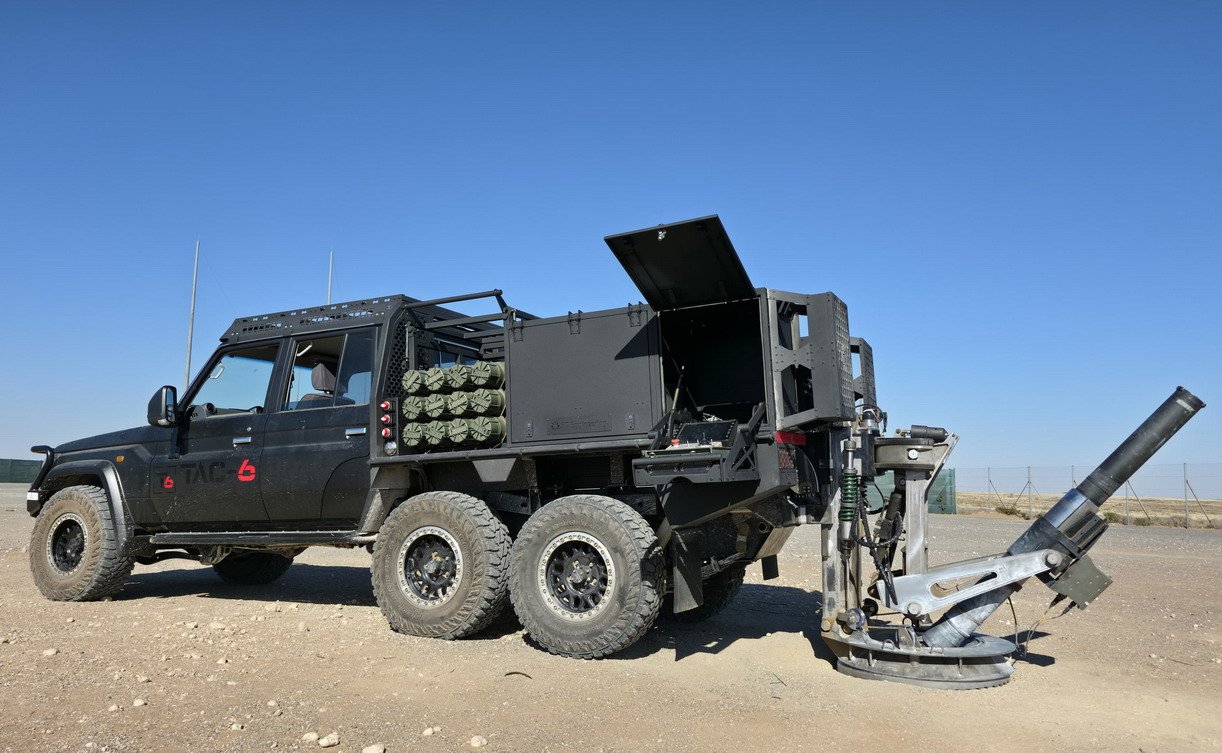
Singapore’s ST Engineering recently teamed up with Armormax Defence to host a demonstration to select members of the South African National Defence Force (SANDF) and diplomatic corps, in which they showcased the 120 mm Ground Deployed Advanced Mortar System (GDAMS) on the TAC-6 vehicle.
The demonstration took place at Armscor’s Alkantpan artillery range in the Northern Cape on 29 October.
Grant Anderson, Managing Director of Armormax Defence, said ST Engineering’s GDAMS is a world leading 120 mm rapidly deployable mortar system (it can also be configured with an 81 mm barrel). Capable of deploying in under 15 seconds, its fire control system locks it onto target coordinates and allows for immediate engagement.
During the Alkantpan demonstration, an eight-round fire mission with just two crew took a minute and a half from the time the TAC-6 stopped to the time it pulled off. “With the GDAMS base plate being firmly planted on the ground (the GDAMS hydraulically pushes down, almost lifting the rear of the TAC-6 off the ground) first round accuracy is assured.”

The coordinates for the fire mission were provided by an onboard drone unit which is housed in a dedicated launcher on the roof of the TAC-6. Equipped with a laser range finder, high definition optical and thermal/infrared cameras, the drone is capable of flying out to the 9 km maximum range of the GDAMS, ranging targets and sending back accurate coordinates to the fire control computer. It is capable of observing fall of shot and then returning, tracking and landing on the TAC if it has moved to a different location.
 Anderson highlighted that after firing, the TAC-6’s mobility allows rapid relocation. Traditional mortar or towed systems are vulnerable once they fire (counter-battery radar detects ballistic trajectory) but the TAC-6 can “shoot-and-scoot”, minimising exposure. Additionally, the combination of real-time drone spotting means that the system may fire fewer rounds with higher accuracy (thanks to precise coordinates and battle damage assessment), reducing ammunition signature and logistics tail, which in turn lessens the opportunity for enemy detection and retaliation. “This behaviour inherently compresses the kill chain: fewer steps, higher speed, higher accuracy, reduced exposure.”

In the Double Cab configuration, the TAC-6 can carry at least 50 rounds of ST Engineering’s extended range PM120 GPS guided ammunition, along with additional smoke, illumination and traditional high explosive (HE) rounds.
The TAC-6 GDAMS was protected against drones by two six-barrel Centauri CRx-40, 40mm grenade launchers. These launchers can fire a sequence of ST Engineering’s airburst grenades to counter inbound first-person view (FPV) drones. When using 40×51 mm grenades, the CRx-40 can engage targets out to 500 metres. The CRx-40 is typically integrated with Centauri’s TriAD hard-kill counter-UAV system, comprising radio frequency, radar, and acoustic sensors for detection, an electro-optical/infrared module for target engagement, and a CRx-30 30×113 mm cannon plus CRx-40 turret.

After the conventional GDAMS mortar rounds were demonstrated to the guests at Alkantpan, the new ST Engineering 120 mm GPS guided precision (PM120) round was then demonstrated. This can reduce the average 120 mm mortar round CEP (circular error probable) of around 135 meters at maximum range down to a CEP of sub 10 meters (CEP is where there is a 50% probability that rounds will fall within the radius of a circle centred on a target). “This moves the traditional role of the 120 mm mortar from an area weapon to that of a precision weapon system,” Anderson said.
“The net effect of the combined systems is that the highly mobile and agile TAC-6 can pre-deploy the spotter drone, and once the target is identified, expediently move to a firing position, stop and deploy the GDAMS, execute a fire mission using either the incredibly accurate GPS guided or traditional HE rounds, and then rapidly depart before any counter battery fire or FPV drones can be brought to bear,” Anderson explained.
“On today’s transparent battlefield, the ability to shoot and scoot, using obscuring terrain and features and always seeking beneficial firing positions is paramount. Recent and current global conflicts are driving a change in doctrine, lightning-fast response to opportunity and target intelligence, coupled with decisive and accurate application of force makes the difference between victory and defeat. The TAC-6 GDAMS gives a battlefield commander a really versatile addition to the force at his disposal,” Anderson said.

He added that ST Engineering selected the TAC-6 as a platform of choice for the GDAMS. The 6×6 TAC-6 is a modular, high-mobility tactical vehicle based on a heavily modified Toyota Land Cruiser 79 series but with an added third axle, increasing payload (up to 4 400 kg), and giving a gross vehicle mass (GVM) of seven tons. With 50% extra traction from the third axle, the TAC-6 offers high cross-country mobility.
The extra payload capacity is able to support a wide range of vehicle configurations, such as weapons platform, drone platform, logistics vehicle, etc. To date, in addition to the ST Engineering 120 mm GDAMS mortar unit, the TAC-6 has been outfitted with various remote weapons systems, the Aselsan Alkar 81 mm mortar and the Centauri TriAd 30×113 mm & 40 mm counter-drone system.
The TAC-6 is aimed at filling a multitude of civil and military roles – from firefighting to weapons carrier – with agility and versatility at its core. The vehicle is powered by a 4.5 litre V8 turbodiesel engine driving an eight speed automatic transmission developed and homologated by ZF. The TAC-6 has done over 250 000 km of testing in Europe and Africa.
So far Armormax Defence has built single, double and stretch versions of the TAC-6 (the latter with an extra 50 centimetres of length). An armoured personnel carrier variant is in the works, as is a variant with an armoured cab. Armormax specialises in armouring private vehicles – it has armoured nearly 2 000 vehicles over the last 20 years – and offers a variety of armour packages for the TAC-6. STANAG Level I vehicle armour can stop shell fragments as well as 7.62 mm and 5.56 mm bullets: lightweight armour and 40 mm ballistic glass is employed throughout to replace the original windows.