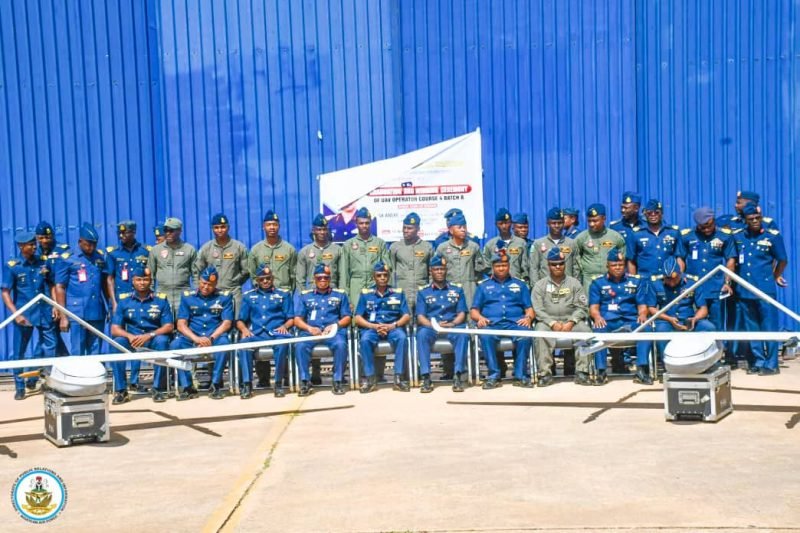
The Nigerian Air Force (NAF) has formally inducted a new cadre of Unmanned Aerial Vehicle (UAV) operators, marking a pivotal step in its transition toward technology-driven warfare. On November 13, 2025, nine officers from Course 4 Batch B received their wings at the 401 Flying Training School in Kaduna.
This graduation is not merely a routine training cycle; it represents the human component of a massive hardware acquisition drive that has accelerated throughout 2024 and 2025. With the service taking delivery of diverse unmanned platforms—from heavy-hitting Turkish combat drones to versatile Chinese hybrids—the demand for qualified operators has never been higher.
Representing the Chief of the Air Staff (CAS), Air Marshal Sunday Kelvin Aneke, the Air Officer Commanding Air Training Command, Air Vice Marshal Ahmed Yusuf Dari, presided over the ceremony. The leadership’s message was clear: the future of Nigerian air power relies on precision and intelligence rather than sheer brute force.

Building the “Man-in-the-Loop” Capability
The 401 Flying Training School (FTS) has traditionally been the cradle of NAF’s fixed-wing pilots, but its curriculum has evolved to address the asymmetric nature of modern threats. The nine newly winged operators are tasked with managing complex systems that provide real-time Intelligence, Surveillance, and Reconnaissance (ISR) and precision strike capabilities.
Air Marshal Aneke noted that these operators bear the responsibility of defending Nigeria’s airspace with “professionalism, precision, and honour.” This focus on precision is critical. In counter-insurgency operations against embedded threats—such as bandits in the North-West or oil thieves in the Niger Delta—the ability to distinguish between combatants and civilians is paramount. UAVs offer the persistent “stare” capability that fast jets often lack, allowing operators to observe targets for hours before engaging.
Diversifying the Fleet: The Sky Whale Acquisition
The graduation comes on the heels of a strategic diversification of the NAF’s drone inventory. In September 2025, the Air Force expanded its capabilities with the acquisition of Sky Whale Max hybrid Vertical Take-Off and Landing (VTOL) drones from the Chinese manufacturer Shenzhen Yangda Security Company Limited.
The Sky Whale Max represents a cost-effective solution for the NAF’s surveillance and logistics needs. Unlike traditional fixed-wing drones that require runways or quadcopters that suffer from limited range, the Sky Whale utilises a hybrid design. It uses battery-powered rotors for vertical lift and a gasoline engine for forward flight.
This acquisition, finalised after multiple training visits in August 2025, suggests the NAF is building a tiered surveillance network. While larger drones handle strategic strikes, platforms like the Sky Whale can handle pipeline monitoring in the South and border patrols in the North without incurring the high operating costs of manned aircraft.
The Nigerian military also operates a plethora of other Unmanned Systems acquired from a diverse source over the years.
Project Guardian and the Turkish Backbone
While the Chinese systems handle tactical surveillance, the NAF’s strike capability is being bolstered by “Project Guardian.” Initiated in 2024, this ambitious program involves the procurement of 43 Bayraktar TB2 drones from Turkey.
The TB2 is a Medium Altitude Long Endurance (MALE) platform that has become a staple of modern air warfare. Capable of staying aloft for up to 27 hours, it carries laser-guided smart munitions (such as the MAM-L and MAM-C) that allow for pinpoint strikes.
The induction of the new pilots at 401 FTS is directly linked to this hardware influx. The training pipeline has been robust; in 2022, the NAF sent personnel to Turkey for specialised instruction. Brigadier General U.G. Ogeleka, Commander of the Nigerian Army Space Command, previously noted that 46 personnel—including pilots, mission operators, and avionics engineers—underwent rigorous training between May and September 2022 to master these systems.
A Modernised Force
The integration of these systems aligns with the NAF’s broader modernisation goals, which include a target of 90% aircraft serviceability by the end of 2025. By combining high-end strike drones with cost-effective VTOL platforms, the service is creating a flexible air wing capable of responding to Nigeria’s diverse security challenges.
For the nine new operators winged in Kaduna, the mission is immediate. They join a service that is actively deployed on multiple fronts, equipped with tools that—if used with the precision emphasised by Air Marshal Aneke—could significantly alter the operational landscape.