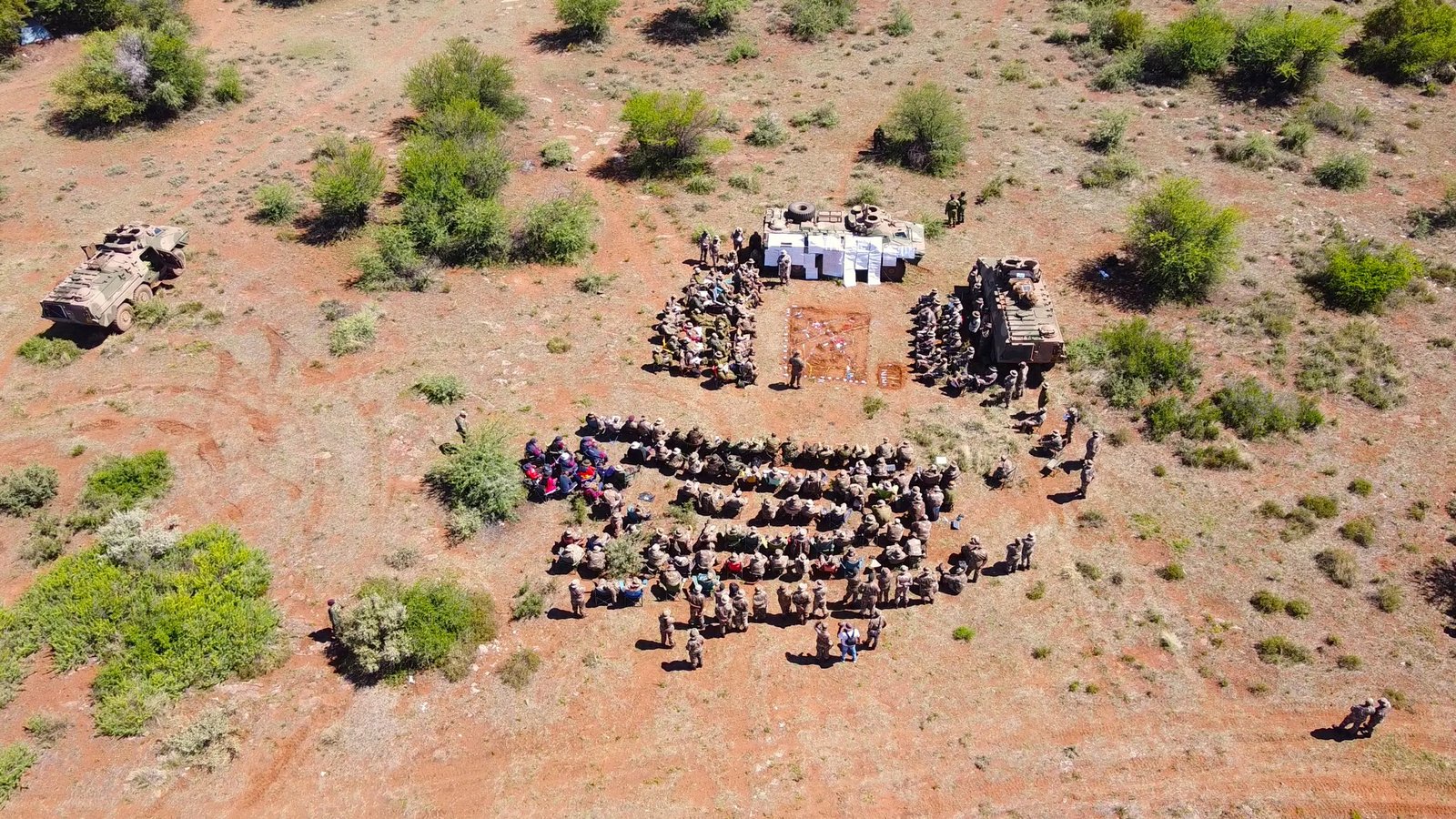
A brigade level exercise such as the SA Army force preparation exercise Vuk’uhlome has many hands-on elements ranging from planning and support through to doing it in real time.
An insight into hands-on aspects at the Combat Training Centre (CTC) comes from personnel detached to Exercise Vuk’uhlome IV Division Corporate Communication. They include SA Army Reserve Force Captain Jacques de Vries and Corporal T Makota.
De Vries reports: “Rooikat armoured reconnaissance cars together with Ratel infantry fighting vehicles advanced to the area of operation’s simulated contact in the twilight hours of Monday 17 November 2025, after a preparatory bombardment on destabiliser forces brought onto target by G5 155mm gun howitzers. Olifant main battle tanks entered the smoke-filled fray created by the fire from Ratel and Rooikat 90 mm and 76 mm high-explosive fire, with supporting elements from the South African Engineer Corps and South African Military Health Service in tow”.
“Effective combat in diverse engagement environments requires seamless co-operation between mechanised infantry, armour, artillery, engineers and health specialists, supported by essential aviation elements. Their integration maximises firepower, mobility, survivability and resilience.”

Photo: Captain Jacques de Vries
One aviation component of Vuk’uhlome saw a C-130BZ Hercules (401) of 28 Squadron working with 101 Air Supply Unit to deliver – by parachute – consumables to a specified drop zone. SA Army Junior Command and Staff Course (JCSC) students at Lohathla busy with a field orders presentation had a prime view of the multi-parachute delivery.
The C-130BZ flew nearly two hours between Air Force Base Bloemspruit and the Combat Training Centre on 16 November, carrying eight containers weighing 10 000 pounds (4.5 tons), and 16 containers weighing 20 000 pounds (9 tons) the following day. At the drop zone, the aircraft was flying at 5 500 feet above mean sea level.
“Exercises like these remain critical in maintaining readiness and operational success, to prepare troops for real-world scenarios while ensuring they are ready to respond effectively to any given situation. The SA Air Force combat planner for Exercise Vuk’uhlome IV, Lieutenant Colonel Ronnie Mashau, said the exercise was aimed at enhancing readiness and operational efficiency in logistics and ground support. During the exercise, crews executed precise cargo drops, simulating real-world scenarios where ground forces require immediate resupply of food, water and medical supplies,” Major Takalani Thomas Mulaudzi reported.
The SA Air Force (SAAF) also put jets into the Vuk’uhlome mix tasking 2 Squadron and 85 Combat Flying School Gripen and Hawk Mk 120 assets for sorties at CTC, 500 nautical miles from a weapons camp at Air Force Base (AFB) Overberg where they were recently deployed.
On the ground the JCSC orders presentation marked the end to weeks of preparation, culminating in a meticulously constructed sand model of the order group’s area of operations with a Ratel utilised as a display of information relevant to the task, de Vries reported.
On Vuk’uhlome overall he noted “unified effort ensures sustained operations, rapid adaptation and mission success, highlighting the indispensable importance of joint capability in modern warfare”.

One element of this year’s Exercise Vuk’uhlome is crowd control, and last week deployed elements prepared for this. Corporal T Makaota reported that the Light Modern Brigade with the South African Police Service carried out integrated training of crowd control. Horses, dogs and motorcycles were included in training.
On Tuesday 18 November, troops practiced a Casspir vehicle-borne motorised infantry attack as part of Exercise vuk’uhlome IV. Casspir vehicles, equipped with Browning M2 12.7 mm heavy machine guns, spearheaded an assault, supported by mortar detachments deploying M3 81 mm and M5 120 mm systems to provide layered indirect fire. The lighter 81 mm mortars ensured rapid suppression of destabilisers at platoon and company level, while the heavier 120 mm mortars extended reach and destructive effect for brigade-level shaping fires, de Vries reported. The South African Army’s engineers added bridging equipment to the scenario, enabling Casspirs and supporting vehicles to cross obstacles under simulated combat pressure.
Exercise Vuk’uhlome 2025 started in early September and is set to end with a distinguished visitors’ day later this month.

Photo: Bombardier RA Taje