The Sudanese Armed Forces (SAF) are reportedly attempting to acquire advanced Russian fighter jets to counter the momentum of the Rapid Support Forces (RSF) in Sudan’s devastating civil war. This renewed push for high-end airpower, following a string of ground defeats including the fall of El Fasher, aims to provide the SAF with a long-range strike capability it currently lacks.
However, with a war-torn economy and a modest official defence budget, any such acquisition is almost certainly tied to a high-stakes geopolitical barter: Russia’s long-standing ambition for a naval base on the Red Sea.
The Sudanese Air Force has deployed its MiG-29 fighter jets in support of the Sudanese Army’s ongoing military operations against the ‘Rapid Support Forces’ (RSF) militia in several parts of the country. The RSF is a paramilitary group that operates under the authority of the Sudanese government and has been involved in multiple conflicts and human rights violations in the country.
This renewed interest in Sukhoi aircraft, first reported in March 2024, is born of desperation. The SAF’s air arm, once a dominant force, was severely attrited in the opening days of the conflict in April 2023. RSF special forces conducted highly effective surprise attacks on key air bases, most notably at Merowe. Open-source intelligence from that attack confirmed the destruction or capture of numerous aircraft on the ground, including several of the SAF’s best air-to-air fighters, the MiG-29.
Recent intelligence reports reveal that the United Arab Emirates has facilitated the delivery of Chinese-manufactured FK-2000 short-range air defence systems and FB-10A missiles to the Rapid Support Forces (RSF), routing them through Chad to evade scrutiny. This move, documented in open-source analyses and media outlets during early August 2025, equips the RSF with advanced tools to challenge the Sudanese Armed Forces’ (SAF) control of the skies, potentially prolonging a conflict that has already displaced millions and devastated infrastructure since its eruption in April 2023.
The SAF’s remaining combat-capable fleet consists of older Soviet-era Su-25 ground-attack jets, Su-24M bombers, and various Chinese-made aircraft. While these assets can still conduct air strikes, their serviceability is questionable, and they are increasingly vulnerable. The RSF has proven adept at using man-portable air-defence systems (MANPADS) and, more recently, has reportedly fielded more advanced mobile air defence systems supplied by Wagner Forces.
The 4+ Generation Shopping List
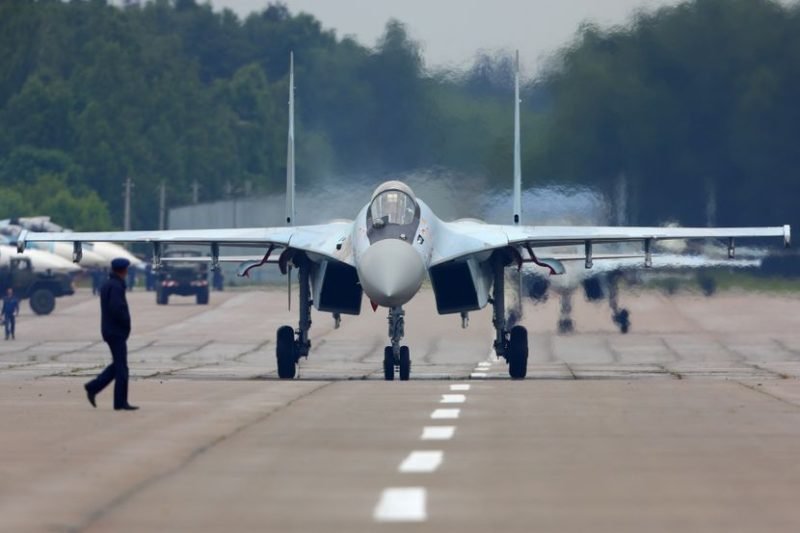
The SAF’s objective is to acquire 4+ generation multirole fighters, a technological leap that would allow them to conduct precision strikes deep into RSF-held territory. The primary aircraft under consideration are reportedly Russia’s Sukhoi Su-30 and Su-35, along with potential interest in China’s J-10.
The Su-30 (NATO reporting name: Flanker-C) is a two-seat, multirole fighter known for its long range, heavy payload, and advanced sensors. It would be a logical choice, offering a mature and proven export platform. The Su-35 (Flanker-E) is a more advanced, single-seat “super-manoeuvrable” fighter with superior avionics and radar, but it carries a much higher price tag.
The acquisition of either platform would give the SAF capabilities it has never had, particularly the ability to deploy long-range, precision-guided munitions. This would allow them to interdict RSF supply lines and command centres, which are currently operating with relative impunity across the vast expanses of Darfur and Kordofan, far from the SAF’s remaining strongholds.
This is not the first time Sudan has been linked to such a purchase. In 2017, reports emerged that Sudan had acquired Su-35s during a visit by former President Omar al-Bashir to Moscow. However, no such aircraft were ever delivered or visually confirmed in Sudan, and most analysts now regard those reports as premature or false. The key difference in 2025 is that the SAF’s very survival is in question, giving Russia new leverage.
The Geopolitical Price: Port Sudan
Sudan cannot afford these aircraft. With an annual defence budget estimated at around $500 million, even before the war, a multi-billion-dollar jet procurement is impossible through conventional financing.
This is where the naval base becomes the central commodity. Russia has actively pursued a “logistics support facility” at Port Sudan since signing an agreement in 2020. This facility would be its first naval base in Africa and its first warm-water port on the Red Sea since the Cold War, giving it direct access to one of the world’s most critical maritime chokepoints.
The deal stalled after Sudan’s 2021 coup and the subsequent outbreak of the civil war. Now, the SAF, led by General Abdel Fattah al-Burhan, appears to have revived the deal as its primary- and perhaps only- bargaining chip.
SAF Assistant Commander-in-Chief General Yassir al-Atta has publicly confirmed this new alignment. In televised interviews, he stated that an international alliance is backing the SAF, with Russia as a key supporter. He explicitly linked Russian military assistance to the establishment of the Red Sea naval base. This was later echoed by the de facto government’s acting foreign minister, Ali Yusuf.
This potential “jets-for-a-base” deal presents a clear, if desperate, trade-off for the SAF. In exchange for a tangible military capability to fight the RSF today, it would grant Moscow a permanent strategic foothold that alters the geopolitical balance of the Red Sea, much to the concern of the United States and other regional powers.