

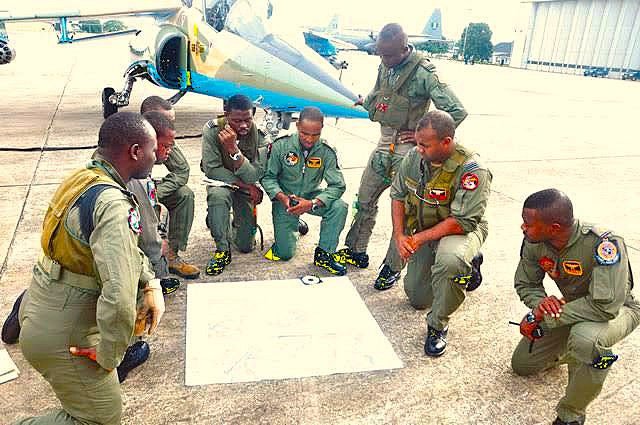
The Nigerian Air Force (NAF) is repositioning its operational strategy under new leadership, a move taking on heightened urgency as it faces a severe diplomatic crisis with the United States. While Nigeria’s new Chief of the Air Staff (CAS), Air Marshal Sunday Aneke, demands greater professionalism and accountability in counter-terrorism operations, his command must navigate reports that Washington is developing contingency plans for military intervention.
This external pressure formed the backdrop of Aneke’s maiden strategic meeting with Branch Chiefs and Air Officers Commanding (AOCs) in Abuja. The CAS convened the session to frankly assess national security challenges and reposition the NAF for greater efficiency and operational safety.
In his address, Aneke described the meeting as a “call to purpose” and stated his leadership would be anchored on professionalism, discipline, and accountability. He told the commanders that his focus would revolve around operations and safety, supported by modern logistics, technology, and effective administration. “This is about putting square pegs in square holes,” Aneke stated. “The NAF needs leaders who can deliver, and I believe we have the right team to take us to the next level.”
He affirmed that the hopes of millions of Nigerians rest on the NAF’s effective performance and that President Bola Tinubu’s directives “will be implemented to the letter.”
A central theme of the CAS’s directive was the absolute requirement to safeguard non-combatants. “Protecting civilians and preventing collateral damage will remain a defining hallmark of our professionalism,” Aneke declared.
This emphasis is not merely a tactical adjustment. It is a direct response to the allegations fueling the dispute with Washington. The United States, under President Donald Trump, has threatened military action based on claims of alleged “genocide” against Christians in Nigeria. The NAF’s ability to demonstrate precision and adherence to the laws of war is now a matter of strategic communication and national sovereignty, intended to counter the narrative that Nigeria’s internal security crisis is one of religious persecution.
The Nigerian government has vehemently rejected this characterisation. Information Minister Mohammed Idris stated the designation stems from “inaccurate data and misrepresentation” of the nation’s complex security challenges. Idris clarified that Nigeria faces terrorism, not religious persecution, and that extremists have victimised both Christians and Muslims.
In a briefing in Abuja, the minister called on the US to “approach the Nigerian situation with an understanding of its complex realities.” He added, “Nigeria welcomes dialogue, we welcome cooperation… but we believe constructive engagement is the surest and most effective way to achieve peace and stability.”
US Contingency Plans Reported
The call for engagement comes amid disquieting reports, first published by The New York Times, that President Trump has ordered the Pentagon to “prepare to intervene.” According to military officials familiar with the deliberations, the directive prompted U.S. Africa Command (AFRICOM) to present multiple operational options to the Department of Defense.
These proposals reportedly outline varying levels of engagement. The “heavy option” would involve deploying a US Navy aircraft carrier strike group to the Gulf of Guinea to support fighter jets or long-range bombers hitting militant targets deep inside northern Nigeria.
A “medium option” proposes the use of unmanned aerial vehicles, specifically MQ-9 Reaper and MQ-1 Predator drones, for targeted strikes against insurgent camps and convoys. The “light option” focuses on enhanced intelligence sharing, logistics support, and joint operations with Nigerian forces, which more closely resembles existing, albeit strained, cooperation.
Pentagon officials reportedly concede that limited airstrikes are unlikely to resolve Nigeria’s protracted insurgency. They assess that only a full-scale campaign, similar to operations in Iraq or Afghanistan, could achieve decisive results, an approach that currently has no traction in Washington.
The geopolitical situation is further complicated by China, which declared its support for Nigeria on Tuesday. Chinese Foreign Ministry spokesperson Mao Ning stated, “China firmly opposes any country using religion and human rights as an excuse to interfere in other countries’ internal affairs.”
This leaves the NAF’s new leadership in a precarious position. Air Marshal Aneke must now implement his promised reforms, improving the NAF’s operational tempo against insurgents while simultaneously proving his force can conduct complex operations professionally. He must deliver measurable results in the field, knowing that his force’s every action is being scrutinised by both a hopeful Nigerian public and a critical foreign power.


