- Fixing the foundations of the global financial system is essential to overcome years of under-delivery, debt dependence and eroding trust.
GENEVA, Switzerland – Improving the international financial architecture is a prerequisite for unlocking the volume and type of finance needed to support climate-resilient development.
In a new report, UN Trade and Development (UNCTAD) spells out three core areas of action: Enhancing access to liquidity and stability tools, securing fiscal and policy space for adequate and predictable climate and development finance, and rebalancing global economic governance.
Published ahead of the upcoming UN climate change conference COP30, the report calls for faster progress on the goal agreed at COP29 to mobilise at least $300 billion per year by 2035 – led by developed countries – and an aspirational target of $1.3 trillion from all sources.
Where current structures fall short
Climate finance, which aims to support countries’ efforts to address climate change, is not separate from the broader global financial architecture but is embedded in it.
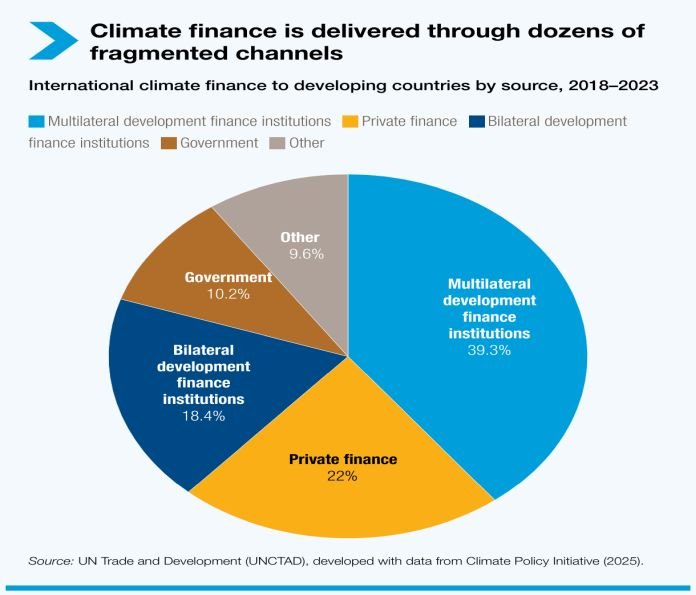
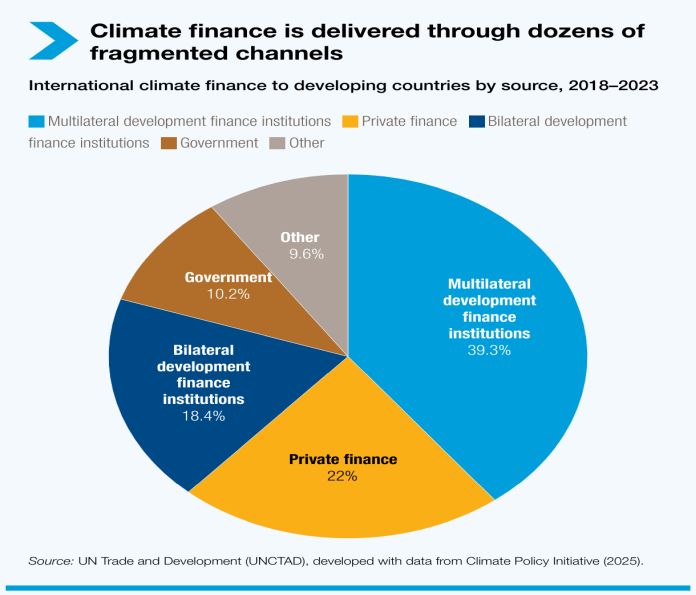
Such financing is currently delivered through dozens of channels, including bilateral donor programmes, multilateral development banks and cross-border private finance – each with its own rules and procedures.
For many countries, especially those with limited administrative capacity, this means accessing climate finance is slow, unpredictable and burdensome.
The fragmentation of funding channels has also worsened distributional inequity in current climate finance flows.
Despite a marked increase in recent years, least developed countries received just 18% of the total climate finance provided and mobilized by developed countries in 2022, while small island developing states got only 2.8%.
In terms of thematic areas, adaptation – helping countries prepare for the impacts of climate change – received just 3.4% of global climate finance in 2023. Most private investment continues to flow to mitigation projects that cut emissions and offer quicker financial returns.
At the same time, efforts to address climate-related loss and damage often depend on short-term aid or new loans, deepening debt and limiting already scarce public funds.
For many developing countries, the same financial constraints that have slowed growth are now holding back climate action. That’s why reaching the $1.3 trillion goal brings renewed urgency to reform the international financial architecture.
“The system should be reoriented to protect national policy space from financial instability, provide reliable long-term finance for climate-aligned structural transformation, and ensure fair and inclusive governance,” UNCTAD notes in the report.
“Without such changes, new climate pledges risk reproducing the same patterns that have long undermined sustainable development – deepening debt dependency, holding back investment-led just transitions and widening inequality.”
A framework for reform
The report outlines three priorities for systemic reform that can contribute to accelerating equitable finance delivery and allow all countries to meet their climate and development goals:
- Enhancing access to liquidity and stability tools, reducing vulnerability to boom-bust cycles and climate shocks and establishing a fairer global financial safety net that offers timely, unconditional support to all countries in need.
- Scaling up adequate and predictable climate finance to support resilient structural transformation in developing countries, including addressing unsustainable sovereign debt and enhancing domestic resource mobilization.
- Re-balancing global economic governance with a more representative and accountable system that reflects all countries’ interests and needs in the face of climate and development challenges.
Efforts to reform the international financial architecture have gained momentum across a range of platforms, yet the landscape remains fragmented. Citing nine proposals launched between 2022 and 2025, the report maps how they respond to the three reform areas outlined above.
The results show that broad consensus for change is emerging, but implementation is still fragmented, insufficient and restrained to the bounds of perceived “political feasibility” rather than the transformative ambition that responds to climate change demands.
The report is the first on the topic of climate finance published under the Geneva Consensus, the new mandate recently adopted by 195 Member States at the 16th UN Conference on Trade and Development (UNCTAD16).
The Geneva Consensus highlights, among others, UNCTAD’s analytical work on climate finance and sustainable development and its role in helping developing countries leverage financing resources.