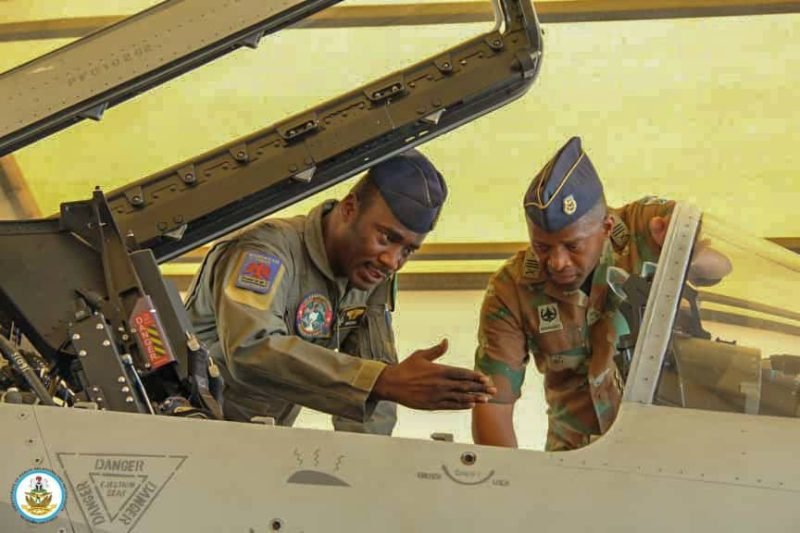
The Chief of the South African Air Force (SAAF), Lieutenant General Wiseman Mbambo, completed a high-level visit to Nigeria last week, meeting with Nigerian Air Force (NAF) leadership to strengthen defense cooperation between the two regional powers. The visit, which took place from October 27-28, 2025, included engagements at NAF Headquarters in Abuja and the Tactical Air Command (TAC) in Makurdi.
According to the NAF, the discussions focused on deepening collaboration in key areas, including technological innovation, aircraft maintenance, joint training, and counter-terrorism operations. The engagement is part of a stated “mutual resolve… to enhance peace, stability, and security” across the continent.


The visit brings together two of sub-Saharan Africa’s most prominent air forces, each facing a starkly different operational and budgetary reality. General Mbambo’s visit to the 131 Engineering Group in Makurdi featured a static and aerial display, where he “commended the NAF for its progress in modernising its fleet, improving aircraft serviceability, and advancing indigenous maintenance capacity”.
This modernisation is arguably the most ambitious on the continent. The NAF is in the midst of a massive recapitalisation, inducting a diverse fleet of new platforms. This includes JF-17 Thunder multirole fighters from Pakistan, A-29 Super Tucano light-attack turboprop aircraft from the United States, and Leonardo M-346FA light combat aircraft from Italy. This new hardware is augmented by a sophisticated unmanned fleet, including Turkish Bayraktar TB2 and various Chinese UCAVs, which have been central to Nigeria’s internal security operations.
In contrast, the SAAF, despite its deep institutional knowledge, is grappling with a severe and prolonged budget crisis. This has resulted in grounding its core combat fleet, the Saab Gripen C/D, and in critical maintenance challenges for its C-130 transport aircraft.
This paradox defines the new partnership. Nigeria offers a view of rapid, multi-faceted fleet modernisation and hard-won combat experience from its counter-insurgency campaigns. The SAAF, in turn, offers a deep well of high-end, Western-standard doctrinal expertise, advanced pilot training methodologies, and decades of experience in complex systems integration.
Focus on Indigenous Tech and New Threats
A central theme of the visit was the need for self-reliance. General Mbambo identified “driving indigenous technology development to address peculiar African challenges as key to achieving sustainable air power”. This sentiment was echoed by NAF leadership, who reiterated their commitment to innovation and capacity development. The NAF’s 131 Engineering Group, for instance, has been central to its efforts to build in-country Periodic Depot Maintenance (PDM) and MRO capabilities.
Both chiefs stressed that this push for self-reliance is driven by a new and pressing common threat: “the increasing access of non-state actors to advanced military technology”. In Nigeria’s theatre, this includes the use of commercial drones for reconnaissance and light-strike missions by insurgent groups, as well as the persistent threat of anti-aircraft weapons.
Mbambo emphasised the importance of “solidarity among African air forces” to address these evolving security challenges and safeguard the continent’s collective defence interests.
Tactical and Strategic Cooperation
The visit to the Tactical Air Command (TAC) in Makurdi was operationally focused. TAC is the NAF’s primary air combat command, and Mbambo was briefed on its structure, roles in defending Nigeria’s airspace, and its contributions to internal security. The briefing specifically covered air surveillance and radar coverage, key capabilities being enhanced by the NAF’s new sensor-rich platforms.
General Mbambo reaffirmed the SAAF’s readiness to partner with the NAF in joint training, counter-terrorism initiatives, and technical exchange programs.
Representing Nigeria’s Chief of the Air Staff, Air Vice Marshal IH Etukudo, described the visit as a notable step in strengthening intra-African air power cooperation. The NAF concluded that the engagement reinforces a “shared vision of a safer, stronger, and more united Africa through air power diplomacy”. This visit moves the relationship beyond diplomacy, laying the groundwork for technical and operational exchanges between two air forces that, while on different trajectories, have much to offer each other.