A Russian-operated Sukhoi Su-24 strike aircraft was lost in Mali on the morning of June 14, 2025, after crashing into the Niger River near the Gao airport. The Malian Armed Forces (FAMA) General Staff confirmed the incident, stating both pilots were recovered in good health.
The aircraft was not part of the Malian Air Force inventory. It was operated by Russia’s Africa Corps, the military structure that has subsumed the functions of the Wagner Group under the formal control of the Russian Ministry of Defence. The incident exposes the depth of Russia’s direct combat involvement in Mali and removes a high-value, low-density air asset from a theater defined by harsh conditions and escalating insurgent threats.
Conflicting Causes and a Murky War
According to the official FAMA statement, the two-seat aircraft “made a forced landing in the river at Gao, not far from the runway” while returning from a mission. The statement attributed the crash to “a strong sudden weather degradation with a strong sand wind at the time of the accident.” An investigation was immediately launched to determine the precise circumstances.
This official narrative was immediately contested. The Azawad Liberation Front (Front de Libération de l’Azawad, or FLA), a Tuareg-led coalition of armed groups, claimed responsibility for the downing. The group alleged its fighters had engaged the aircraft with ground-to-air fire, forcing it to retreat before it crashed.
Neither claim can be independently verified, and both are plausible. The Sahel’s severe dust storms, known as haboobs, present extreme dangers to aviation, capable of causing engine flameouts through foreign object debris (FOD) ingestion or catastrophic spatial disorientation for pilots.
Conversely, the FLA and other insurgent groups in the region are known to possess heavy anti-aircraft machine guns. There is a persistent threat of man-portable air-defense systems (MANPADS) proliferation in the Sahel. A successful shoot-down would represent a notable tactical victory for the rebels and a serious threat to the airpower that has been so central to the Malian junta’s recent military gains.
The aircraft was reportedly supporting “Operation Dougoukoloko,” a large-scale FAMA offensive launched on April 25, 2025, with the stated goal of “restoring Malian state sovereignty throughout the country.” This operation is primarily directed against the rebel coalitions in the north, including the FLA, making their claim of engagement credible.
The Fencer: A Strategic Asset
The presence of a Su-24 (NATO reporting name: Fencer) in Mali represents a substantial escalation in aerial warfare capabilities for the region. Satellite imagery from Maxar in June 2025 first confirmed the presence of at least one Su-24M at Bamako Airport. While reports suggest the aircraft may have been delivered in 2022 or 2023, its operation by the Africa Corps, rather than FAMA, was only confirmed by this crash.
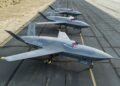
The Su-24M is a formidable, all-weather, tactical strike aircraft. Unlike the Malian Air Force’s Su-25 “Frogfoot” ground-attack jets, which are subsonic, heavily-armoured “flying tanks” for close air support, the Su-24 is a different class of weapon.
Its key feature is its variable-sweep wing design, allowing it to optimize its wing profile for both low-speed (fully extended) and high-speed (fully swept) flight. It is a supersonic-capable (at altitude) interdiction and attack platform designed for low-level penetration of enemy air defences to deliver a heavy bomb load. The modernized Su-24M variant, as seen in Mali, features sophisticated avionics, including the Kaira-24 electro-optical and laser targeting system. This allows it to deploy a range of precision-guided munitions, a capability far exceeding that of the Su-25s and L-39s in FAMA’s inventory.
In the Malian context, the Fencer provides the Russian/FAMA forces with the ability to conduct deep, all-weather, and nighttime strikes against insurgent command centers, logistics hubs, or strongholds far from the front lines. The loss of such a complex and capable asset, even if temporary, is a material setback.
Mali’s Rapid Air Force Pivot
The crash and the Fencer’s presence must be understood within the context of Mali’s dramatic geopolitical pivot. Since the 2020 coup, the Malian junta has systematically expelled its Western partners, culminating in the withdrawal of French (Operation Barkhane) and United Nations (MINUSMA) forces by 2023.
In their place, Mali has turned to Russia and Turkey for its security needs. This has resulted in a rapid and substantial re-equipment of the Malian Air Force. In August 2022, FAMA received a major arms package from Russia, including five L-39C Albatros light attack jets, a single Su-25 close air support aircraft, and a Mi-35 attack helicopter. This was followed in March 2023 by another delivery of four more L-39Cs and, notably, three Bayraktar TB2 armed drones from Turkey.
This new airpower has been instrumental in the junta’s recent offensives, allowing FAMA to seize key northern towns like Kidal for the first time in a decade. However, these assets are flown with heavy support from, and often exclusively by, foreign partners. The crash at Gao is the clearest evidence yet that Russia’s Africa Corps is not merely in an advisory or training role; it is actively flying combat missions on behalf of the Malian state.
The loss of the Su-24, whether to a dust storm or an insurgent missile, demonstrates the high-risk, high-stakes nature of this intervention. It validates the effectiveness of Russia’s support model while simultaneously exposing its direct vulnerability in a complex and intractable conflict.